
US Marines move to arm amphibious vehicles against drones
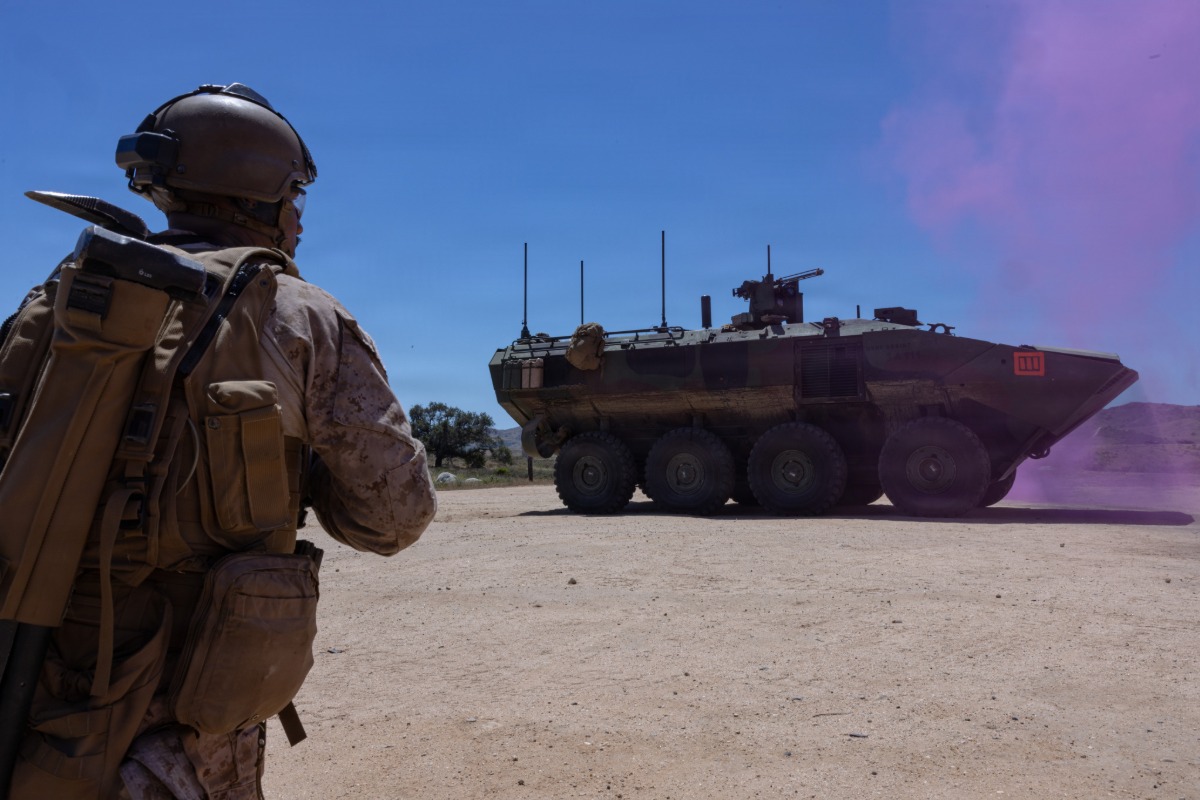
A U.S. Marine Corps amphibious vehicle that can swim ashore from a warship still can’t stop a hobby-store drone from watching it do it, and the Marines just confirmed the fix, and the company they intend to buy it from, without opening the job to competition.
The Marine Corps’ Program Manager Advanced Amphibious Assault, part of the Portfolio Acquisition Executive – Marine Corps, published a Notice of Intent to Sole Source and Sources Sought on August 3, 2026, confirming plans to negotiate directly with Anduril Industries, a defense technology company based in Costa Mesa, California, to supply counter-drone equipment for the Amphibious Combat Vehicle fleet. The notice specifies the Marine Corps wants Anduril’s Pulsar Lite MKI-RX/TX 4CH system, known as Pulsar-L, along with the accessories needed to operate it, including a control station interface, an omnidirectional antenna array, electronic warfare software, and ongoing warranty and support.
The Amphibious Combat Vehicle, or ACV, is an 8×8 wheeled armored vehicle BAE Systems builds for the Marine Corps to replace the decades-old Assault Amphibious Vehicle, capable of launching from ships offshore, swimming through open ocean surf, and then driving inland once it reaches the beach, carrying a crew of three plus 13 combat-loaded Marines. The vehicle has entered full production across multiple variants since achieving initial operational capability in 2020, but according to the Marine Corps Capabilities Development Directorate, the current fleet lacks any organic ability to detect, track, identify, or defeat small drone threats, a gap the notice describes as urgent enough to justify skipping a competitive bidding process entirely.
That directorate specifically pointed to a formal planning document as the basis for the decision.
“Enclosure (1) provides the materiel requirement, concept of employment, and distribution plan,” the notice states, quoting the Marine Corps Capabilities Development Directorate’s own guidance.
That enclosure identifies the Anduril Pulsar-L as the only viable solution capable of meeting requirements laid out in what the military calls an Urgent Statement of Need, a formal designation reserved for capability gaps considered too time-sensitive to work through the normal, multiyear procurement process. The notice also points to precedent, noting the Army has already incorporated Anduril’s Pulsar-L packages into its own vehicle-mounted counter-drone contracts under a separate sole-source justification approved in March 2026, a pattern that reflects how thoroughly Anduril’s electronic warfare hardware has spread across multiple military branches over the past year. Reporting from InsideDefense on an earlier version of this same requirement in June 2026 indicated the Marine Corps had already determined no other manufacturer could supply a comparable system without meaningful risk to the government’s interests, since Anduril remains the sole designer and producer of the Pulsar-L platform.
The Marine Corps wants a combined sensor and jamming package mounted directly onto the ACV that can detect drones dependent on GPS or radio-frequency control signals at ranges between 2 and 5 kilometers (1.2 to 3.1 miles), then trigger jamming capable of disabling those drones out to 2 kilometers (1.2 miles). The system must be able to engage multiple drones simultaneously while the vehicle is either parked or actively moving, adapt to new drone technologies and tactics without requiring frequent software updates to predefined threat libraries, and survive reliably in both land and maritime environments, a combination that reflects the ACV’s unusual dual role as both a beach assault vehicle and an amphibious warship substitute.
The notice states the counter-drone package cannot exceed a limited amount of onboard space and weight the Marine Corps has allotted specifically for this equipment, though officials declined to publicly disclose the exact figures for either constraint. For the system’s eventual, more advanced objective capability, the Marine Corps wants the entire package condensed into a single box weighing 35 pounds (15.9 kg) or less once fully integrated, with jamming range extended beyond 2 kilometers and expanded to include GPS jamming specifically, alongside a ground control system compatible with displays already installed inside the ACV rather than requiring an entirely separate control unit.
The notice requires the eventual contractor to demonstrate the ability to manufacture more than 50 counter-drone packages within 12 months and sustain regular delivery fast enough to support the Marine Corps’ planned integration schedule, which is set to begin in the first quarter of Fiscal Year 2027. Companies believing they can meet or exceed these requirements have until August 18, 2026, to submit a five-page executive summary responding to the sources sought portion of the notice, though the sole-source language throughout the document makes clear the Marine Corps has already largely settled on Anduril as its intended supplier barring a compelling alternative response.
Anduril’s broader footprint across the Pentagon’s counter-drone efforts helps explain why the Marine Corps arrived at this conclusion. The Army awarded Anduril a $20 billion, 10-year enterprise contract in March 2026 consolidating more than 120 separate existing Anduril agreements into a single vehicle, with the company’s Lattice software serving as the command and control backbone for Army counter-drone operations, while the State Department separately approved a $1.98 billion sale of Anduril’s counter-drone systems to Kuwait in June 2026. That scale of adoption across services and allied nations gives the Marine Corps a straightforward argument for moving fast with a proven vendor rather than opening a lengthy competition for a capability the service has explicitly labeled an urgent operational gap.
Content preview only. Full article available at source. View Full Article
The U.S. Marine Corps confirmed plans to negotiate with Anduril Industries for counter-drone equipment for its Amphibious Combat Vehicle fleet on August 3, 2026. The acquisition aims to address an urgent operational gap in detecting and defeating drone threats. The Marine Corps seeks the Pulsar Lite MKI-RX/TX 4CH system, which will enhance the vehicle's capabilities against small drones. This decision follows a precedent set by the Army's previous contracts with Anduril for similar systems.
- U.S. Marine Corps confirmed plans to negotiate with Anduril Industries for counter-drone equipment.
- The Marine Corps intends to acquire the Pulsar Lite MKI-RX/TX 4CH system.
- The counter-drone system is needed for the Amphibious Combat Vehicle fleet.
- The acquisition process is being expedited due to an urgent operational gap.
- Anduril Industries has been previously contracted by the Army for similar systems.