
U.S. Media: American Defense Giant Completes Testing, F-35 Fighter Jet Can Use AI to Locate "Enemy Targets"
[Global Times Special Correspondent Chen Yang] As artificial intelligence (AI) becomes increasingly prevalent across various sectors of society, the Pentagon can no longer hold back. The U.S. defense news website Defense News reported on the 25th that American defense giant Lockheed Martin has announced that it has successfully tested AI technology to enhance target acquisition capabilities for the F-35 fighter jet in flight. This is just the tip of the iceberg regarding the U.S. military's increased use of AI for military purposes.
According to reports, the test, named the "Sentinel Program," was conducted at Nellis Air Force Base in Nevada. It integrates AI machine learning models into the aircraft's information control systems. The new AI model can generate digital information based on the surrounding environment of the aircraft and analyze it, presenting potential targets to the pilot. The company stated that this is the first time a tactical AI model has independently suggested combat targets to fighter pilots.
Jack Watts, Vice President of F-35 Combat Systems at Lockheed Martin, stated that the company will continue to advance AI-driven decision models, enabling pilots to identify combat targets more quickly. "Equally important is our ability to reprogram the AI model on the ground and apply these updates for the next sortie—this is a crucial step in maintaining a tactical advantage in a rapidly evolving threat environment."
The U.S. website "Power" reported on the 25th that Lockheed Martin also revealed more details on how to use AI technology to help F-35 pilots detect enemy air defense systems more quickly and accurately, including using AI to improve and enhance the existing electronic warfare systems of the aircraft. All of this marks a significant step towards more advanced cognitive electronic warfare capabilities for the F-35, allowing it to respond more flexibly to emerging threats, even during missions.
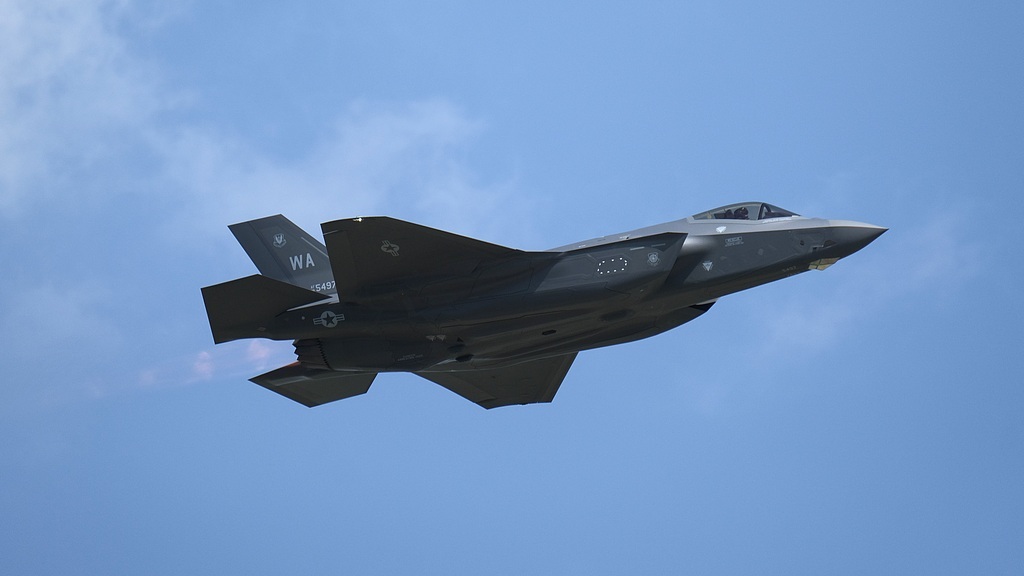
Reports indicate that AI technology has improved the situational awareness of the F-35 fighter jet and reduced decision-making delays for pilots. More importantly, engineers can use automated tools to mark new radiation sources (typically ground-based air defense systems or airborne radar), retrain the AI model within minutes, and reload the updated model for the next flight.
It is said that these improvements are based on lessons learned from the Russia-Ukraine conflict. In 2023, the U.S. Air Force Times revealed that an F-35 encountered related challenges while training near the Russian direction. Colonel Craig Anderl, then commander of the 388th Fighter Wing, described, "What we saw was a Russian S-300 system. I knew it was an S-300, and intelligence also indicated that there was an S-300 there, but my aircraft could not identify it. Because that S-300 might be operating in a readiness mode we had never seen before."
Defense News stated that using AI on fighter jets follows a directive issued by the U.S. Air Force in April 2025, which indicated that AI would be integrated into the entire Air Force system as a force multiplier. "AI will enhance intelligence, surveillance, and reconnaissance (ISR) capabilities by providing networked sensors."
Additionally, the report mentioned that the Pentagon announced last summer that it would award defense contracts to four AI companies—Anthropic, Google, OpenAI, and Musk's xAI. Each contract is valued at $200 million. Among them, Anthropic is the first AI company authorized to enter classified military networks.
Recently, the Pentagon has put extreme pressure on Anthropic, demanding that the company completely lift military application restrictions on its developed model Claude before Friday night U.S. time. Under the dual pressures of politics and business, Anthropic subsequently released a new policy, officially abandoning its previous stance of "unilaterally suspending large model training if safety measures cannot be guaranteed."
Reports indicate that the trigger for this controversy stemmed from disagreements between the company and the Pentagon regarding AI applications and the ethics of warfare. After the U.S. military forcibly took control of Venezuelan President Maduro in January, the disputes between the two sides further escalated. Earlier reports indicated that the Claude model was used to assist in this operation, raising concerns for Anthropic regarding the military use of its large model.
The Pentagon has also been in contact with Google, OpenAI, and xAI. U.S. media reported that xAI has reached an agreement with the Pentagon, allowing the U.S. military to integrate its model Grok into classified systems and fully accepting the military's standards "for all lawful purposes."
Lockheed Martin successfully tested AI technology to enhance target acquisition capabilities in F-35 fighter jets at Nellis Air Force Base, Nevada. This development aims to improve situational awareness and reduce decision-making delays for pilots. The integration of AI is part of the Pentagon's strategy to use advanced technologies as force multipliers in military operations, drawing lessons from recent conflicts.
- Lockheed Martin successfully tested AI technology for F-35 target acquisition.
- The testing took place at Nellis Air Force Base in Nevada.
- AI enhances situational awareness and reduces decision-making delays for pilots.
- The improvements are based on lessons learned from the Russia-Ukraine conflict.
- The Pentagon is integrating AI as a force multiplier in military operations.