
U.S. Mediation Faces Pressure on Second Day of Three-Day Russia-Ukraine Ceasefire: Both Sides Accuse Each Other of Violating the Truce and Clashes Erupt with Drones at the Frontline
 Dmitri Volkov
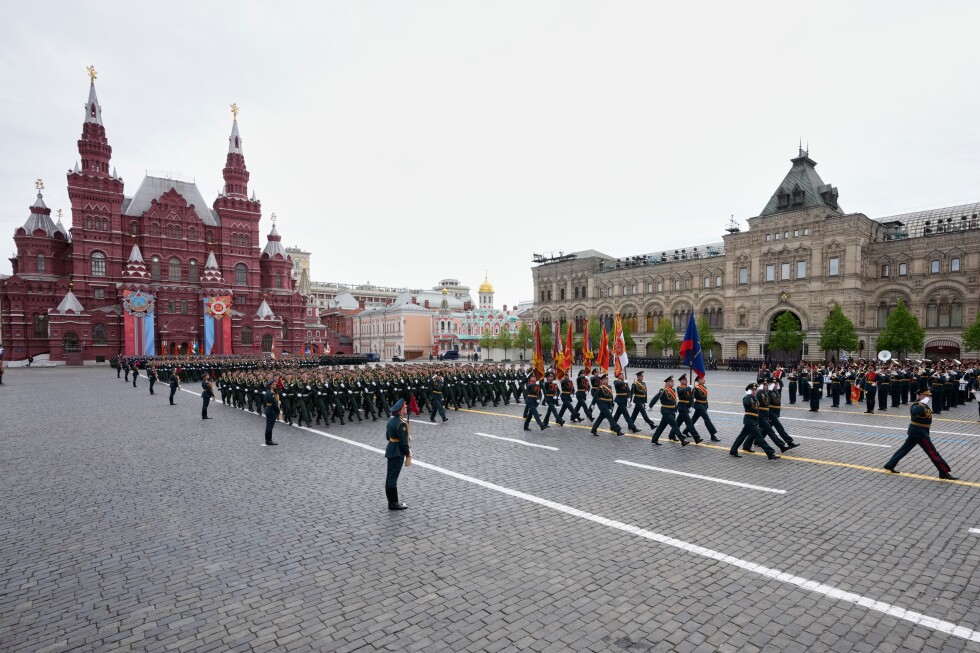 Image: Russian soldiers march during the Victory Day parade in Moscow on May 9, 2026. Photo source: AP Photo/Pavel Bednyakov, Pool; HiWars CDN archive.
Core Judgment: The US-brokered three-day ceasefire between Russia and Ukraine came under severe pressure on its second day. Reuters reported on May 10 that Ukraine and Russia accused each other of violating the US-supported ceasefire arrangement; AP and BBC reported simultaneously that both sides claimed there were drone strikes, shelling, or frontline clashes in the past 24 hours. Based on reports from local Ukrainian governments and the Air Force, it can be confirmed that cross-regional airstrikes, frontline contacts, and damage to civilian targets still occurred during the ceasefire window; however, regarding "who first violated the ceasefire," the specific number of violations, and military responsibility, the information mainly comes from the statements of both warring parties, and the battlefield fog must be retained.
Confirmed Facts
- Ceasefire Framework: The three-day ceasefire window announced and promoted by the US is from May 9 to 11. The Kyiv Independent reported that this ceasefire was announced by US President Trump on May 8, against the backdrop of previous short ceasefire proposals from both Russia and Ukraine.
- Mutual Accusations on the Second Day of Ceasefire: Reuters reported on May 10 in "Ukraine, Russia trade accusations of violating US-backed ceasefire" that both sides accused each other of violating the US-supported ceasefire. AP confirmed the same day in a report titled "Russia and Ukraine accuse each other of violating US-brokered 3-day truce" that both Moscow and Kyiv claimed there were drone and shelling incidents causing casualties in the past 24 hours.
- Attacks and Casualties in Ukraine: The Kyiv Independent cited a report from the Ukrainian local government on May 10 stating that in the past day, Russian attacks resulted in at least 1 civilian death and 19 injuries; the affected regions include Kharkiv, Dnipro, Donetsk, Kherson, Zaporizhzhia, Sumy, and Chernihiv.
- Drone Activity Continues: The Ukrainian Air Force stated that the Russian military launched 27 drones from the Primorsko-Akhtarsk and Millerovo directions at night, all of which were intercepted by Ukraine. This claim was relayed by the Kyiv Independent citing the Ukrainian Air Force report.
- Frontline Not Completely Silent: The Kyiv Independent cited the Ukrainian General Staff stating that there were still 147 combat contacts on the frontline during the ceasefire. The BBC also reported that Ukraine and Russia accused each other of violating the three-day truce after the ceasefire.
Statements from Both Sides: Must Be Viewed in Layers
Ukrainian Statement: The Ukrainian local government reported multiple regions were subjected to drone, aerial, and artillery attacks; Zaporizhzhia reported that in the past 24 hours, Russian forces conducted 780 strikes on 33 settlements, resulting in 1 death and 3 injuries; Kherson reported 7 injuries, with Russian attacks targeting critical and social infrastructure as well as residential areas; a nine-story residential building in Kharkiv was hit by a drone, causing acute stress reactions in several children. Ukraine also stated that the ceasefire did not prevent frontline fighting.
Russian Statement: According to the BBC, Russia accused Ukraine of repeatedly violating the ceasefire, including over 6,000 drone strikes and hundreds of artillery attacks. Russia also linked the situation to the security of Victory Day and the potential risk of Ukrainian strikes towards Moscow. However, these figures currently mainly come from Russian reports, lacking third-party verification.
Military Implications: Short Ceasefire Lacks Enforcement Mechanism
The biggest problem with this ceasefire is not the "announcement," but rather the lack of enforceable verification, communication, and de-escalation mechanisms. The characteristics of drones, FPV, artillery countermeasures, and border harassment on the Russia-Ukraine battlefield are high-frequency, dispersed, and highly deniable; even if there is political agreement on a short ceasefire, frontline units may still continue to fire due to reconnaissance contacts, counter-battery fire, or autonomous drone mission chains.
The political symbolism surrounding Victory Day also amplifies the risks. Moscow seeks to ensure the safety of the May 9 parade, while Kyiv fears that a short ceasefire could become a window for Russian forces to regroup. The result of mutual accusations is that the US-brokered window is quickly consumed, and any subsequent longer ceasefire will require at least three technical conditions: first, a clear ceasefire line and types of prohibited fire; second, the establishment of a real-time military hotline; third, allowing third parties or technical means to record drone, artillery, and missile launch trajectories. Otherwise, the "ceasefire" will continue to devolve into a framework of accusations in the information war, rather than a constraint mechanism on the battlefield.
Assessment
- Credibility: High. Reuters, AP, BBC, Kyiv Independent, and official/local reports from Ukraine form a cross-verification pointing to serious friction on the second day of the ceasefire.
- To Be Confirmed: The precise number of violations of the ceasefire by both sides, specific responsibility attribution, and whether there is a unified command layer authorized to violate the ceasefire.
- Intelligence Level: ⭐⭐⭐⭐⭐. This event directly affects the credibility of US mediation, the battlefield rhythm around Victory Day for Russia and Ukraine, and the space for the next round of ceasefire/prisoner exchange negotiations.
Main Sources
- Reuters, 2026-05-10, “Ukraine, Russia trade accusations of violating US-backed ceasefire”
- Associated Press, 2026-05-10, “Russia and Ukraine accuse each other of violating US-brokered 3-day truce”
- BBC, 2026-05-10, “Putin says he thinks Ukraine conflict ‘coming to an end’”
- Kyiv Independent, 2026-05-10, “Russia breaks 3-day ceasefire as strikes kill 1, injure 19 across Ukraine”
- Ukrainian Air Force, Ukrainian General Staff, and local governments of Kharkiv, Dnipro, Donetsk, Kherson, Zaporizhzhia, Sumy, and Chernihiv publicly reported (as relayed by Kyiv Independent)
On May 10, 2026, Ukraine and Russia accused each other of violating a U.S.-brokered ceasefire, with reports of drone strikes and artillery fire. Russian attacks resulted in at least 1 civilian death and 19 injuries across several regions, including Kharkiv and Dnipropetrovsk. Ukrainian forces intercepted 27 drones launched by Russia, while 147 combat engagements were reported during the ceasefire.
- Both Ukraine and Russia accused each other of violating the ceasefire on May 10, 2026.
- At least 1 civilian was killed and 19 injured due to Russian strikes in Ukraine.
- Ukrainian forces intercepted 27 Russian drones launched during the night.
- 147 combat engagements occurred during the ceasefire period.
- The ceasefire is set from May 9 to May 11, 2026.