
U.S. Military High Command Collective Statement: We Can't Fight Anymore, We Can't Fight Anymore!
The U.S.-Iran conflict has been ongoing
with both sides in a standoff for six months
U.S. military ammunition stocks are frequently "flashing red"
On August 31 local time
Trump once again threatened to "hit Iran hard"
However,
internally, the Pentagon is "revealing its shortcomings"
Is the U.S. really unable to fight?
Trump stated:
Hit Iran hard
Late at night on August 30 Tehran time, a senior U.S. official disclosed that the U.S. military bombed two Iranian Islamic Revolutionary Guard weapon installations on Iran's Qeshm Island, marking the U.S. military's return to military action against Iran after a month.
However, just about two hours after U.S. officials disclosed the attack on Qeshm Island, the Iranian military quickly responded with force.
On the 31st, Trump commented on the new round of U.S.-Iran conflict, stating that he would retaliate against Iran's attack on the U.S. base in Jordan. According to Trump, "We will hit them (Iran) hard."
Pentagon
Exposes "empty coffers"
However, compared to Trump's tough stance, the U.S. military appears to be struggling to continue advancing the war against Iran.
U.S. High Command:
Large-scale military operations against Iran are unsustainable
A Pentagon internal document disclosed on August 30 shows that several senior U.S. military commanders warned U.S. Secretary of Defense Lloyd Austin that continuing large-scale military operations against Iran would be unsustainable, as this would weaken the U.S. military's ability to conduct operations globally and even defend the U.S. homeland.
A large number of senior U.S. military officials
Oppose continued military deployment against Iran
According to the document, the U.S. plans to extend the deployment of some troops stationed in the Middle East until September of this year, with some U.S. forces possibly remaining in the Middle East until 2027.
Commanders of the U.S. European Command, Pacific Command, Southern Command, and the Chief of Naval Operations oppose this deployment plan, believing that the current U.S. military actions against Iran have lasted "too long." A large number of ships and aircraft have been diverted to the U.S. Central Command responsible for operations in the Middle East, squeezing resources for U.S. training and homeland defense.
Additionally, the U.S. Navy currently has only about a quarter of its destroyers available for immediate combat; if other conflicts arise in the future, the limited ship maintenance capacity may lead to a shortage of vessels. Without a clear end timeline for the conflict, the Navy is unable to maintain the current intensity of operations against Iran.
U.S. military air defense interceptors' stock is running low
On the other hand, there are new reports regarding the U.S. military air defense interceptors running low due to the conflict with Iran.
According to a statement from the U.S. Department of Defense on August 31, it has signed two key framework agreements with General Dynamics Ordnance and Tactical Systems and Lockheed Martin to increase the production capacity of the "Patriot Advanced Capability-3" missiles and the "THAAD" missile defense system. According to the Pentagon, these two agreements will significantly increase the production capacity of important U.S. air defense interceptors by several times, specifically:
The production capacity of the "Patriot Advanced Capability-3" missile's enhanced variant will be increased to three times the original;
The production capacity of the "THAAD" missile defense system interceptors will be increased to four times the original.
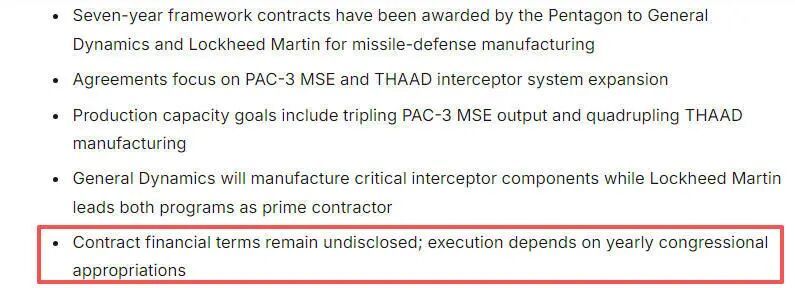
▲ Analysts believe that the specific financial terms of the interceptor production agreements signed by the Department of Defense have not been disclosed, and the actual implementation is still subject to congressional appropriations.
According to insiders, since the conflict with Iran began, the U.S. military has consumed nearly four-fifths of its "THAAD" missile defense system missile stock and about half of its "Patriot" air defense system interceptors. However, industry insiders analyze that the current Department of Defense is only signing orders with arms manufacturers, and the financial terms of the contracts have not been disclosed. As for the subsequent ammunition production involving expansion of production lines and actual production, it will still take time, and the specific execution also depends on congressional appropriations each year. Therefore, the U.S. military's interceptor stock shortage is likely to persist for a long time.
U.S. Navy carrier deployments face multiple issues
In addition to the U.S. military's ammunition shortages, issues such as long-term carrier deployments have also been frequently reported. The high-intensity operational deployments of the U.S. military continue to squeeze personnel rest, equipment maintenance, and military rotation space.
Previously, the "Lincoln" aircraft carrier was reported to have sailors facing living conditions and mental health issues due to the high-intensity operational tempo and long-term deployment, with several individuals even attempting to jump overboard due to mental breakdowns, drawing widespread public attention.
Source: CCTV Military Comprehensive CCTV-7 National Defense Military Morning News, CMG International News
Reporter: Li Jiannan, Zhao Miao, Liu Xiaoqian
U.S. military officials conducted airstrikes on Iranian Revolutionary Guard positions on Larak Island on August 30, 2023. Concerns were raised about the sustainability of ongoing military operations against Iran due to significant resource depletion and ammunition shortages. The Pentagon indicated that the U.S. Navy's missile inventory is critically low, impacting future operational capabilities.
- U.S. military conducted airstrikes on Iranian Revolutionary Guard positions on Larak Island.
- Pentagon warns that continued military operations against Iran are unsustainable due to resource depletion.
- U.S. Navy's missile inventory is critically low, with significant consumption of THAAD and Patriot missiles.
- High-ranking military officials oppose prolonged deployments in the Middle East due to operational strain.