
U.S. Navy finalizes Lockheed order for F-35 power and cooling upgrades
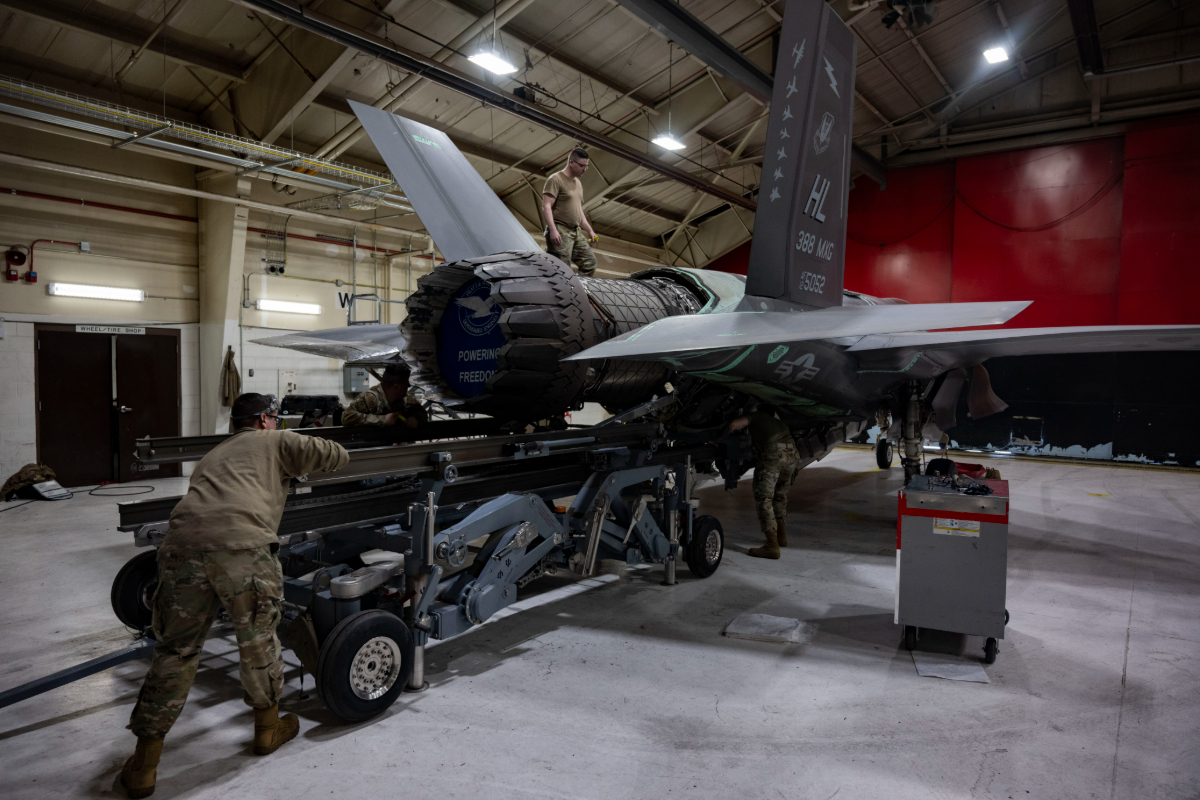
The U.S. Navy has added $13.3 million and 50,000 labor hours to a Lockheed Martin order covering integration of the F-35’s upgraded F135 engine core and the move of a new power and cooling system for the fighter into preliminary design.
Naval Air Systems Command announced the cost-plus-fixed-fee, level-of-effort modification on Oct. 27, definitizing an undefinitized contract action, which means the government and Lockheed have now agreed on final terms for work that began before the price was settled, and extending the effort to April 2027. No money was obligated at award, and the work, which supports the U.S. Air Force, U.S. Navy, U.S. Marine Corps and the F-35 cooperative program partners, was not competed.
The modification sits on a delivery order NAVAIR first issued in fiscal 2025 as a not-to-exceed $107 million undefinitized order, which paid Lockheed to run trade studies and an alternatives assessment of every potential power and thermal management solution for the F-35, along with the integration work needed to fit Pratt & Whitney’s Engine Core Upgrade into Block 4 aircraft. That order was due to finish in December 2026, so the new action pushes completion back four months while shifting part of the effort from study to design as the power and thermal management upgrade enters its preliminary design phase.
Fort Worth, Texas, where Lockheed builds the F-35, accounts for 47% of the work, while Torrance and El Segundo, California, take 19% between them and two sites in Britain, Blackburn and Cheltenham, take 6% each, with the remainder spread across Haltom City, Texas; South Bend, Indiana; Windsor Locks and West Hartford, Connecticut; Rockford, Illinois; and Orlando, Florida.
The engine and cooling work both stem from the amount of heat the F-35’s electronics generate. The F-35 Joint Program Office has said Block 3 jets produce about 30 kilowatts of waste heat, a figure expected to reach 47 kilowatts in Block 4, while the current engine is optimized to absorb about 14 kilowatts. That heat is removed by the Power and Thermal Management System, or PTMS, a Honeywell unit that draws bleed air from the engine and also provides auxiliary and emergency power, engine starting and cabin environmental control, and because the PTMS takes more air from the F135 than its designers planned, the engine runs hotter and wears out faster, raising sustainment costs across the fleet.
Pratt & Whitney’s Engine Core Upgrade, or ECU, redesigns the F135’s core to produce more thrust, supply more bleed air and electrical power, and restore the engine life lost to heat, while the separate Power Thermal Management Upgrade, or PTMU, will replace or enlarge the cooling system that uses that air. In October 2024, the Joint Program Office named Lockheed the lead systems integrator for the PTMU after concluding that no other company could manage the integration, and the order modified this week is the contract vehicle for that role.
Honeywell, which builds the current PTMS, unveiled a near-term cooling option called P40 in September that would raise capacity from about 32 kilowatts to 40 kilowatts through software changes and liquid-cooling modifications, with no airframe changes and fielding planned for 2029 or 2030, and the company says the architecture could later grow to 62 kilowatts or more. Collins Aerospace, a sister company of Pratt & Whitney within RTX, is competing with a new design called the Enhanced Power and Cooling System, and the two companies have said that pairing it with the ECU would yield about a 7% gain in range and thrust along with double the cooling capacity, figures that come from the manufacturers. The modification does not say which approach Lockheed’s trade studies favored or whether preliminary design will cover one solution or several, and the government has not announced a PTMU selection.
The Pentagon chose in March 2023 to upgrade the F135 instead of re-engining the F-35 with an adaptive-cycle design from the Adaptive Engine Transition Program, citing cost and the difficulty of integrating a new engine into the short-takeoff F-35B and carrier-based F-35C. Pratt & Whitney then completed the ECU’s preliminary design review in July 2024 and later that year received a contract worth up to $1.3 billion for design maturation, rig testing and aircraft integration through March 2028.
In late August, the Navy added a modification worth up to $240.8 million to move the ECU into engineering and manufacturing development and buy long-lead hardware for a spare test engine, and Pratt & Whitney completed the upgrade’s risk reduction design review on Sept. 15. The company describes the ECU as a drop-in replacement core that can be installed on new engines or retrofitted at F135 depots, and John Sneden, the U.S. Air Force’s portfolio acquisition executive for propulsion, said in July that ground testing is planned for late 2027 and flight testing for around 2030, later than the 2029 fielding date Pratt had cited in 2024.
Lockheed’s share of the integration covers the aircraft side of the engine change, since a new core alters bleed-air flow, electrical power extraction, engine controls and heat loads, each of which affects the airframe’s fuel, cooling and mission systems. The engine and cooling upgrades also have to be timed together, because the extra cooling capacity Block 4 needs depends on both programs delivering.
The Government Accountability Office has warned of integration risks to the ECU timeline, and the Block 4 upgrade, which carries the new sensors and weapons responsible for much of the added heat, has slipped repeatedly. The fiscal 2027 budget request seeks $317.5 million for F-35 propulsion work, up from about $121 million in 2026, with much of the increase meant to accelerate the ECU and PTMU.
Content preview only. Full article available at source. View Full Article
The U.S. Navy finalized a $13.3 million modification to a Lockheed Martin order for integrating the F-35’s upgraded F135 engine core and a new power and cooling system into preliminary design as of October 27, 2023. This effort extends to April 2027 and involves multiple locations, with Fort Worth, Texas, handling the majority of the work. The upgrades aim to enhance the aircraft's performance and manage increased heat generation.
- U.S. Navy added $13.3 million and 50,000 labor hours to Lockheed Martin order.
- The modification extends the effort to April 2027.
- Fort Worth accounts for 47% of the work on the F-35 upgrades.
- The F-35 Joint Program Office named Lockheed the lead systems integrator for the PTMU.
- The fiscal 2027 budget requests $317.5 million for F-35 propulsion work.