
U.S. Navy funds early materials for future carrier USS Clinton
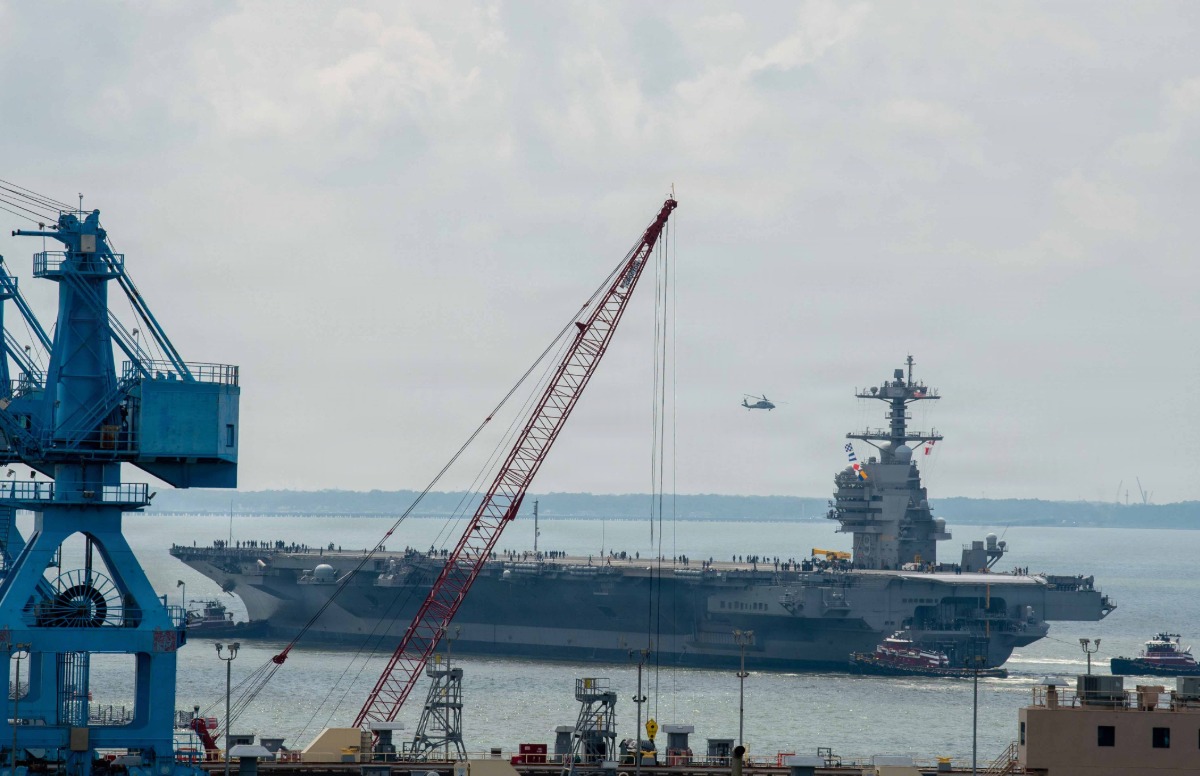
The U.S. Navy has awarded Huntington Ingalls Industries $336.1 million to begin buying materials with long manufacturing lead times for the future USS William J. Clinton (CVN 82), the fifth Gerald R. Ford-class aircraft carrier, according to a Department of War contract announcement.
The contract covers advance procurement only, meaning the money goes toward ordering components and materials that take years to manufacture, well before construction of the ship itself begins. Naval Sea Systems Command awarded the deal as what’s known as an undefinitized contract action, a type of contract that lets work start on a not-to-exceed cost basis while the government and contractor continue negotiating final pricing terms.
Huntington Ingalls will perform the work at its Newport News, Virginia, shipyard, the same yard that has built every Nimitz and Ford-class carrier in Navy history. The contract runs through March 2039, and the Navy is obligating the full $336.1 million in fiscal 2026 shipbuilding funds now, with the money set to remain available beyond the current fiscal year. The Navy awarded the contract without competition, citing federal law that allows sole-source awards when only one contractor can meet the requirement, since Huntington Ingalls is the only U.S. shipyard capable of building nuclear-powered aircraft carriers.
Then-Secretary of the Navy Carlos Del Toro named the future carrier in January 2025, honoring former President Bill Clinton, who served two terms from 1993 to 2001. It will be the first Navy vessel named for the former president. Chelsea Clinton, his daughter, will serve as the ship’s sponsor.
CVN 82 will follow the USS Gerald R. Ford (CVN 78), USS John F. Kennedy (CVN 79), USS Enterprise (CVN 80) and USS Doris Miller (CVN 81) as the fifth ship in the Ford class. Like its sister ships, the carrier is expected to displace roughly 100,000 tons fully loaded, measure about 1,106 feet (337 meters) long, and run on two A1B nuclear reactors. The class is designed to carry more than 80 aircraft and a crew of roughly 4,660 sailors.
Program timelines released alongside the January 2025 naming announcement projected that CVN 82 and its sister ship, the future USS George W. Bush (CVN 83), would begin construction in the years following their naming. Budget planning documents have placed the carrier’s procurement around fiscal year 2030, with some projections putting delivery to the fleet around 2040, though these dates remain estimates this early in the program rather than fixed milestones.
Content preview only. Full article available at source. View Full Article
The U.S. Navy awarded a $336.1 million contract to Huntington Ingalls Industries for the procurement of materials for the future USS William J. Clinton (CVN 82). This contract, which runs through March 2039, is for advance procurement and allows work to begin on components that have long manufacturing lead times. The carrier is expected to be the fifth in the Gerald R. Ford class, with construction projected to start around fiscal year 2030.
- U.S. Navy awarded $336.1 million contract to Huntington Ingalls Industries
- Contract is for advance procurement of materials for USS William J. Clinton (CVN 82)
- Construction of the carrier is projected to begin around fiscal year 2030
- The carrier will be the fifth in the Gerald R. Ford class
- Huntington Ingalls is the only U.S. shipyard capable of building nuclear-powered aircraft carriers.