
U.S. Navy just put one of its most-used missiles in a museum
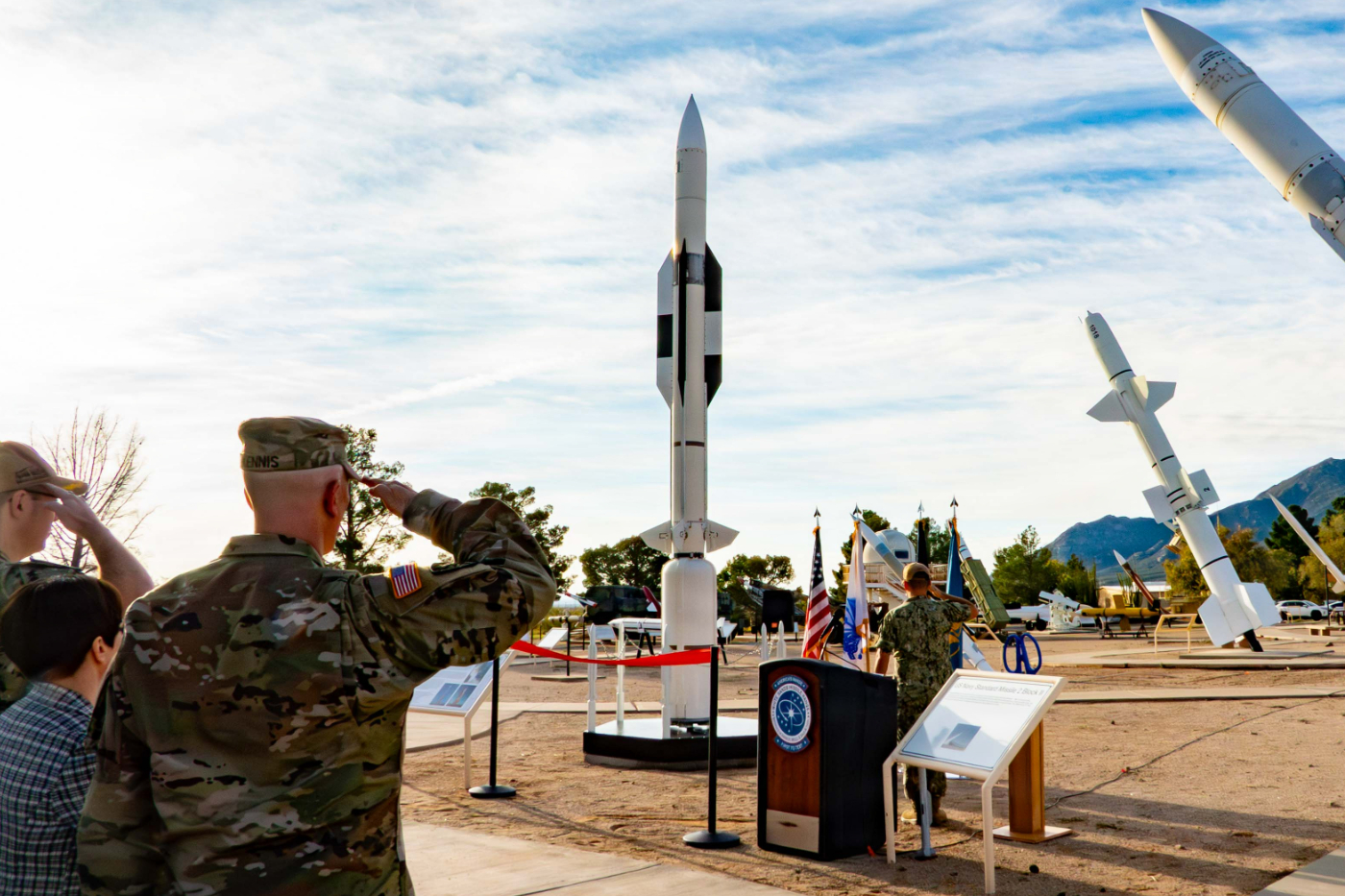
The Standard Missile 6, which the U.S. Navy is still buying by the hundreds, went on display at the White Sands Missile Range Museum in New Mexico on Nov. 13 “as a historical artifact,” the range’s chief of staff said at the unveiling.
The U.S. Navy’s White Sands detachment hosted the ribbon-cutting at the museum’s outdoor Missile Park, according to a range release. Speakers included the U.S. Navy captain who runs the Standard Missile program office and Raytheon’s SM-6 program manager.
“Today, we add another chapter of history with the unveiling of the Standard Missile 6 as a historical artifact,” said Patrick Curran, White Sands Missile Range’s chief of staff. “This is not just a Navy artifact; this is now a truly joint munition.”
The release doesn’t say which version of the missile is on the stand, or whether it’s an inert round built for display or one left over from testing.
It is an unusual museum piece. Six weeks before the ceremony, the U.S. Navy signed a $24.4 billion deal with Raytheon’s parent RTX for more than 1,900 SM-6s over five years, USNI News reported. Most of the park’s other exhibits, such as the Talos, left service decades ago.
White Sands has a claim on the missile’s history all the same. The SM-6 flew for the first time there in June 2008, launched from the Desert Ship, a concrete blockhouse in the New Mexico desert that the U.S. Navy uses to stand in for a warship’s launch system. That first shot hit a BQM-74 target drone using the missile’s new active radar seeker. The U.S. Navy has tested weapons at the range since 1946.
The missile entered service in November 2013. On paper it was a longer-ranged replacement for older Standard Missiles: a two-stage, solid-fuel weapon fired from a ship’s vertical launch cells to shoot down aircraft and cruise missiles. The museum lists it at 6.55 meters (21.5 feet) long and 1,500 kg (3,300 pounds), with a range of 240 km (150 miles) and a top speed of Mach 3.5.
What set it apart was the seeker. Earlier Standard Missiles needed the ship’s radar to light up the target until impact. The SM-6 carries its own radar, so another ship or aircraft can find the target and pass the data over a network, and the missile finishes the job itself. The U.S. Navy calls that network NIFC-CA, for Naval Integrated Fire Control-Counter Air. It lets a destroyer shoot at things beyond its own radar horizon.
Michael Ladner ran the SM-6 program as a U.S. Navy captain during its early development and testing. He is now deputy technical director at Naval Surface Warfare Center Port Hueneme Division, the detachment’s parent command, and he spoke at the ceremony.
“The program that I worked on in the beginning was focused mostly on integrating this brand-new missile into a canister, into a launcher, into that combat system,” Ladner said. “Over time, this program has been able to leverage the inherent capability and the hardware and brought on all these new missions.”
Those missions are what Curran meant by “joint.” A later version added GPS guidance, which let the SM-6 strike ships and land targets. It can also hit ballistic missiles in the last phase of their flight. The U.S. Army fires it from a truck-mounted launcher called Typhon. In 2024, the U.S. Navy revealed an air-launched version, the AIM-174B, carried by F/A-18 Super Hornets. Raytheon sells it as “three missiles in one.”
The museum itself reopened in 2023 after renovations. The indoor space covers 4,000 square feet with 15 exhibits and 145 artifacts, per the release, on subjects that run from the range’s natural history to “instrumentation and test support.” The Missile Park is the outdoor section.
Besides Curran and Ladner, the speakers were Capt. Thomas Seigenthaler, major program manager for the Standard Missile Program Office, and Courtney Heath, Raytheon’s Standard Missile 6 program manager.
Content preview only. Full article available at source. View Full Article
The U.S. Navy unveiled the Standard Missile 6 as a historical artifact at the White Sands Missile Range Museum on November 13. This event coincided with a $24.4 billion procurement deal for over 1,900 SM-6 missiles. The missile, which entered service in 2013, features advanced capabilities, including a range of 240 km and the ability to engage multiple target types.
- The Standard Missile 6 was unveiled at the White Sands Missile Range Museum on November 13.
- The U.S. Navy signed a $24.4 billion deal for over 1,900 SM-6 missiles.
- The missile entered service in November 2013 and has a range of 240 km.
- The SM-6 can be launched from ships and has capabilities against various targets, including ballistic missiles.