
US NMESIS and Japan Type-25 Missiles Turn Yonaguni Into 2026 Taiwan Tripwire
 Marcus Chen
US NMESIS and Japan Type-25 Missiles Turn Yonaguni Into 2026 Taiwan Tripwire
The distance is 110 kilometers. That is all that separates Yonaguni, Japan's westernmost inhabited island, from Taiwan. In October 2026, the United States and Japan will put a new kind of military problem on that small piece of land: a distributed missile network built around mobility, sensors, and denial rather than a carrier battle group.
A Missile Exercise on the Taiwan Strait's Edge
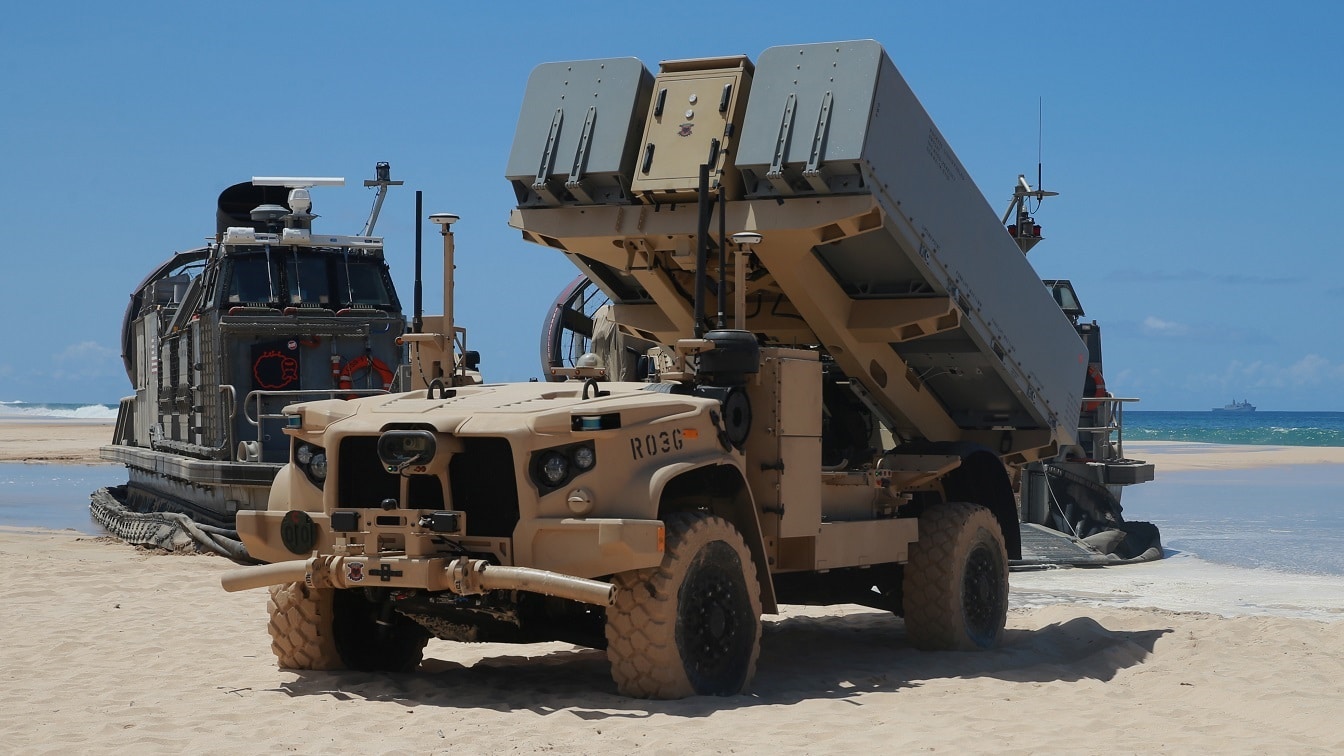
According to Defense News, the U.S. Marine Corps will deploy the Navy-Marine Expeditionary Ship Interdiction System, or NMESIS, and the Marine Air Defense Integrated System, or MADIS, to Yonaguni for Exercise Keen Sword. The systems will arrive for the first time on the island as the exercise runs from October 19 to 29.
The move matters because it is not a symbolic visit by a destroyer. NMESIS is a mobile, ground-launched anti-ship system with a reported reach of about 115 miles. MADIS is designed to protect expeditionary units against low-altitude threats, including drones and cruise missiles. Together, they give a small Marine unit a way to threaten ships while making itself harder to find and target.
Japan is adding considerably more range. The Ground Self-Defense Force will train with the Type-25 surface-to-ship missile, formerly known as the upgraded Type-12, whose reported range is 1,000 kilometers. The exercise lineup also includes the Type-88 anti-ship missile and the upgraded Type 03 Chu-SAM Kai air-defense system. U.S. Army HIMARS will deploy to nearby Ishigaki, while the Army's Typhon launcher is expected to move to Okinawa during the same period.
The Point Is Sea Denial, Not Island Defense
These systems should not be judged by whether they can hold Yonaguni against a determined attack. They cannot. The island is small, its roads and port are limited, and its military infrastructure remains exposed to missile strikes. The useful question is different: can a network of mobile launchers make it dangerous for the People's Liberation Army Navy to operate through the waters around Taiwan?
That is the logic behind the Marine Corps' littoral force redesign. Instead of asking a few large platforms to maintain sea control everywhere, Washington is trying to distribute shorter-range weapons across a chain of islands. A launcher can hide, displace, and fire from land. It does not need a runway or a carrier deck. If its targeting data is current, even a modest number of anti-ship missiles can force Chinese ships to change course, slow an amphibious formation, or spend scarce air assets hunting launchers.
But a missile's range is not its combat power. The kill chain still requires surveillance, identification, communications, and battle-damage assessment. Yonaguni's radar already fills what Japanese officials once called a surveillance vacuum between the island and Taiwan, but radar coverage alone does not guarantee a firing solution against a moving warship. In a real fight, Chinese jamming, cyberattacks, decoys, and persistent drones would attack the network before the first salvo.
Distributed Forces Still Need Logistics
The exercise exposes the central contradiction in the American approach. Dispersal improves survivability, but it multiplies the logistical burden. Every island position needs fuel, reloads, spare parts, air defense, medical support, and a reliable data link. A launcher that survives the opening strike but has no replacement missiles is an expensive spectator.
Yonaguni's civilian infrastructure makes the problem visible. Large equipment will move through Kubura Port, and local officials have warned about road, port, and airspace congestion. The local government has also opposed an exercise it believes exceeds the island's capacity. Those are not public-relations details. They are operational constraints. If military traffic cannot move during a training exercise without disrupting the population, moving missiles under combat conditions will be harder.
The absence of a carrier strike group is also instructive. In previous Keen Sword iterations, USS George Washington provided a visible centerpiece. This year, the carrier is not expected to participate after being sent to the Arabian Sea. The result is a drill that looks less like a conventional naval exercise and more like a rehearsal for an island-based area-denial architecture.
China Faces a Wider Target Set
For Beijing, the deployment expands the number of American and Japanese positions that must be watched or suppressed. Yonaguni is not a fortress, but it sits close enough to Taiwan to complicate movement through the southwestern islands. Chinese coast guard activity between Yonaguni and Taiwan, along with the memory of a Chinese ballistic missile landing roughly 80 kilometers from the island in 2022, has already made the geography politically charged.
Yet the network creates escalation risks for Tokyo as well. A Japanese missile unit operating from the Nansei Islands would be a legitimate military target in a conflict, not a neutral observer. The closer Japan moves toward long-range standoff strike, the less credible its old separation between homeland defense and a Taiwan contingency becomes. That may strengthen deterrence, but it also makes Japanese territory part of the opening calculations of any crisis.
The Verdict
USNI News has described the Pentagon's wider push for Pacific area denial and high-end munitions. Keen Sword shows what that policy looks like on the ground: missiles spread across islands, protected by short-range air defense, and linked to a sensor network.
The concept is sound. The math is not settled. NMESIS and Type-25 can impose costs on a Chinese fleet, but only if the launchers receive targeting data, survive counterfire, and receive reloads through ports that may already be under attack. Yonaguni is becoming a tripwire because it sits close to Taiwan. It will become a credible deterrent only when Washington and Tokyo can keep that tripwire supplied after the first day of the war.
The U.S. Marine Corps deployed NMESIS and MADIS to Yonaguni for Exercise Keen Sword from October 19 to 29, 2026, alongside Japan's Ground Self-Defense Force training with Type-25 missiles. This exercise aims to establish a distributed missile network for sea denial near Taiwan, complicating operations for the People's Liberation Army Navy. The deployment highlights logistical challenges due to Yonaguni's limited infrastructure and the absence of a carrier strike group during the exercise.
- U.S. Marine Corps will deploy NMESIS and MADIS to Yonaguni for Exercise Keen Sword in October 2026.
- Japan's Ground Self-Defense Force will train with Type-25 missiles with a range of 1,000 kilometers.
- The exercise aims to create a distributed missile network for sea denial near Taiwan.
- U.S. Army HIMARS will deploy to Ishigaki, and Typhon launcher is expected to move to Okinawa during the same period.
- Yonaguni's infrastructure poses logistical challenges for military operations.