
U.S. Osprey fleet gets new flight computers
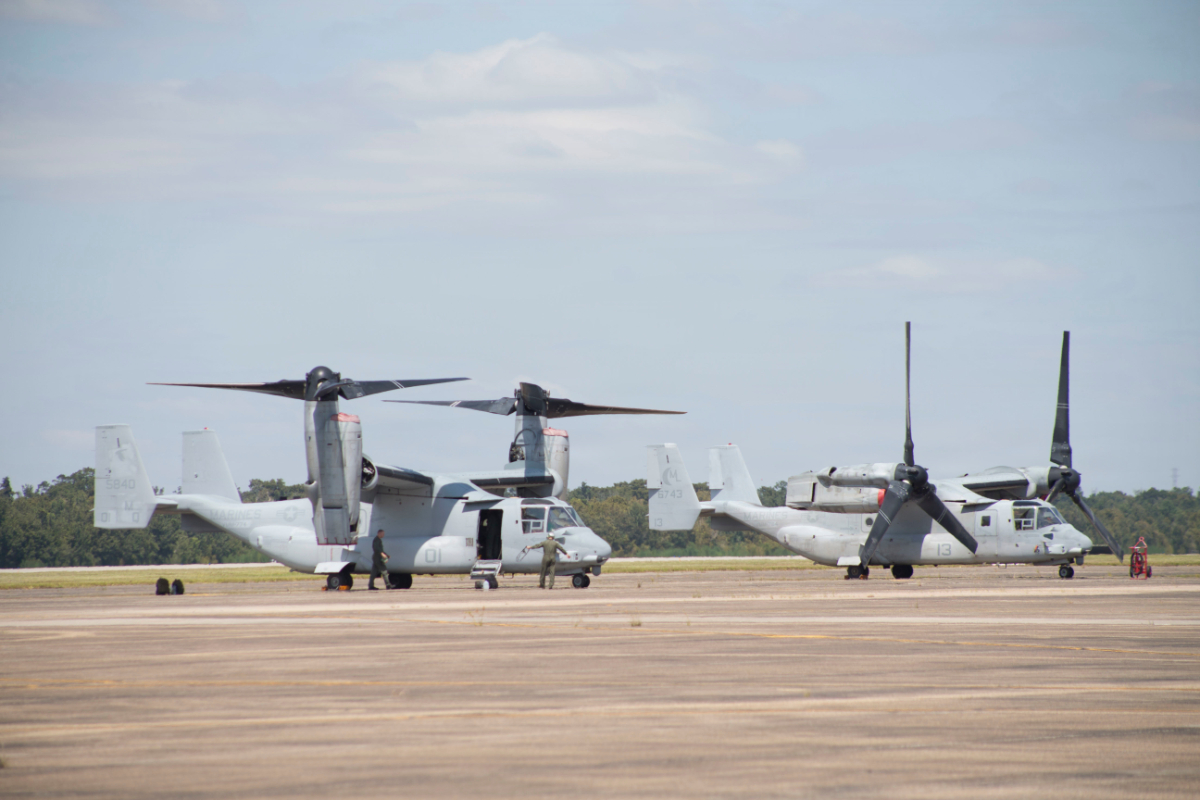
The U.S. Navy has awarded the Bell Boeing joint venture $90.8 million to continue redesigning the V-22 Osprey’s flight control system, including new flight control computers and cockpit interface units for the tiltrotor aircraft flown by the U.S. Marine Corps, U.S. Air Force, U.S. Navy and a foreign customer.
The order, signed on Oct. 15 by Naval Air Systems Command at Patuxent River, Maryland, also covers new test equipment, software, technical documentation and logistics products needed to buy and support the redesigned system later. The U.S. Department of War said the upgrade is meant to deal with aging electronic components, cybersecurity requirements and parts that are no longer being made, so the Osprey fleet can keep flying for the rest of its service life.
The flight control system is the core of the V-22’s fly-by-wire design. Its computers turn pilot inputs into commands for the aircraft’s rotors, wings and engine nacelles, which tilt between helicopter and airplane modes in flight, so the computers have to keep working reliably for the Osprey to fly at all.
Bell Boeing will perform 52% of the work in Ridley Park, Pennsylvania, where Boeing builds the Osprey’s fuselage, and 42% in Mesa, Arizona, with smaller shares in Fort Worth, Texas, where Bell assembles the aircraft, and at other U.S. locations. Work is scheduled to finish in October 2030.
The government obligated about $4.9 million at signing, including roughly $3.1 million in U.S. Air Force research and development funds, $369,250 in U.S. Navy research funds and $1.4 million from the Foreign Military Sales customer. Japan is the only foreign country flying the Osprey, with V-22s in service with its Ground Self-Defense Force, though the contract notice did not name the buyer.
The award, issued as a sole-source order under an existing basic ordering agreement, extends work that began five years ago. In September 2021, the U.S. Navy gave Bell Boeing a $214.4 million order for the redesign and development of the V-22 flight control system, flight control computer and cockpit interface unit, citing functional obsolescence, cybersecurity and parts shortages. That work was due to be completed in June 2026.
The U.S. Marine Corps flies the MV-22B for troop and cargo transport, Air Force Special Operations Command uses the CV-22B for special operations missions, and the U.S. Navy operates the CMV-22B to carry people and supplies to aircraft carriers. The services plan to keep the aircraft in service for decades after production wraps up, which makes replacing electronics that suppliers no longer support a recurring task for the program.
Bell Boeing is expected to complete development of the redesigned flight control system, along with the software and support products needed to field it across the fleet, by October 2030.
Content preview only. Full article available at source. View Full Article
The U.S. Navy awarded a $90.8 million contract to Bell Boeing on October 15, 2023, to redesign the V-22 Osprey's flight control system, including new flight control computers and cockpit interface units. The upgrade aims to address aging components and cybersecurity needs, ensuring the fleet's operational capability until at least October 2030. The majority of the work will be conducted in Ridley Park, Pennsylvania, and Mesa, Arizona, with Japan being the only foreign operator of the V-22.
- The U.S. Navy awarded a $90.8 million contract to Bell Boeing for redesigning the V-22 Osprey's flight control system.
- The upgrade addresses aging electronic components and cybersecurity requirements.
- Work is scheduled to be completed by October 2030.
- Bell Boeing will perform the majority of the work in Pennsylvania and Arizona.
- Japan operates V-22 Ospreys as part of its Ground Self-Defense Force.