
U.S. South China Sea Reconnaissance Shifts to MQ-9 Drones as PLA Anti-Intervention Surveillance Pressure Enters a New Phase in 2026
 Li Minghui
U.S. South China Sea Reconnaissance Shifts to MQ-9 Drones, PLA Anti-Access Monitoring Pressure Enters a New Phase in 2026
On June 26, the South China Morning Post cited a report from the Beijing think tank "South China Sea Strategic Situation Awareness Program," stating that the U.S. military's public "freedom of navigation operations" in the South China Sea continue to remain low, but the focus of reconnaissance is shifting towards drones and forward positions in the Philippines. This detail is more noteworthy than "fewer naval transits." The maritime presence has not disappeared; rather, it has partially shifted from expensive, conspicuous large vessels to a more dispersed, enduring, and harder-to-define conflict threshold of aerial surveillance networks.
The report provides the following figures: the U.S. conducted two public freedom of navigation operations in disputed waters last year, the same as in 2024, down from six in 2023 and four in 2022. On the surface, this appears to be a de-escalation; however, the same report emphasizes that the U.S. is increasingly relying on the Philippines and unmanned platforms for reconnaissance. The author believes this is not a relaxation of U.S. presence in the South China Sea, but rather a shift from "show-of-force deterrence" to "backstage monitoring."
From Warships to Drones: A Change in the Ledger
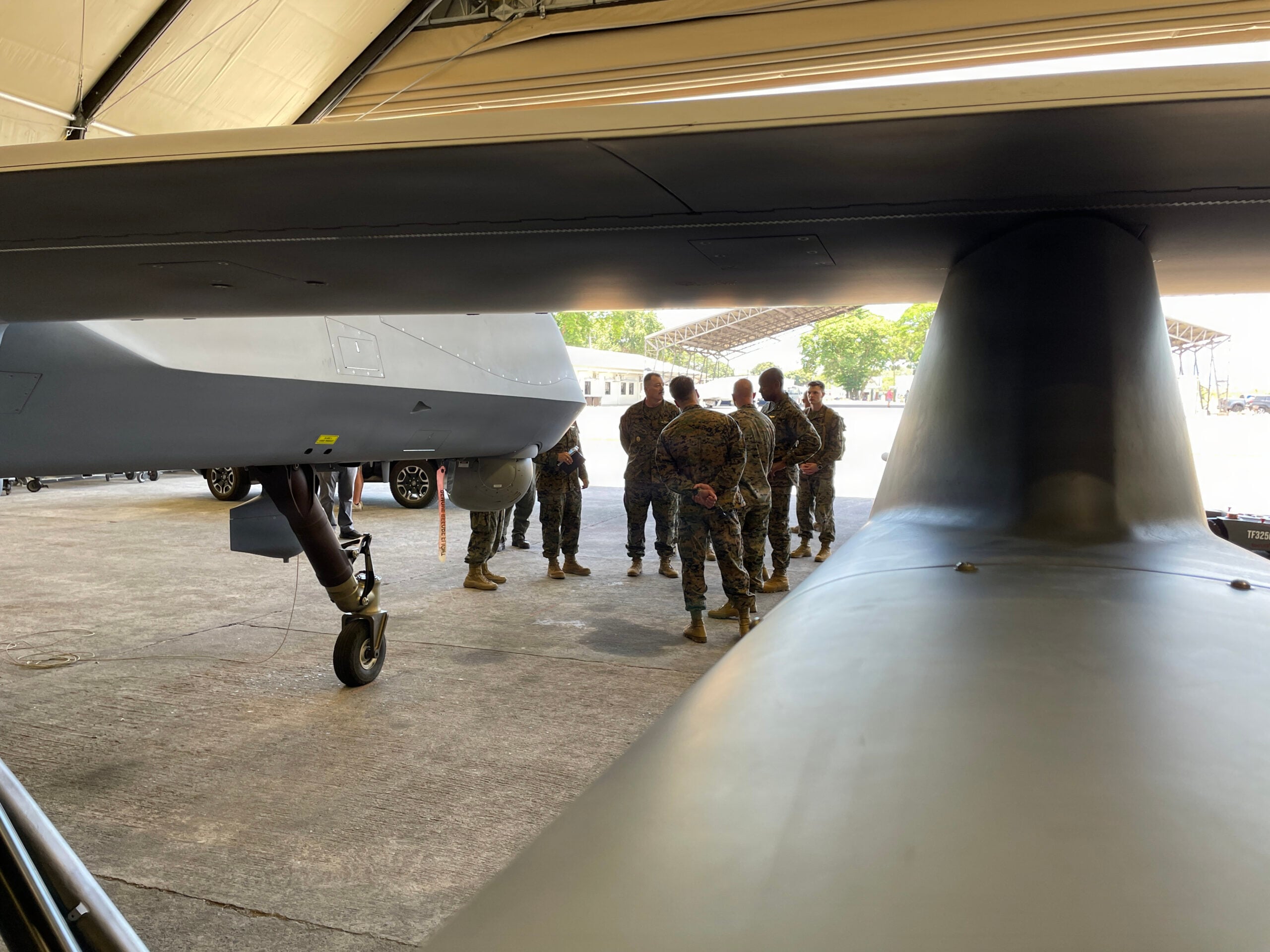
The entry of an aircraft carrier or amphibious readiness group into the South China Sea sends a strong political signal, but it also comes at a high cost. Ongoing conflicts in the Middle East strain U.S. military deployments, and the pressures of ship maintenance and personnel rotations are persistent. The U.S. Seventh Fleet cannot handle every maritime friction with large surface vessels. Drones, on the other hand, such as the MQ-9, are high-altitude, long-endurance platforms that can reportedly stay airborne for over 24 hours and can carry electro-optical, infrared, synthetic aperture radar, and communication relay equipment. In simple terms, they may not necessarily "win" anything, but they are well-suited for long-term monitoring.
This poses a problem for the PLA, as increased reconnaissance density makes it easier for the Navy and Coast Guard's daily operations to be recorded, located, and forwarded in real-time. In the past, when the U.S. sent P-8A patrol aircraft or destroyers close to the area, the PLA could respond tactically through escorting, warnings, and route pressure; unmanned platforms, however, turn the issue into a continuous electromagnetic and data link confrontation. Driving away one drone does not equate to severing the entire surveillance chain.
The Significance of Philippine Nodes is Underestimated
Basa Air Base, northern Luzon airports, and newly established access points between the U.S. and the Philippines have real value not just because they are "close to Taiwan" or "close to the South China Sea," but because they allow the U.S. military to push forward sensors, maintenance, fuel, and data processing. For drones, the location of airports determines loiter time, ground links determine intelligence transmission speed, and spare parts inventory determines mission frequency. From a logistical perspective, this is a logistics issue, not a mapping issue.
From China's perspective, if the U.S. military treats the Philippines as a relay station for unmanned reconnaissance, the northern South China Sea, the Bashi Channel, and the southeast direction of Taiwan could be integrated into the same ISR network. The PLA's Eastern Theater Command and Southern Theater Command's maritime and aerial activities, especially aircraft carrier groups, amphibious fleets, and long-range training routes, will face more continuous external observation. This does not mean the U.S. can grasp all targets in real-time, but it will compress the PLA's space to create uncertainty through weather, sea conditions, and route changes.
China's Drone Industry Advantages Also Bring Reverse Pressure
Interestingly, on the same day, another report from the South China Morning Post mentioned that there is still controversy in the U.S. regarding restrictions on Chinese-made drones. U.S. public safety departments heavily rely on Chinese commercial drones, highlighting an old issue: the U.S. wants to "decouple from China" in military-civilian dual-use unmanned systems, but it is difficult to completely replace them with domestic products of equivalent cost and scale in the short term. This industrial reality poses pressure on the U.S. and is not purely good news for China.
China has scale advantages in civilian drones, low-cost sensors, lithium batteries, and small flight controls, providing a supply chain foundation for the PLA's development of tactical unmanned systems. However, in a high-intensity confrontation environment like the South China Sea, what is needed is not consumer-grade quadcopters, but rather anti-jamming data links, satellite communications, maritime identification algorithms, and cross-service intelligence integration. A commonly overlooked shortcoming is that a cheap platform does not mean a cheap system. The real cost lies in getting hundreds or thousands of sensors to send data to the correct command nodes.
The PLA's Focus is Not on Shooting Down Drones
If the issue is understood as "shoot down one drone for every one that comes," it is too simplistic. The South China Sea is not a full-scale war scenario; the political cost of shooting down a U.S. drone is very high, especially when it takes off from the direction of the Philippines and flies along the edge of disputed waters. A more realistic response will focus on three types of capabilities:
- Electronic reconnaissance and signal positioning to understand the rhythms of drone links, relay stations, and ground stations;
- Low-visibility maritime operations, including radio silence, decoy targets, and formation camouflage;
- Counter-drone suppression measures, from shipborne electronic warfare to directed energy devices, primarily used for deterrence during crisis escalation.
This is also why I am not inclined to interpret the decrease in U.S. FONOPs as "the U.S. is retreating." The reduced appearance of large vessels may simply mean that the front-line actions are handed over to allied vessels and unmanned reconnaissance, while the backend data links are retained by the U.S. military. What the U.S. values most may not be each public transit, but whether it can establish a baseline of target activity for several consecutive weeks before a crisis erupts.
The South China Sea Strategic Situation Awareness Program states that regardless of how the U.S. government adjusts its strategy, the Asia-Pacific, especially the South China Sea, will remain one of the most critical strategic theaters for the U.S. military, and forward operations may become more aggressive and provocative.
For the PLA, the pressure in the South China Sea in 2026 is not just about a few more U.S. ships, but rather that the opponent has lowered the cost of "seeing you." The Fujian ship, Type 076, and various long-range training exercises will attract attention, but the more fundamental question is: Can China still maintain sufficient maneuverability, concealment, and operational surprise in an increasingly transparent maritime and aerial environment? This question currently has no answer.
The U.S. military is shifting its reconnaissance focus in the South China Sea towards MQ-9 drones and increased operations from Philippine bases. This change reflects a strategic move to enhance surveillance capabilities while reducing reliance on naval vessels. The number of U.S. freedom of navigation operations has decreased, indicating a shift in approach to monitoring Chinese military activities in the region.
- U.S. military reconnaissance in the South China Sea is increasingly relying on MQ-9 drones.
- The number of U.S. freedom of navigation operations has decreased, with only 2 reported in the past year.
- Philippine bases are becoming critical for U.S. military operations in the region.
- The shift from naval vessels to drones allows for more persistent surveillance.
- China's military activities are under increased scrutiny due to enhanced U.S. reconnaissance capabilities.