
U.S. Space Force taps California startup for orbital nuclear reactor
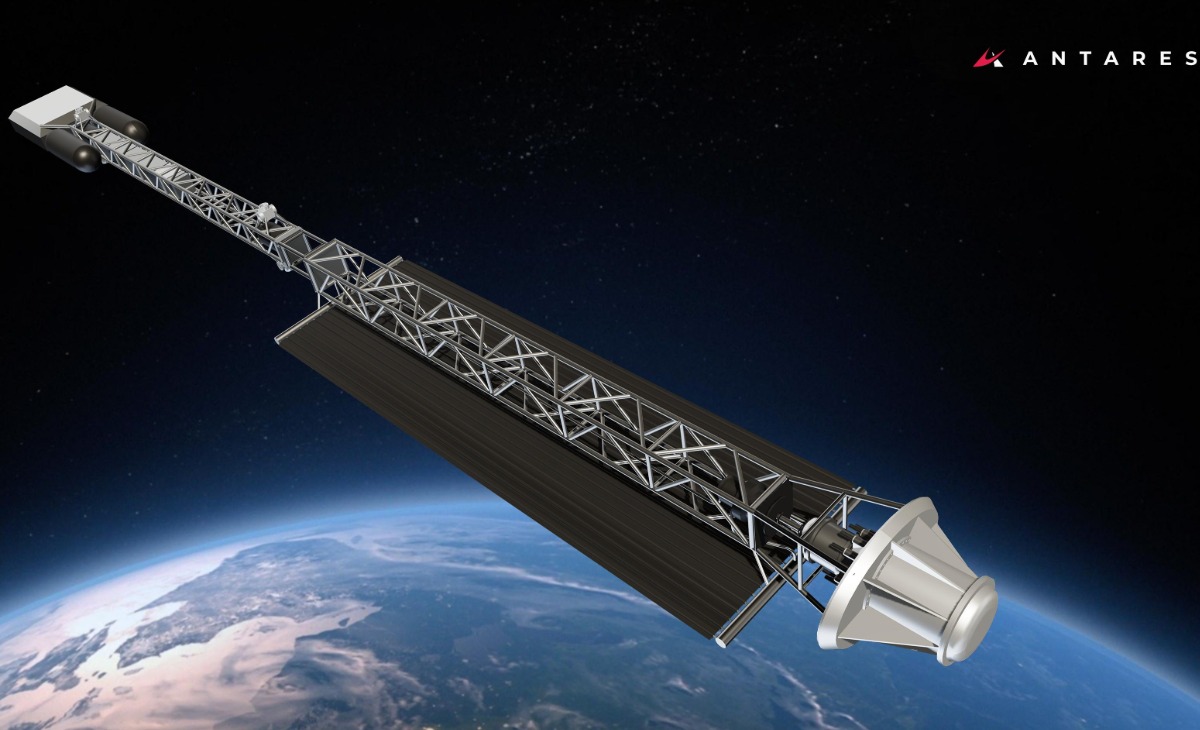 Image courtesy Antares
The Office of the Assistant Secretary of the U.S. Air Force for Space Acquisition and Integration has awarded a $161 million Strategic Breakthrough contract to Antares, a California nuclear startup, to advance a reactor design meant to power spacecraft. The company describes it as the largest Department of War award to date focused specifically on nuclear power in space.
The award covers two related efforts. Antares will run a nuclear ground demonstration of a reactor design called R1-S, then work toward integrating that reactor with a spacecraft ahead of an eventual flight. Separately, the company plans to power an operational ground-to-space asset using Mark-1, an electricity-producing reactor scheduled to begin testing in 2027.
“Space has been core to the Antares thesis since the company was founded,” said Jordan Bramble, CEO and co-founder of Antares. “This partnership with the Space Force turns that long-held vision into a codified space mission. Fission will unlock strategic capabilities that are impossible today.”
Most satellites today run on solar panels and batteries, which limit how much power is available onboard and how freely a spacecraft can maneuver without draining its reserves. A compact nuclear reactor would give a satellite continuous, high-output power instead, supporting heavier onboard computers, more aggressive orbital maneuvers, and power-hungry equipment such as directed-energy systems or electronic-warfare gear.
Antares already has a notable first to its name in this space. On June 4, 2026, the company’s Mark-0 reactor reached criticality, the point at which a nuclear reaction becomes self-sustaining, at Idaho National Laboratory. The test, conducted with the Department of Energy, the laboratory and nuclear fuel maker BWX Technologies, with the U.S. Army observing as a potential future user, made Antares the first private company to bring an advanced reactor to criticality under the Energy Department’s Reactor Pilot Program. It was also the first newly designed reactor to reach criticality at the Idaho site in more than 50 years.
That same reactor line feeds into more than one military effort. Data from the Mark-0 test is being shared with the Department of War’s Project Pele, a long-running program to build a transportable microreactor for military use, and Antares is also a supplier under the U.S. Army’s separate Janus Program, which is installing microreactors at bases including Fort Benning, Georgia.
Antares tied the new Space Force award to a presidential directive the company calls Executive Order 14369, “Ensuring American Space Superiority,” part of a broader government push, outlined in a policy document known as NSTM-3, to fly a nuclear reactor in space as early as 2028 and place one on the lunar surface by 2030.
Antares, founded in 2023 and based in Torrance, California, has raised more than $600 million and operates additional facilities in Idaho Falls, Idaho, and Aiken, South Carolina. The company has not disclosed a target launch date for the R1-S demonstration, named which spacecraft or mission it might eventually support, or said how the $161 million award is divided between the ground demonstration and the Mark-1 testing effort.
Content preview only. Full article available at source. View Full Article
The U.S. Space Force awarded a $161 million contract to Antares to develop a nuclear reactor for spacecraft. Antares will conduct a ground demonstration of the R1-S reactor and plans to test the Mark-1 reactor by 2027. This initiative is part of a broader effort to enhance military capabilities in space, with goals to deploy a nuclear reactor in space by 2028.
- Antares awarded a $161 million contract by U.S. Space Force.
- The contract focuses on advancing a nuclear reactor design for spacecraft.
- Antares plans to conduct a nuclear ground demonstration of the R1-S reactor.
- The Mark-1 reactor is scheduled for testing in 2027.
- Antares aims to fly a nuclear reactor in space by 2028.