
US Virginia Block VI Contract Still Leaves AUKUS Short Three Submarines
 Marcus Chen
US Virginia Block VI Contract Still Leaves AUKUS Short Three Submarines
The number is $76.6 billion. That sounds like the answer to America's submarine problem until the arithmetic catches up with the headline.
According to USNI News, the U.S. Navy has awarded General Dynamics Electric Boat and HII contracts for nine Block VI Virginia-class attack submarines, material for a tenth Virginia, five Build II Columbia-class ballistic missile submarines, and roughly $5 billion in workforce improvements. The award follows nearly three years of delay. It is the biggest shipbuilding award in modern American history, as Rep. Joe Courtney described it, and it gives the submarine industrial base a demand signal into the late 2030s.
It does not prove that the United States can build enough submarines for itself and still transfer three in-service Virginia-class boats to Australia under AUKUS in the 2030s. It proves Washington has finally signed the check.
The Contract Buys Capacity but Not Time
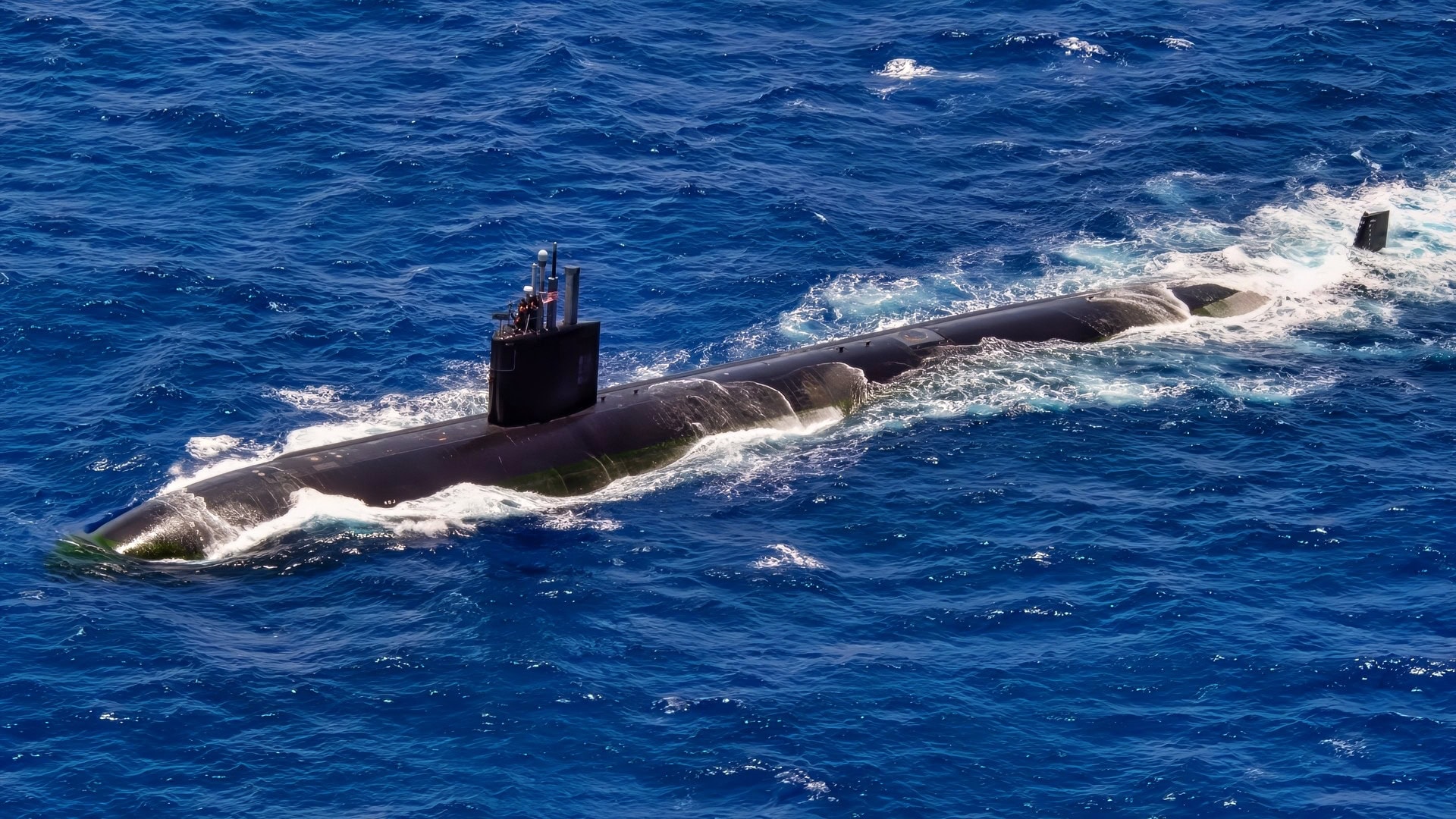
The split matters. USNI reported $42.1 billion for the Block VI Virginia boats, $29.5 billion for the next five Columbia-class nuclear ballistic missile submarines, and $5 billion for workforce investments. Electric Boat and Newport News Shipbuilding build both submarine families. HII builds bows, sterns, and other modules. Electric Boat builds the central barrel, including the reactor compartment and, for Columbia, the missile-tube section for Trident II D5 missiles.
That shared production system is the bottleneck. The Columbia-class program has priority because it replaces the sea-based leg of the nuclear triad. The first boat, District of Columbia, is supposed to deliver by March 2029, followed by Wisconsin in April 2030, according to Navy budget estimates cited by USNI. The Virginia-class force, meanwhile, is the one that has to hunt Chinese submarines, escort high-value units, support special operations, and provide land-attack firepower from inside contested waters.
A Virginia with the Virginia Payload Module carries more strike volume than earlier boats. The Block VI submarines will be the second group configured with that payload module, able to carry Tomahawk Land Attack Missiles and, in future, the Navy's planned hypersonic long-range strike missile. In an Indo-Pacific fight, that is not a nice-to-have feature. It is one of the few survivable ways to put missiles inside the first island chain after air bases and surface ships are under pressure.
The AUKUS Math Is Still Uncomfortable
AUKUS depends on three linked assumptions. First, the U.S. Navy can stabilize its own Virginia production. Second, it can spare three in-service Virginia-class submarines for Australia in the 2030s without hollowing its own force. Third, Australia can absorb nuclear-powered submarines fast enough to make the transfer operationally useful.
The new contract helps the first assumption. It does little for the second.
Washington wants to build roughly two Virginia-class attack submarines per year. Recent performance has been below that. Even if the Block VI contract creates a stronger demand signal, the boats still need welders, pipefitters, nuclear-qualified labor, suppliers, and yard throughput. USNI notes that workforce shortages and wage pressure have been major drivers of cost growth since the pandemic, with shipyards competing against other industries for labor. Anyone who has served on a ship knows what that means in practice: schedules fail at the lowest level, not in the PowerPoint. A missing specialist delays a module. A late module delays a boat. A late boat changes force posture.
Three in-service Virginias for Australia are not just three hull numbers. They are deployment cycles, maintenance windows, crews, spares, and command attention. If those boats leave the U.S. inventory before replacement capacity is truly stable, the Pacific Fleet pays the bill. AUKUS then becomes a transfer of undersea scarcity, not an expansion of allied undersea power.
China Does Not Need to Match the U.S. Boat for Boat
The People's Liberation Army Navy does not have to replicate U.S. submarine quality to exploit this gap. It only has to make the Western Pacific more expensive to enter and harder to sustain. Chinese anti-access systems, maritime patrol aircraft, seabed sensors, surface combatants, and conventional submarines all push U.S. commanders toward the assets that can survive: SSNs, stealth aircraft, long-range missiles, and distributed unmanned systems.
That is why the Virginia backlog matters more than a normal procurement delay. In a Taiwan contingency, attack submarines would be among the first U.S. platforms asked to operate west of Guam with a realistic chance of remaining hidden. They would also be asked to do too many missions at once: track Chinese nuclear submarines, hold surface ships at risk, launch land-attack missiles, gather intelligence, and protect carrier and amphibious forces operating farther east.
A single Block VI Virginia can bring more strike capacity than earlier boats, but it cannot be in the Luzon Strait, the Philippine Sea, and the South China Sea at the same time. The Indo-Pacific is a geography problem before it is a procurement problem.
The Contract Is Necessary and Still Not Enough
There is a reason Navy leaders are calling the award historic. Without multiyear commitments, suppliers hesitate, yards delay hiring, and training pipelines lag. The $5 billion workforce piece may be as important as the hull contracts themselves because submarine construction is labor-constrained before it is politically constrained.
But a demand signal is not a delivered submarine. The Block VI contract locks in intent; it does not recover the three-year delay by itself. Nor does it answer the central AUKUS question: whether America can expand its own attack submarine fleet, recapitalize nuclear deterrence, and sell Australia three Virginias on roughly the same timeline.
The hard part is not deciding that undersea superiority matters. Everyone in Washington can agree on that. The hard part is producing enough steel, skilled labor, and reactor compartments to make the strategy real.
This award is good news for the U.S. Navy. It is also a warning. If the industrial base cannot turn $76.6 billion into predictable delivery rates, AUKUS remains exposed to the same problem it has had from the start. The politics are ahead of the shipyards.
The U.S. Navy awarded contracts totaling $76.6 billion for the construction of nine Block VI Virginia-class submarines and five Columbia-class submarines, addressing production delays. This contract aims to stabilize submarine production but raises concerns about the ability to transfer three Virginia-class submarines to Australia under the AUKUS agreement. The report highlights the challenges posed by workforce shortages and the strategic implications of U.S. submarine capabilities in the Indo-Pacific region.
- U.S. Navy awarded contracts worth $76.6 billion for submarine construction.
- Contracts include nine Block VI Virginia-class submarines and five Columbia-class submarines.
- The production bottleneck is due to shared facilities between submarine classes.
- AUKUS agreement relies on U.S. Navy's ability to stabilize Virginia-class production.
- China's naval capabilities are increasing, impacting U.S. operational strategies.