
"Using a Shield to Nurture a Spear"? Japan is Engaging in Dangerous Actions Again
【Global Times Report by Reporter Guo Yuandan】Recently, foreign media reported that the first ship of Japan's newly built "Aegis-equipped ship" has had its massive main mast installed. In addition, Japan's "Takanami" destroyer, equipped with "Tomahawk" missiles, has recently returned to Japan. Military experts interviewed by the Global Times stated that Japan, under the guise of "missile defense," is pursuing aggressive military expansion, increasingly unmasking its ambition to break free from the constraints of its pacifist constitution. A series of actions by Japan will impact the strategic balance in the Asia-Pacific region, causing substantial damage to regional peace and stability.
The U.S. "Power" website's "Theater" channel reported on August 31 that the construction of Japan's Maritime Self-Defense Force's new type of destroyer, the "Aegis-equipped ship" (ASEV), is progressing, with the recent installation of a large integrated main mast. In the future, the four large fixed array faces of the AN/SPY-7 radar will ultimately be integrated into this structure. According to the Japanese Ministry of Defense's plan, this "Aegis-equipped ship" is expected to be launched in the fiscal year 2026 and enter service in 2027.
The ASEV is classified as a large surface combatant, measuring approximately 189 meters in length, with a maximum beam of about 25 meters and a standard displacement of 12,000 tons. In terms of armament configuration, the ASEV will be equipped with a 64-cell vertical launch system at both the bow and stern, totaling 128 cells. Initially, it is expected to be armed with different variants of the "Standard-3" and "Standard-6" missiles.
Military expert Zhang Junsha stated on the 1st to Global Times reporters that the Japanese "Aegis-equipped ship" is essentially a substitute product after the land-based "Aegis" program was hindered—Tokyo has "transplanted" the land-based missile defense system originally intended for Yamaguchi and Akita prefectures onto a 10,000-ton vessel. According to experts, from an equipment capability perspective, this ship indeed has significant advantages in maritime missile defense and long-range deployment.
The capabilities of the ASEV are merely the surface; the more critical aspect is its strategic implications. Japan deliberately elevates this ship from the "destroyer" level to "missile cruiser" (CG hull number), "reviving the term 'cruiser' for the first time since World War II with a large-tonnage hull design, circumventing the pacifist constitution's restrictions on large offensive vessels, and paving the way for the replacement of maritime main force platforms to facilitate 'remilitarization.'" Zhang Junsha analyzed that nominally it is a "defensive missile defense ship," but in reality, the 128 vertical launch cells can be mixed with U.S.-made "Tomahawk" cruise missiles, providing capabilities for precision strikes against land and sea targets beyond the defense zone. "This approach of 'using a shield to nurture a spear' is a preemptive military expansion disguised as missile defense, which has severely impacted the bottom line of 'exclusive defense' and the constraints of the pacifist constitution."
Additionally, reports indicate that the core mission of the ASEV is ballistic missile defense, but Japanese officials plan to add anti-drone, anti-ship, and land strike capabilities to the ship in the future, with "Tomahawk" cruise missiles also set to be included in the ship's armament configuration.
In addition to the two "Aegis-equipped ships" currently under construction, all future Japanese Aegis destroyers will be equipped with "Tomahawk" cruise missiles.
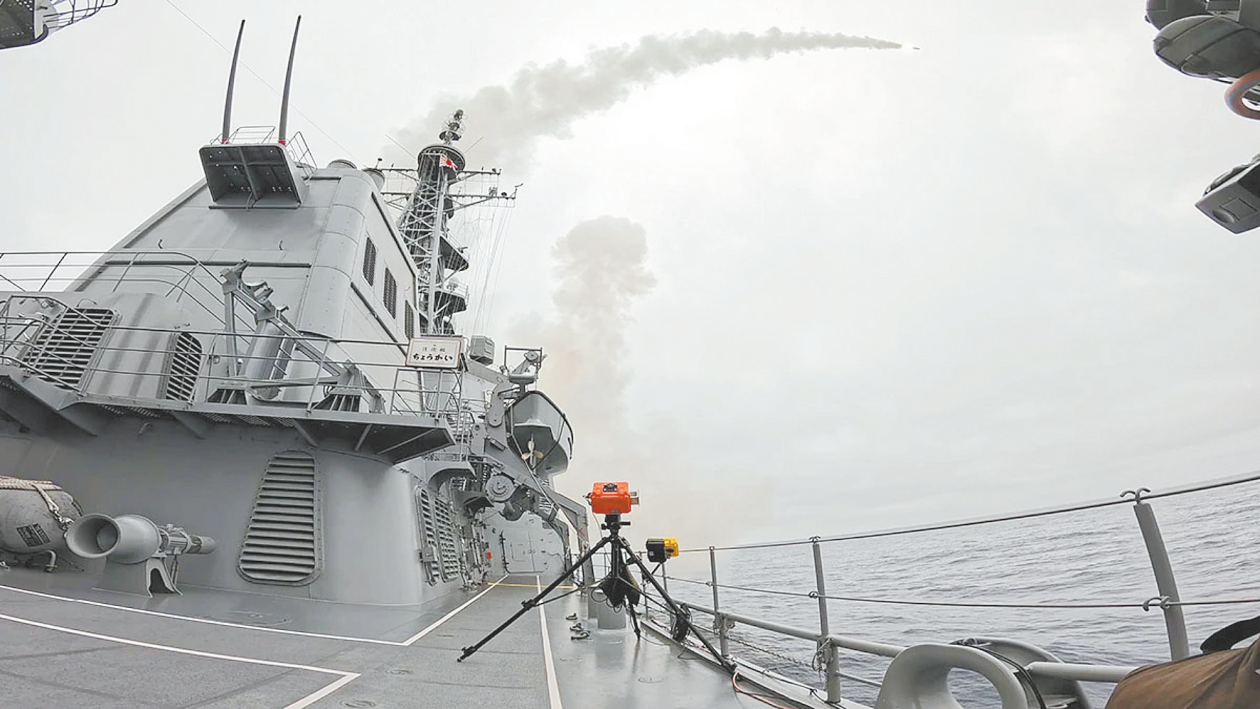
On August 30, Japan's Kyodo News reported that the Japanese Maritime Self-Defense Force's Aegis ship "Takanami," which had been stationed in the U.S. for a long time, returned to its home port at Sasebo base. This ship is the first of Japan's vessels to undergo modification to carry "Tomahawk" cruise missiles in the U.S. On July 28, the ship conducted a live-fire test of the "Tomahawk" cruise missile in the Pacific Ocean near the U.S. Japan has ordered approximately 400 "Tomahawk" missiles from the U.S., and deliveries have already begun.
Zhang Junsha stated that with the acquisition of "Tomahawk" cruise missiles, Japan's offensive combat capabilities will be significantly enhanced. "Japan has long surpassed the bottom line of 'self-defense' and 'exclusive defense,' tearing off the mask of being a 'peaceful nation' that it has long self-proclaimed, indicating that this country, which often presents a facade of 'peaceful development,' is desperately trying to break free from the shackles of the pacifist constitution, racing down a narrow path of highly dangerous military expansion."
Japan is expanding its military capabilities by constructing Aegis-equipped destroyers, with the first ship expected to launch in 2026. The Japan Maritime Self-Defense Force is integrating Tomahawk missiles into its fleet, significantly enhancing its offensive capabilities. This development raises concerns about regional stability and Japan's adherence to its pacifist constitution.
- Japan is constructing Aegis-equipped destroyers with significant missile capabilities.
- The first ship is expected to launch in fiscal year 2026 and enter service in 2027.
- Japan has ordered approximately 400 Tomahawk missiles from the U.S.
- The destroyers will enhance Japan's offensive military capabilities, moving beyond self-defense.
- Japan's military expansion is seen as a challenge to regional stability.