
USS George Washington's 2026 Vietnam Visit Cannot Buy Basing Access
 Marcus Chen
USS George Washington's 2026 Vietnam Visit Cannot Buy Basing Access
Five thousand sailors in Da Nang is a useful signal. It is not a war plan.
The U.S. Pacific Fleet said the Nimitz-class carrier USS George Washington (CVN-73), Carrier Air Wing 5, the guided-missile cruiser USS Robert Smalls (CG-62), and the destroyer USS Shoup (DDG-86) arrived in Da Nang on July 30 for a scheduled port visit. USNI News' Aug. 3 fleet tracker placed the carrier in Vietnam and noted that the strike group is on its first patrol of 2026. The Diplomat counted this as the fourth U.S. carrier visit to Vietnam since USS Carl Vinson made the first post-normalization call in 2018.
That sequence matters. Four carrier visits in eight years, plus the Tripoli Amphibious Ready Group visit in December 2025, show that Hanoi is increasingly willing to host visible American naval power. But the operational question is narrower and harder: if a Taiwan or South China Sea crisis started tomorrow, what does a five-day port call actually give U.S. Pacific Command?
The answer is less than the optics suggest.
A Carrier Visit Is Access Theater
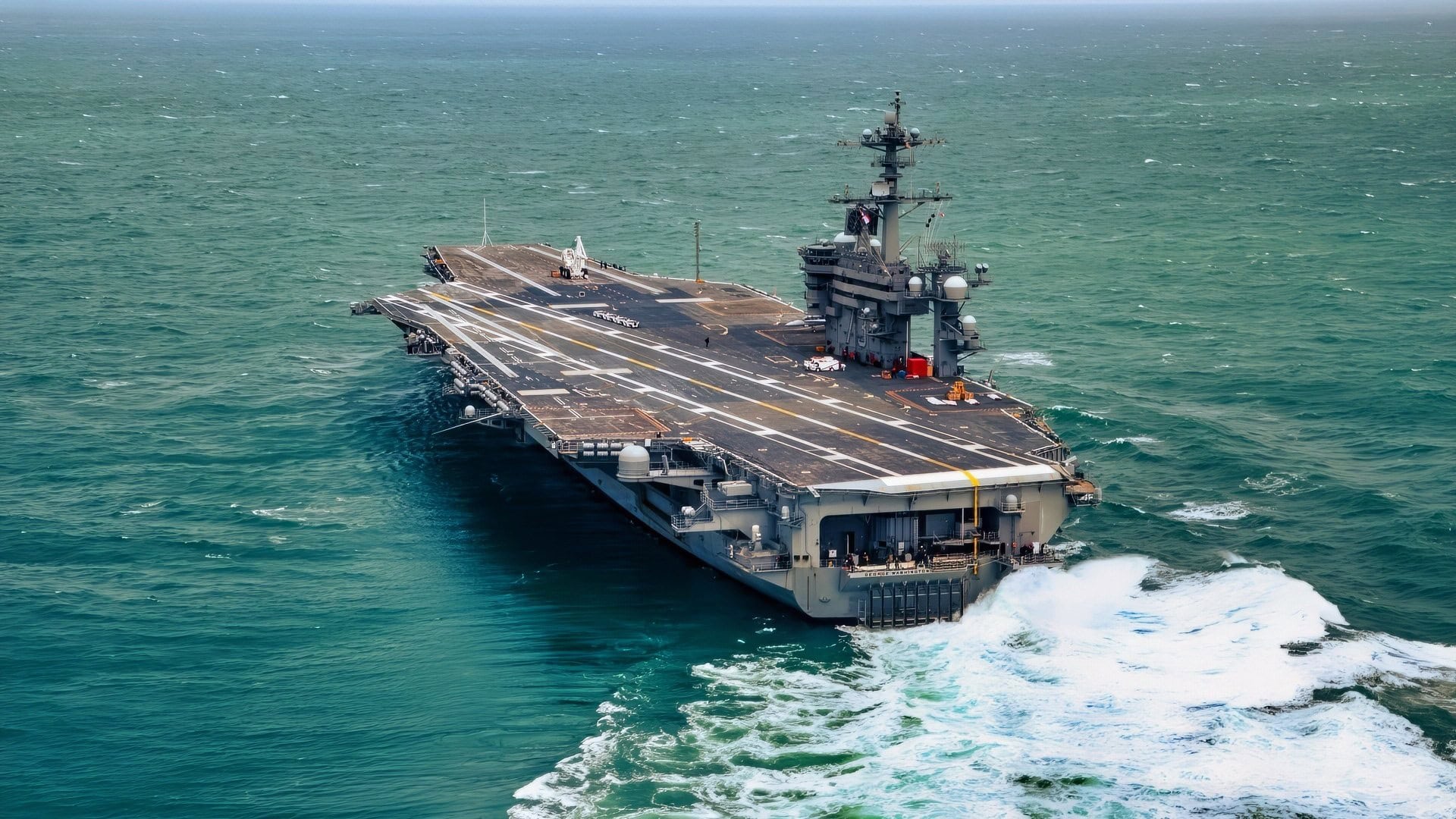
A carrier strike group is still the most visible single unit the U.S. Navy can send. George Washington is the forward-deployed carrier based in Japan, which means Washington does not need to move a carrier from San Diego or Norfolk to put a flattop west of Guam. With Carrier Air Wing 5 embarked, it brings fighters, electronic attack aircraft, airborne early warning, helicopters, escorts, sensors, and a mobile command node into one package.
That is real capability. It is also fragile capability when treated as a substitute for geography.
Da Nang sits roughly 600 nautical miles from the southern reaches of the South China Sea and about 900 nautical miles from the Luzon Strait, depending on routing. From a map, Vietnam looks like valuable central terrain. From a deckplate view, port access does not automatically mean fuel, weapons handling, battle damage repair, protected dispersal, or permission to generate combat sorties from Vietnamese territory during a fight. Anyone who has served on a destroyer knows the difference between a liberty port and a logistics hub. The first raises the flag. The second keeps ships shooting.
Vietnam is offering the first, carefully. It is not offering the second.
Hanoi Is Signaling Without Signing Up
Vietnam has strong reasons to welcome George Washington. China has pressed Vietnam at sea for years, especially around energy exploration and disputed waters. A U.S. carrier in Da Nang reminds Beijing that Vietnam has options. It also gives Hanoi diplomatic leverage without forcing a treaty commitment it does not want.
The Pacific Fleet statement framed the visit around the Comprehensive Strategic Partnership established in 2023, community events, leadership engagements, and shared interest in a free and open Indo-Pacific. U.S. Ambassador Jennifer Wicks called it the fourth U.S. aircraft carrier visit to Da Nang and linked it to recent Pacific Partnership and Pacific Friendship activity. Capt. Nicholas DeLeo, the carrier's commanding officer, put it plainly: the ship represents high-end Navy capability, but the visit supports a relationship growing across a wider range of subjects.
That is the right diplomatic language. It is also a warning label for planners who want more from Vietnam than Vietnam is prepared to provide.
Hanoi's defense policy still rests on avoiding formal alignment. Vietnam wants American presence as balance, not American basing as a trigger. It wants access to training, coast guard support, maritime awareness, and high-level military contact. It does not want to become Subic Bay with Vietnamese characteristics.
Washington should be clear-eyed about that. A port call does not solve the central U.S. problem west of the International Date Line: too much combat power depends on too few fixed locations, especially Japan, Guam, and a small number of Philippine sites whose wartime usability would depend on politics, survivability, and lift.
The Math Still Runs Through Japan and Guam
The useful comparison is not Vietnam versus no Vietnam. It is Vietnam as an occasional access point versus Japan and Guam as hard military infrastructure.
A carrier operating from the Philippine Sea or South China Sea can move aircraft around the board, but it must protect itself while doing so. The Chinese anti-ship missile inventory is built for this exact problem: force U.S. carriers to operate farther out, complicate sortie generation, and make every replenishment cycle a targetable event. A Nimitz-class carrier can move fast, but its escorts, oilers, ammunition ships, and aircraft maintenance requirements define endurance more than the carrier's top speed does.
If the U.S. Navy wants sustained combat power near Taiwan, George Washington helps most as part of a larger network: Kadena, Iwakuni, Yokosuka, Guam, mobile logistics ships, dispersed Marine and Air Force nodes, and allied ports that can handle repair and reload. Vietnam is not yet inside that network in a wartime sense.
This is where the public narrative often gets sloppy. Commentators see an American carrier in Vietnam and read it as a major new military alignment. It is better understood as controlled signaling. Hanoi is comfortable showing China that the U.S. Navy is welcome for visits. It has not shown that U.S. naval forces would be allowed to stage combat operations, reload missiles, or sustain a blockade-breaking campaign from Vietnamese facilities.
Useful Signal, Limited Leverage
The port call still has value. Naval diplomacy is not fake just because it is not basing. It builds habits between officers, gives both governments a visible success after trade friction, and normalizes U.S. carrier presence in a country that once treated such visits as politically impossible. The Diplomat noted that the visit came despite tariff tensions and scrutiny over Chinese transshipment through Vietnam. That makes the timing more interesting: defense ties are now resilient enough to survive a rough commercial patch.
But resilience is not the same as alliance. The U.S. should not pretend a five-day visit changes the Western Pacific force balance. China can count port calls too. Beijing will see the symbolism and complain, but Chinese planners will care more about whether U.S. forces can reload, repair, disperse, and keep aircraft and missiles flowing after the first week of a crisis.
That is where the U.S. position remains thin.
George Washington in Da Nang is a good photograph and a useful diplomatic event. It tells Beijing that Vietnam is not isolated and tells Washington that Hanoi is willing to move a few steps closer. But it does not buy basing access, it does not create a new logistics sanctuary, and it does not shorten the U.S. Navy's kill-chain and sustainment problems in a Taiwan fight.
The visit matters because it shows how far U.S.-Vietnam defense ties have come. It matters just as much because it shows where they still stop.
USS George Washington and its strike group visited Da Nang, Vietnam, on July 30, 2026, with 5,000 sailors aboard. This visit marks the fourth U.S. carrier presence in Vietnam since 2018, signaling Vietnam's willingness to host U.S. naval power. However, Vietnam is not offering basing access, focusing instead on diplomatic engagement and maintaining a balance in its relations with China.
- USS George Washington visited Da Nang on July 30, 2026.
- This is the fourth U.S. carrier visit to Vietnam since 2018.
- Vietnam is not offering basing access, only port visits.
- The visit is framed around the Comprehensive Strategic Partnership established in 2023.
- Vietnam seeks to balance relations with the U.S. without formal military alignment.