

The ships US Navy Sailors go to sea on today are mere shadows of their former selves. A modern aircraft carrier is all but fully air-conditioned; canned food is no longer the default in the mess, with spaces devoted to refrigerated and frozen foods. The racks sailors sleep in are no longer canvas hammocks or two-inch-thick feather mattresses. On board, water desalination plants provide enough fresh water for drinking, cooking, and showering more than once a week. During WWII, submarine sailors wore beards and bathed in seawater or in rain squalls because fresh water was in such short supply.
Modern communications allow Sailors to send and receive emails from home and even make ship-to-shore telephone calls to their families.
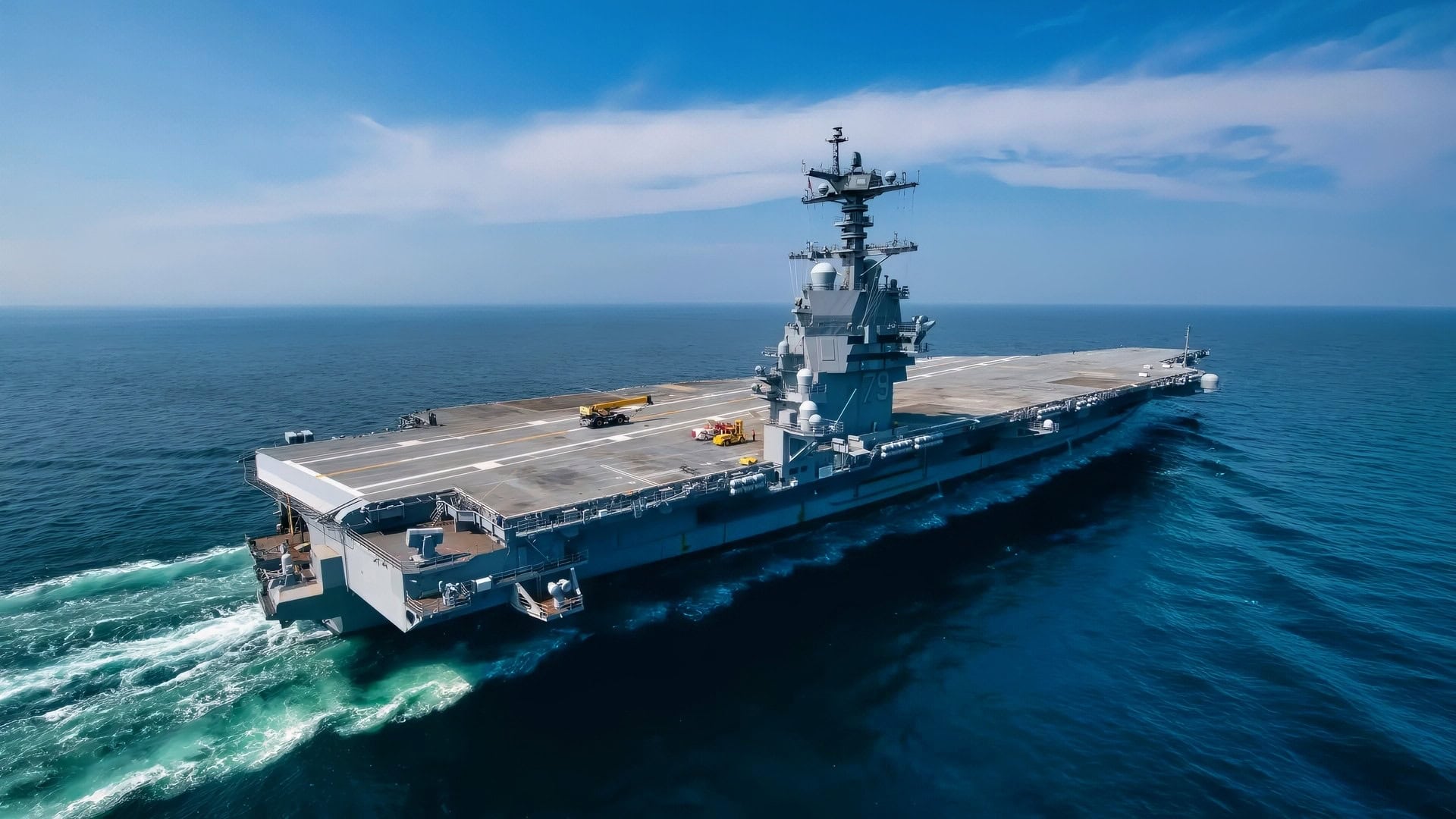
Ford-class Aircraft Carrier Industry Photo Handout
The Navy’s mastery of logistics combined with the almost limitless endurance of nuclear-powered vessels has cut the tether to shore bases for sustainment at sea.
As a result of these advances in crew comfort and ship sustainment, extending deployments well beyond six months is becoming the new normal.
The USS Never Docks Aircraft Carrier
Serving in the Navy, Sailors used a few terms for ships known for long deployments.
A ship that put to sea often after quick turnarounds in port might be called the “USS Haze-Gray-And-Underway” by her crew, but for carriers out for six months or more, keeping station halfway around the world, Sailors used a more precise and descriptive nickname: the “USS Never-Docks.”
In 1973, during the Vietnam War, the carrier USS Midway(CVA-41) set the all-time deployment record for the Navy at 322 days at sea.
That record remained unbroken for 48 years until 2021, when a combination of a routine deployment and the COVID-19 pandemic kept the carrier USS Nimitz (CVN-68) away from its homeport for 341 days.
Now, just 5 years later, both the USS Abraham Lincoln (CVN-72) and the USS Gerald R. Ford (CVN-78) came close to breaking the records set by the Midway and the Nimitz.
The Lincoln spent 302 days on deployment before ending it on the technicality of returning to Guam (and US territory) on September 19th, 2026.
The USS Gerald R. Ford(CVN-78) completed a 326-day deployment in May 2026, setting the Navy record for the longest post-Cold War deployment.
At this point, the USS Abraham Lincoln probably has earned the unofficial nickname “USS Never-Docks.”
If we look at the eleven longest carrier deployments since 1964, the USS Abraham Lincoln has made three of them in just the last seven years.
Six-Month Deployments No Longer Routine
Once upon a time, a 6-month deployment on an aircraft carrier was routine; it might extend by a couple of weeks due to exigencies that could not be anticipated, but it was reasonably consistent.
The reason, in large part, was that the US Navy was much larger than it is today.
With the end of the Cold War with the Soviet Union, the US reduced its number of Carrier Strike Groups from 15 Carrier Battle Groups(as they were called then) to 11 Carrier Strike Groups(as they are now called). We might have gone down to 10, but the Navy has put off retiring the Nimitz until the (delayed)USS John F. Kennedy is finished in 2027. That is a third fewer carriers facing the same number of commitments it had at the height of the Cold War.
More and more often, carrier deployments are running out to nine months and even 11 months.
These long deployments are not just a result of having fewer carriers at sea, but also a function of the Navy’s logistical ability to keep them at sea, supported by improved comfort features for their crews.
That doesn’t make it fun, and it doesn’t come without negative consequences for the crews of these ships and for the Navy as an organization.
The Prison That Can Sink And Drown You
It has been said that serving aboard a Navy ship is like being in a prison that can also sink and drown you.
The operations aboard a ship at sea are conducted 24 hours a day, 7 days a week.
The shifts are 12 hours a day, including meals. Under combat conditions, you might as well throw away the clocks. Days stretching to 18 or 20 hours will occur while operating under these conditions.
The result can be a crew of zombies going about their work without any sense of time or even what day it is; the days and hours just run together without the breaks in routine that mark the day in normal life ashore.
Some Sailors working below deck (especially in Engineering) can go for days or weeks without being on deck in sunlight. These all combine to create serious mental health issues that can result in self-harm.
Long deployments also lead to deferred maintenance on ships. Equipment can’t be overhauled and refurbished; additional wear and tear on aircraft can shorten the time between major refueling and complex overhauls of carriers, as they expend their nuclear fuel faster. It can also extend the time it takes to complete this overhaul.
This can also affect the Navy’s efforts to retain service members long-term. Deployments lasting 9-11 months are very hard on sailors with families. They come home to wives and children they have been away from for upwards of a year.
The prospect of being back home for a couple of months before having to return to sea for another 9-11 months will be too much for many of them. The extra pay for being at sea is a little more than $16 a day and has not increased since 2014.
To be certain, the US Navy exists to fight a war far from our shores (hopefully). To do so effectively, it must retain trained and experienced Sailors beyond their initial four- or six-year enlistment. There’s no amount of creature comforts or additional pay that could make these long deployments attractive to most of them.
The new Ford-Class aircraft carriers are vastly more powerful than the carriers they are beginning to replace, but having fewer, more capable ships that can deploy longer is at odds with retaining the crews needed to man them.
The obvious solution is to return to 15 Carrier Strike Groups.
About the Author: Sean Spoonts
Sean Spoonts is the former Editor-In-Chief of SOFREP.com. He is a military analyst, writer, and commentator whose work has appeared in Newsweek, CNS News, Ukrinform, and various military/veteran media networks and professional publications, including the Military Intelligence Professional Bulletin. He is a U.S. Navy veteran, having served as an Aviation Anti-Submarine Warfare Operator and Search and Rescue Helicopter Aircrewman.