

Summary and Key Points: USS Nimitz makes its own fresh water. Four distilling units draw in seawater, flash-boil it into steam, leave the salt behind, and condense about 400,000 gallons a day, roughly 80 gallons per sailor, for drinking, cooking, laundry, and showers. That system still failed in a different way. In September 2022, off Southern California, sailors said the water smelled and tasted like fuel. JP-5 aviation fuel had entered an unused tank about 18 months earlier. Eleven sailors got sick. All were treated on board and back on duty by the start of October.
How an Aircraft Carrier Produced Its Own Fresh Water
A Nimitz-class aircraft carrier can spend months at sea carrying more than 5,000 sailors, serving tens of thousands of meals every day and operating dozens of aircraft.
Keeping a ship of that size supplied with drinking water might therefore seem like a significant logistical challenge.
In reality, the U.S. Navy does not need to load enough fresh water aboard its nuclear-powered carriers to last an entire deployment. Instead, the ships simply make their own.
A Multi-Billion Dollar Vessel
Construction began on USS Nimitz in 1968, taking seven years and almost $2 billion ($12.5 billion in 2026) to complete before it was commissioned in May 1975.
At 1,092 feet long and displacing around 100,000 tons, the carrier helped establish the basic design that would dominate the U.S. Navy’s carrier fleet for the next half-century, with nine more commissioned through 2009.
Each carrier is powered by two nuclear reactors, allowing the ships to remain at sea for extended periods without the enormous quantities of conventional fuel that would otherwise be required to propel vessels of their size.
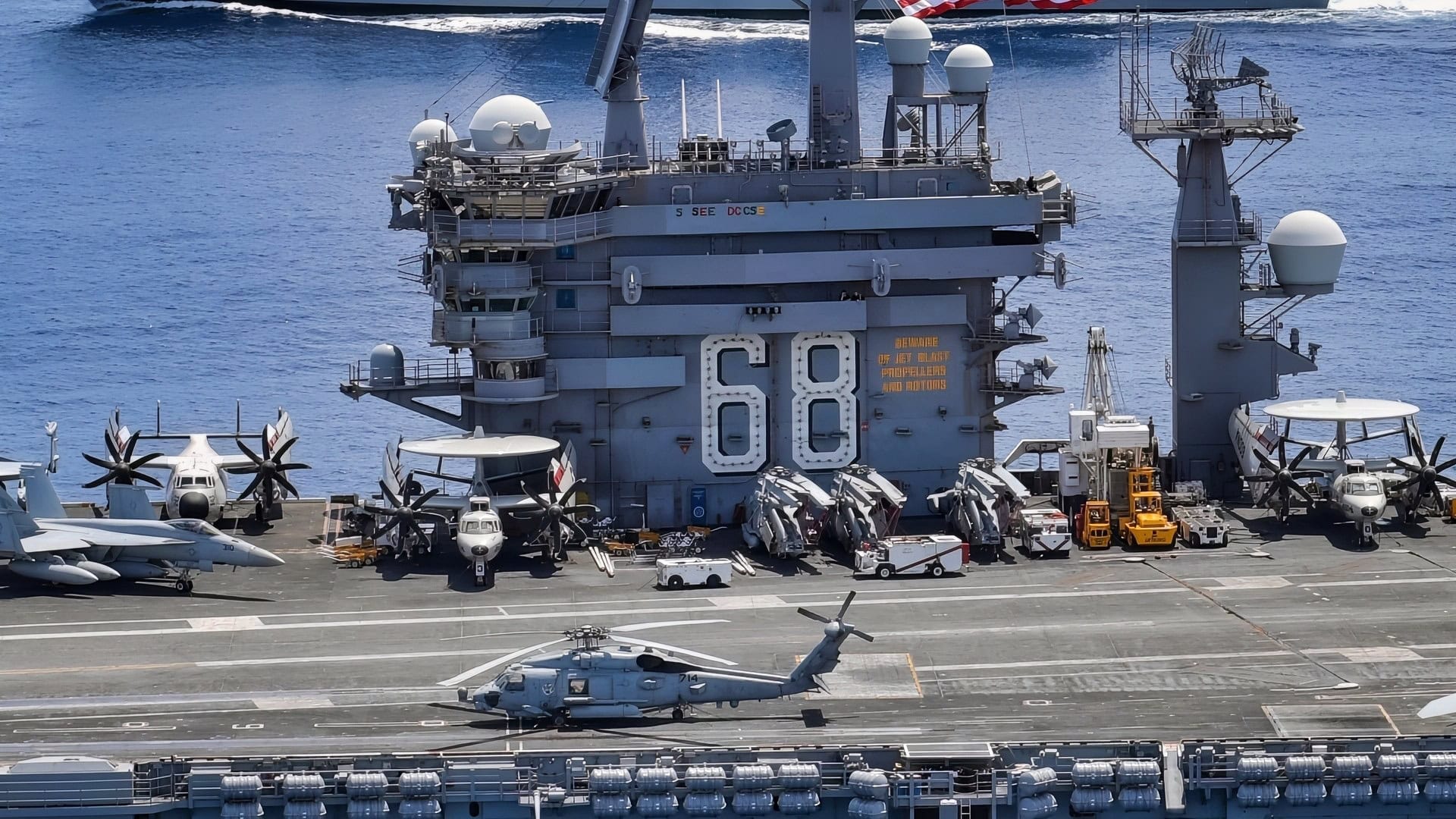
INDIAN OCEAN (July 20, 2020) The Nimitz Carrier Strike Group, consisting of flagship USS Nimitz (CVN 68), Ticonderoga-class guided missile cruiser USS Princeton (CG 59), and Arleigh Burke-class guided missile destroyers USS Sterett (DDG 104), and USS Ralph Johnson (DDG 114), along with Indian Navy ships Rana, Sahyardi, Shivalik and Kamorta, steam in formation during a cooperative deployment in the Indian Ocean July 20. (U.S. Navy photo by Mass Communication Specialist 3rd Class Jose Madrigal)
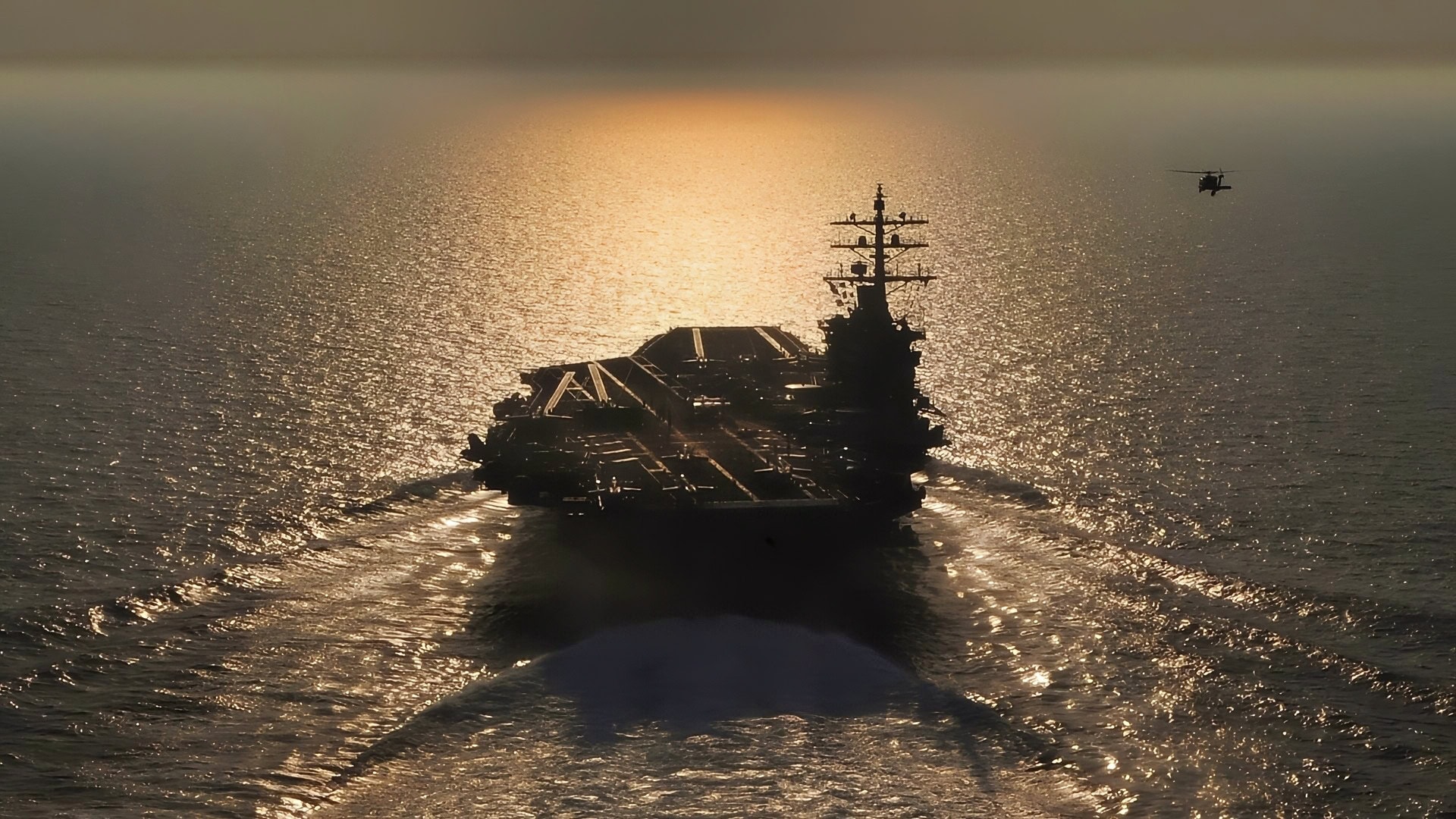
MEDITERRANEAN SEA (July 10, 2012) – An SH-60F Seahawk from the Nightdippers of Helicopter Anti-Submarine Squadron (HS) 5 flies alongside Nimitz-class aircraft carrier USS Dwight D. Eisenhower (CVN 69), July 10. Dwight D. Eisenhower is on a regularly scheduled deployment in support of Maritime Security Operations (MSO) and Theater Security Cooperation (TSC) efforts in the U.S. 5th and 6th Fleet areas of responsibility. IKE deployed as part of Eisenhower Carrier Strike Group (CSG), which includes CSG 8, IKE, guided-missile cruiser USS Hue City (CG 66), guided-missile destroyer USS Farragut (DDG 99), guided-missile destroyer USS Winston S. Churchill (DDG 81), USS Jason Dunham (DDG 109), the seven squadrons of Carrier Air Wing (CVW) 7, and Destroyer Squadron 28. (U.S. Navy photo by Mass Communication Specialist 2nd Class Julia A. Casper/Released)
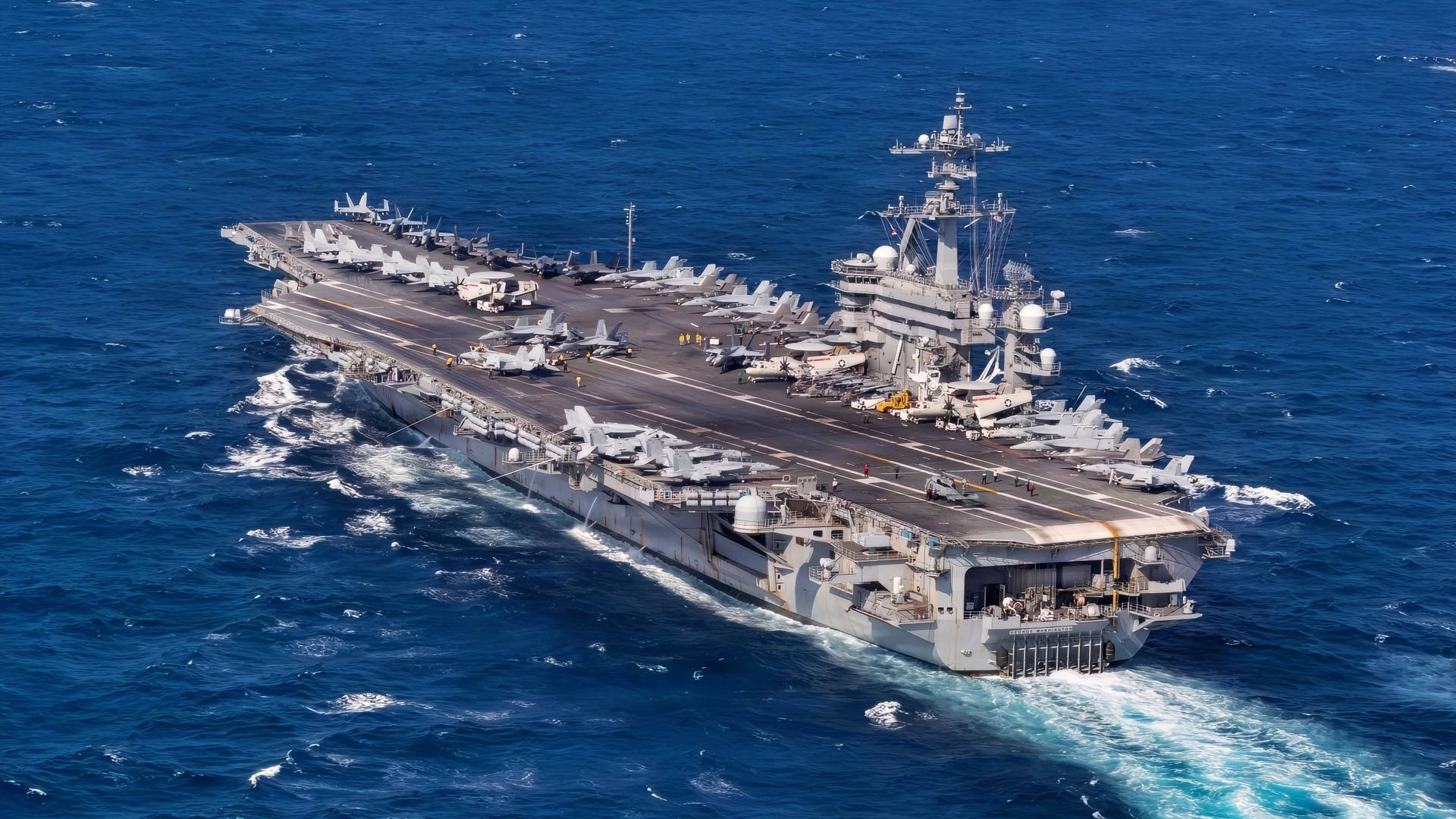
Nimitz-class aircraft carrier USS George Washington (CVN 73) operates in the South China Sea, Aug. 8, 2026. George Washington, operating in the U.S. 7th Fleet area of operations, is the U.S. Navy’s premiere forward-deployed aircraft carrier, a long-standing symbol of the United States’ commitment to maintaining a free and open Indo-Pacific, while operating alongside allies and partners across the U.S. Navy’s largest numbered fleet. (U.S. Navy photo by Mass Communication Specialist Seaman Anthony Vilardi)
Of course, the aircraft aboard need fuel, and the crew needs food, with up to 18,000 meals a day served onboard Nimitz. Fresh water, however, can be produced by the carrier itself.
A Complex Distilling System
Nimitz is capable of distilling 400,000 gallons of fresh water every day, providing 80 gallons each to the carrier’s 5,000 personnel. Of course, this is not limited to just drinking water. Fresh water is needed for meal preparation, laundry, cleaning, and for plumbing to allow showers to run and toilets to flush.
Using four distilling units, seawater is drawn into the ship and flash-boiled into steam, separating the salt before being condensed back into fresh water. Chemicals such as chlorine are then added to make the water safe before it is pumped into water tanks around the ship.
This remarkable system allows Nimitz to sail for far longer than otherwise could, as continual replenishment of fresh water negates the need for lengthy stopovers at port.
It also frees up supply vessels for other missions, meaning the nuclear-powered carrier can not only ensure long voyages but also keep its personnel fed and watered.
Contamination
Naturally, a nearly half-century-old vessel is bound to encounter problems at some stage in its life, and Nimitz’s water distillation system is no exception.
In September 2022, the carrier was operating off the coast of Southern California when sailors began reporting that their drinking water smelled and tasted like fuel. The crew secured access to the potable-water system and began testing its tanks, while bottled water was distributed aboard the ship.
A subsequent investigation found that JP-5 aviation fuel residue had entered an unused water tank nearly 18 months before the incident was first reported. 11 sailors became sick, all of whom were treated onboard the carrier before returning to duty by the start of October.
As a temporary measure, Nimitz relied on the City of San Diego’s water supply while Naval Air Station North Island was investigated. 22 of the ship’s 26 water tankers were below the recommended levels for JP-5 by October 1, with the remaining four cleaned, repaired, and inspected before being returned to service. From the initial report on September 16, the ship departed San Diego just over two and a half weeks later on October 2.
Forthcoming Retirement
More than half a century after entering service, USS Nimitz is now approaching retirement.
The Navy had originally planned to deactivate the carrier in May 2026, but earlier this year it extended Nimitz’s service life by around 10 months. It is now scheduled to be deactivated in March 2027, around the time the new Gerald R. Ford-class carrier USS John F. Kennedy is expected to enter the fleet.
The ship left Naval Base Kitsap-Bremerton for the final time in March 2026 and eventually arrived at Norfolk, Virginia, in July after sailing around South America. For the remaining months of its active life, the Navy is using Nimitz largely as a training carrier, allowing naval aviators to complete carrier qualifications. After deactivation, the far longer process of dismantling a nuclear-powered aircraft carrier will begin.
Nimitz’s retirement will mark the end of the career of a ship that entered service when Gerald Ford was president, making way for an entire generation of American aircraft carriers that bear his name.
About the Author: Shay Bottomley
Shay Bottomley is a British journalist. He has written for the Western Standard, Business Insider, Maidenhead Advertiser, Slough Express, Windsor Express, Berkshire Live and Southend Echo.