
USS Portland V-BAT Launch Shows US Amphibious ISR Can Survive in the South China Sea
 Marcus Chen
USS Portland V-BAT Launch Shows US Amphibious ISR Can Survive in the South China Sea
A 124-pound drone lifting off from USS Portland on June 17 matters more than another carrier photo opportunity. The aircraft was Shield AI's MQ-35A V-BAT, launched by Marines and supporting contractors from a San Antonio-class amphibious transport dock inside the South China Sea. It did not need a runway, a catapult, a hangar, or a large aviation detachment. That is exactly why the event deserves attention.
The United States has spent years talking about distributed maritime operations and expeditionary advanced base operations. Most of that language is too clean. The hard problem is simple: a commander in the first island chain needs eyes beyond the radar horizon without advertising the position of every manned aircraft, burning scarce aviation hours, or depending on fixed bases that China can target early. A small vertical-takeoff ISR aircraft does not solve that problem by itself. But it changes the cost curve.
The launch details matter
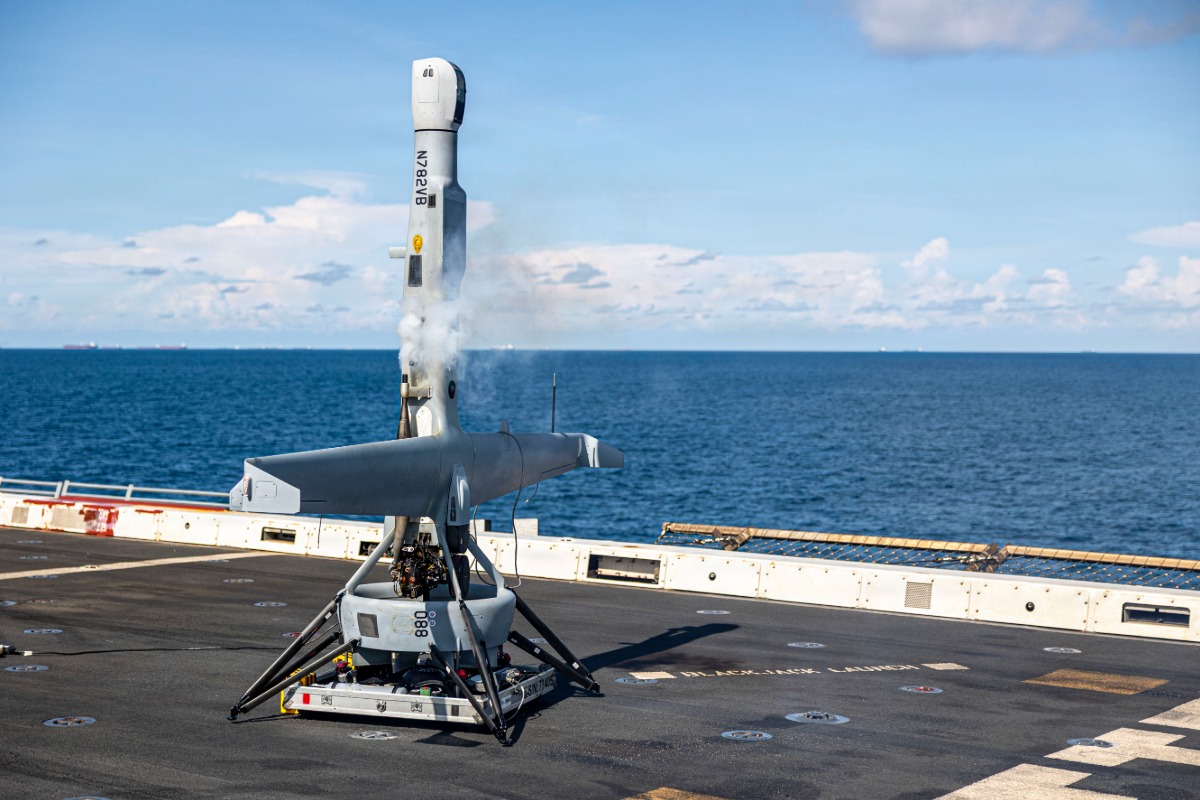
Defence Blog reported that the V-BAT launched from USS Portland while the ship operated with the Boxer Amphibious Ready Group. The 11th Marine Expeditionary Unit is embarked across USS Boxer, USS Portland, and USS Comstock, giving the group roughly 2,200 Marines, infantry, logistics, assault support, and aviation elements without requiring an airfield ashore.
The V-BAT is not a glamorous platform. Shield AI lists the aircraft at 12.5 feet of wingspan, 9.6 feet of height, and 161 pounds maximum gross takeoff weight. It can operate from a landing zone as small as 4.6 by 4.6 meters, according to the company, and uses heavy fuel compatible with naval logistics. The source report gave a more conservative deck-space figure of about 20 by 20 feet. Either way, this is not a runway aircraft pretending to be maritime.
The important number is endurance. A drone that can stay airborne for more than ten hours gives an amphibious ship something it usually lacks: persistent off-board sensing at modest cost. If a ship's radar horizon is roughly 20 to 25 nautical miles for low-altitude surface contacts, pushing a drone 70 nautical miles ahead turns a blind transit into a watched transit. That is not a strike capability. It is the difference between reacting late and having time to decide.
Why China should care about a small drone
China's South China Sea posture is built around layered presence. Coast guard ships, maritime militia, artificial island sensors, combat aircraft, shore-based missiles, and naval patrols create a picture in which Beijing tries to see first and force others to maneuver under observation. The US Navy usually answers that with larger symbols: destroyers, carrier strike groups, bombers, and maritime patrol aircraft.
The V-BAT points in a different direction. It makes the amphibious ship less dependent on scarce P-8A patrol aircraft or MQ-4C Triton coverage. It also lets a Marine commander watch a reef, a surface contact, or a choke point without launching an MV-22 or tying up a helicopter. Anyone who has served on a warship knows flight deck time is not abstract. Every launch has a maintenance cost, a fuel cost, and a safety risk. A small unmanned aircraft does not erase those costs, but it lowers them enough that commanders can afford to look more often.
That matters in a sea where ambiguity is the tactic. A militia vessel crossing a line, a coast guard ship shadowing a Philippine resupply run, or a PLAN surface group operating near a disputed feature rarely gives Washington a clean escalation ladder. Persistent ISR gives policymakers evidence. More importantly, it gives ship commanders warning.
The numbers still cut both ways
There is a danger in overselling this. A V-BAT is not a survivable penetrating aircraft against a serious Chinese air defense envelope. Its payload is limited, its speed is modest, and a determined opponent can jam, spoof, or shoot down small drones. The point is not that one MQ-35A can stare down the People's Liberation Army Navy. The point is that losing a 161-pound ISR drone is a very different operational event from losing a crewed helicopter or a multimillion-dollar theater surveillance asset.
That attritable logic is where the math gets uncomfortable for China. A single amphibious ready group with several small vertical-takeoff drones can generate many hours of surveillance without asking for carrier air wing support. Add allied ships, Marine littoral units, and temporary sites in the Philippines or Japan, and the United States begins to build a mesh of small sensors. None of them is decisive. Together, they make concealment harder.
The industrial question is whether the Pentagon can buy enough of them and train enough operators before the next crisis. Distributed sensing only works if it is distributed in fact, not just in PowerPoint. If every MEU has one small detachment and a thin spare-parts pipeline, China can wait it out. If amphibious ships, expeditionary bases, and allied units all carry systems in useful numbers, Beijing has to plan against a much messier maritime picture.
What this says about US sea control
Sea control in the South China Sea will not look like Cold War blue-water control. The United States is unlikely to keep every square mile under friendly observation, and it does not need to. What it needs is enough ISR to identify threats, document coercion, cue longer-range fires, and keep ships from sailing blind inside a sensor-rich theater.
USS Portland's launch is a small data point, but a useful one. It shows that an amphibious platform can generate its own over-the-horizon picture without waiting for a carrier or a land base. It also shows why the future fight may be decided by unglamorous equipment that fits on a crowded deck and can be replaced faster than it is destroyed.
The carrier still matters. The destroyer still matters. But in the South China Sea, the side that sees first without exposing its most valuable platforms gains time. On June 17, the United States showed one practical way to buy that time.
USS Portland launched the MQ-35A V-BAT drone for ISR operations in the South China Sea on June 17. This event involved the 11th Marine Expeditionary Unit, which comprises about 2,200 Marines. The V-BAT drone can operate without a runway and provides persistent off-board sensing capabilities, enhancing the operational effectiveness of amphibious ships in the region.
- USS Portland launched the MQ-35A V-BAT drone on June 17.
- The V-BAT can operate without a runway and has a flight endurance of over ten hours.
- The 11th Marine Expeditionary Unit includes approximately 2,200 Marines across multiple ships.
- The V-BAT enhances ISR capabilities in the South China Sea without relying on manned aircraft.