
Valiant Shield 26 Shows US Indo-Pacific Firepower Still Has a Sustainment Problem
 Marcus Chen
Valiant Shield 26 Shows US Indo-Pacific Firepower Still Has a Sustainment Problem
Thirty nations, more than 30 surface ships, five submarines, 206 aircraft, and 30,000 personnel are moving through the Pacific exercise cycle at the same time. That is the useful number, because it tells us what Washington can assemble. It does not yet tell us what Washington can sustain.
Exercise Valiant Shield 26 began on June 22 and runs through July 1 across the Northern Mariana Islands, Guam, Japan, and the Mariana Islands Range Complex. Two days later, RIMPAC 2026 opened in Hawaii as the 30th iteration of the world's largest maritime exercise. On paper, the overlap looks like exactly what U.S. Indo-Pacific Command wants: a distributed coalition force training from the second island chain to Hawaiian waters while China watches the logistics trail.
The real question is less flattering. If this were not an exercise, how many days could the United States and its allies keep this tempo under missile attack, cyber disruption, port congestion, and contested airspace?
Valiant Shield Is No Longer a US-Only Demonstration
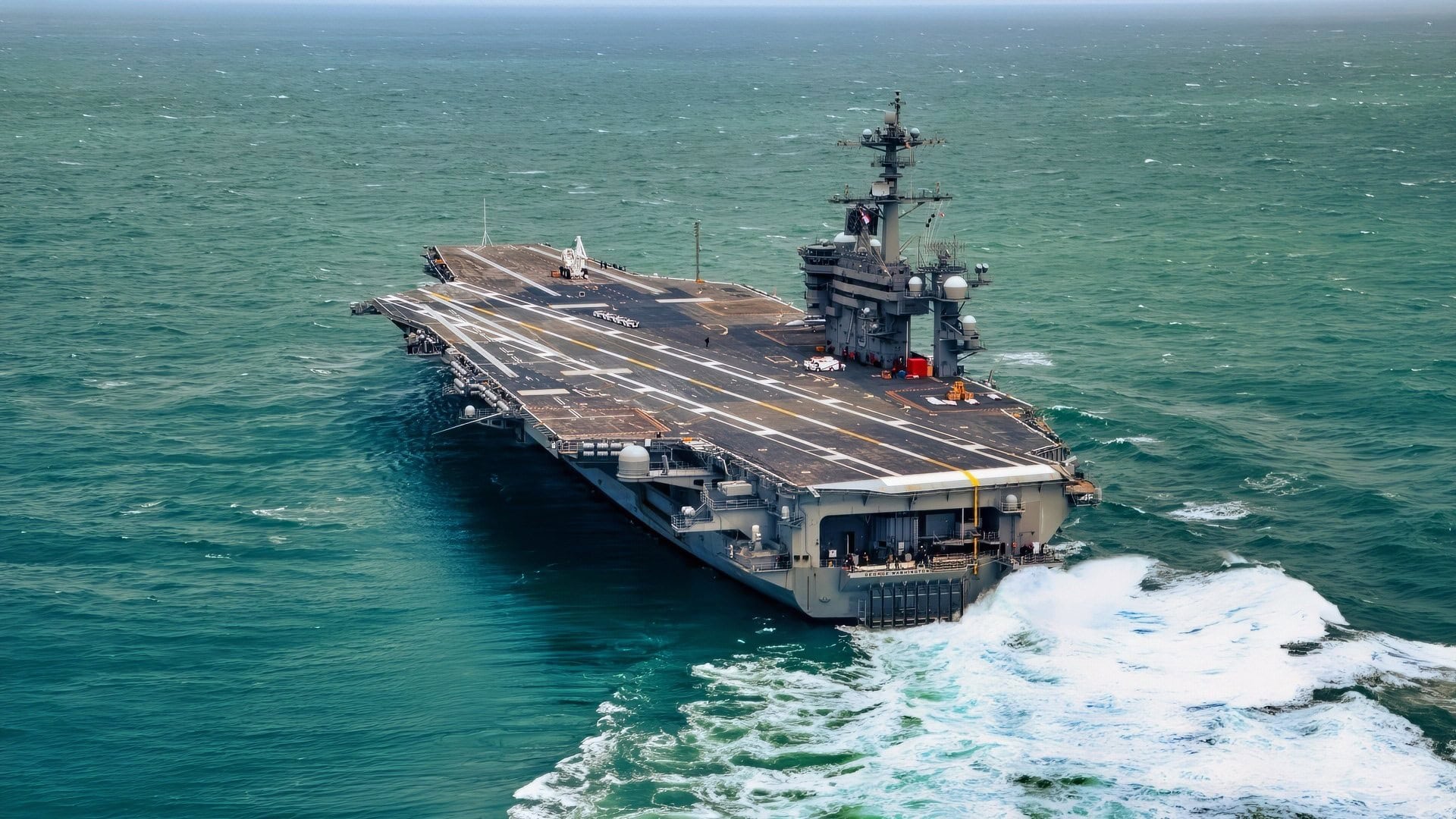
The Navy's June 22 release describes Valiant Shield 26 as a multinational, biennial field training exercise built around detecting, locating, tracking, and engaging units at sea, in the air, in space, on land, and in cyberspace. That language matters. This is not a photo-op formation sail. It is the command-and-control rehearsal for a fight in which a destroyer, a Marine F-35B, a Space Force sensor, a Japanese submarine, and a transport aircraft may all sit inside one kill chain.
Valiant Shield started in 2006 as a unilateral American drill. Since 2024 it has become a multilateral joint field training exercise, and this year's iteration is the second in which the Japan Self-Defense Forces are heavily integrated into planning and execution. That evolution reflects the operational reality around Taiwan and the Philippine Sea. The United States cannot fight west of the date line as a solo actor and still pretend the map works.
The DVIDS Valiant Shield feature page adds the sharper detail. Recent VS26 imagery includes Marine KC-130J refueling of F-35B Lightning II aircraft, P-8A Poseidon operations, 3rd Multi-Domain Task Force support, and a live-fire sinking exercise in which a Japan Maritime Self-Defense Force submarine fired a torpedo at the decommissioned USS Juneau. That SINKEX is the part Beijing's planners will care about. It shows allied submarines being folded into a live maritime strike problem, not merely exercising parallel tracks.
RIMPAC Adds Scale But Also Reveals the Bottleneck
RIMPAC 2026 began on June 24 and runs through July 31 around the Hawaiian Islands. U.S. 3rd Fleet says the exercise brings together 30 nations, more than 30 surface ships, five submarines, 15 national land forces, more than 206 aircraft, and 30,000 personnel. The menu includes amphibious operations, gunnery and missile events, anti-submarine warfare, air defense, mine countermeasures, explosive ordnance disposal, diving and salvage, humanitarian assistance, and disaster response.
That is a huge training bill. It is also a reminder that the U.S. Navy's Pacific posture depends on a thin chain of ports, tenders, tankers, magazines, and maintenance teams. Hawaii is not the front line. Guam is closer, but still roughly 1,500 nautical miles from the Luzon Strait and more than 1,700 nautical miles from Taiwan's eastern approaches. A carrier strike group can sprint. An ammunition ship cannot sprint forever. A submarine can disappear. Its torpedoes and Tomahawks still have to come from somewhere.
Anyone who has served on a destroyer knows the glamorous part of sea control lasts until the first serious casualty report or the first vertical launch cell count starts getting uncomfortable. The Pacific is unforgiving because distance converts every tactical success into a logistics problem. If the magazines are not forward, if repair capacity is not dispersed, and if tankers cannot survive, the battle force becomes a rotating visitor rather than a persistent combat system.
The Useful Signal to China Is Not the Ship Count
Counting ships is easy. Counting reloads is harder. China will not simply ask whether Valiant Shield and RIMPAC can generate impressive combined force pictures. The People's Liberation Army Navy will ask whether the United States can keep a carrier air wing, maritime patrol aircraft, Marine stand-in forces, Japanese submarines, and long-range fires connected after the first week of a crisis.
There is a reason Valiant Shield now includes U.S. Transportation Command and U.S. Space Command. The Navy can talk about lethality, but the exercise architecture is quietly admitting the core problem. Space-based sensing, theater lift, cyber resilience, and maritime sustainment are not supporting actors. They are the campaign.
Japan's deeper role also changes the math. A Japanese submarine participating in a SINKEX is a practical signal that Tokyo's undersea force is becoming part of the coalition's sea-denial picture east and south of Japan. That matters more than another communique about shared values. Submarines impose uncertainty. In a Taiwan contingency, uncertainty is one of the few affordable ways to slow Chinese surface movement without trying to match the PLAN hull for hull.
The Exercise Still Dodges the Hardest Question
The hard question is whether the coalition can absorb losses and continue. RIMPAC's 30,000 personnel and Valiant Shield's cross-domain integration prove that the United States can convene a large maritime coalition. They do not prove that the coalition can sustain combat power inside the weapons engagement zone for weeks.
The Navy's current answer is distribution: more bases, more partners, more domains, more nodes. That is the right direction. But distribution only works if every node has fuel, munitions, repair capacity, medical evacuation, and command links that survive first contact. Otherwise, distribution becomes a map full of isolated outposts waiting for resupply.
Valiant Shield 26 is the right exercise for the right theater. It is more realistic than a single-carrier presence patrol and more useful than another diplomatic statement about deterrence. But the operational verdict is still open. Washington has shown it can gather a coalition and fire together. The next test is whether it can reload, repair, reconnect, and keep fighting after China starts attacking the system that makes those ships useful.
That is the gap. The exercise is impressive. The sustainment problem is still undefeated.
Valiant Shield 26 and RIMPAC 2026 involved 30,000 personnel and over 206 aircraft across the Northern Mariana Islands, Guam, Japan, and Hawaii from June 22 to July 31, 2026. The exercises emphasized multinational cooperation and operational readiness, while raising concerns about the sustainability of military operations under potential threats. The integration of Japan's Self-Defense Forces marked a significant evolution in coalition capabilities.
- Valiant Shield 26 involves 30 nations and 30,000 personnel.
- The exercise runs from June 22 to July 1, 2026, across multiple locations.
- RIMPAC 2026 began on June 24 and includes 30 nations and over 206 aircraft.
- The exercises focus on cross-domain integration and multinational cooperation.
- Sustainment challenges under missile attack and cyber disruption are highlighted.