
Vigor unveils its newest Maneuver Support Vessel for U.S. Army
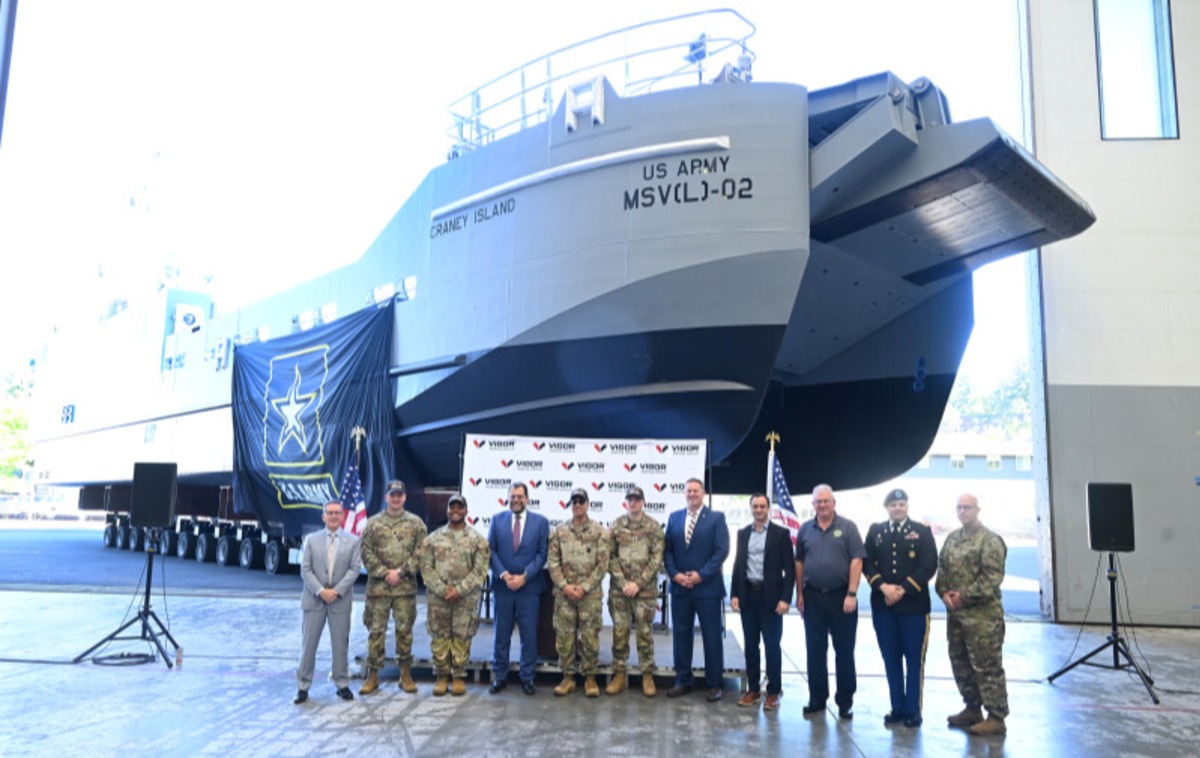
A boat built to carry a 70-ton battle tank through the surf rolled off an assembly line in Vancouver, Washington, and the U.S. Army is counting down to delivery this fall.
Vigor Marine Group unveiled the USAV Craney Island, the second Maneuver Support Vessel (Light) built under a program designed to replace the Army’s aging landing craft fleet, the company announced, describing the vessel as carrying next-generation capabilities meant to improve payload capacity, maneuverability, speed and operational flexibility over the class it replaces.
The Maneuver Support Vessel (Light), known by its shorthand MSV(L), exists to retire a landing craft that has been hauling Army equipment ashore since 1959, a boxy, flat-bottomed vessel commonly nicknamed the “Mike Boat” for its official designation, the Landing Craft Mechanized-8. That aging fleet has kept the shallow-water beaching capability the Army needs to move heavy equipment from ship to shore in places without developed ports, but decades of service left it increasingly outmatched by the weight and speed modern battlefield logistics demand. Vigor built Craney Island using an all-aluminum hull design paired with waterjet propulsion, a lightweight construction approach that keeps the vessel maneuverable in shallow coastal waters while still delivering the payload capacity needed to move some of the Army’s heaviest vehicles.
Francesco Valente, CEO of Vigor Marine Group, framed the unveiling as validation of years of work by the Vancouver workforce that built the vessel.
“We are proud to reach this important milestone with the unveiling of Craney Island. This is a critical milestone for both the U.S. Army and for our skilled Vigor Marine Fabrication workforce in Vancouver, where this journey began years ago. Today reflects the dedication of our employees, suppliers and Army partners who have worked together to refine this next-generation vessel. Our goal is to support our customer’s mission by completing quality work safely, and today we celebrate achieving that on behalf of the U.S. Army,” said Valente.
More than 300 skilled workers at Vigor Marine Fabrication’s Vancouver facility, led by Vice President and General Manager Mark Norris, contributed to building Craney Island, drawing on trades including aluminum welders, electricians and mechanics who specialize in the kind of precision fabrication national security vessels require. More than 40 Washington state-based companies contributed to the effort as well, alongside additional suppliers and partners spread across the Pacific Northwest and the broader United States, a distributed industrial footprint that Vigor says has directly supported growth in family-wage manufacturing jobs in the Vancouver area.
Craney Island did not emerge from a blank design. Vigor launched the program’s prototype, the SSG Elroy F. Wells, in 2022, and has spent the years since working alongside the Army to test that vessel across the Pacific Northwest and in Hawaii, gathering real-world performance data under actual operating conditions rather than relying solely on computer modeling or dockside testing. Craney Island incorporates the lessons learned from that testing period, combined with what the company describes as expert craftsmanship from its local workforce, resulting in what Vigor calls a first-of-its-kind capability for the Army built around a sophisticated all-aluminum design paired with advanced propulsion systems and electronics.
The vessel’s design centers on features built specifically for the demanding job of moving armored vehicles between ship and unimproved shore. Its drive-through configuration, with ramps at both the bow and stern, lets vehicles load and unload without needing to turn around inside the craft, a detail that speeds up operations during time-sensitive amphibious missions. The combination of lightweight aluminum construction and waterjet propulsion gives the vessel a shallow draft suited to littoral operations, the term for missions conducted in the near-shore waters where larger, deeper-hulled ships cannot safely operate, while still delivering what Vigor describes as significant payload carrying capability and unparalleled maneuverability compared to the legacy fleet it replaces.
The company’s Vancouver facility has now entered full-rate production of MSV(L) hulls, the manufacturing phase that follows initial prototype and early production work, while simultaneously continuing fabrication of a separate vessel class, the Combatant Craft Medium, of which the yard has already produced more than 30 units for other military customers. That dual production track underscores how central the Vancouver facility has become to a specific segment of American naval shipbuilding, one focused on smaller, specialized craft rather than the large surface combatants that typically dominate headlines about the state of the U.S. Navy’s shipbuilding industrial base.
Vigor tied the Craney Island unveiling directly to a broader federal policy push, noting that the skilled workforce building these vessels represents an important piece of the nation’s maritime industrial base and supports military readiness through the delivery of advanced, high-quality vessels.
The company said those capabilities align with the objectives of Presidential Executive Order 14269, Restoring America’s Maritime Dominance, a directive emphasizing the need to strengthen America’s shipbuilding capacity and maritime workforce after decades of decline in domestic commercial and military shipbuilding relative to competitors like China and South Korea.
Content preview only. Full article available at source. View Full Article
Vigor Marine Group unveiled the USAV Craney Island in Vancouver, Washington, designed to carry a 70-ton battle tank. This new Maneuver Support Vessel (Light) aims to replace the Army's aging landing craft fleet, enhancing operational capabilities with its all-aluminum hull and waterjet propulsion. The delivery is expected in Fall 2023, marking a significant milestone for the U.S. Army and the local workforce involved in its construction.
- The USAV Craney Island is designed to carry a 70-ton battle tank.
- It is the second Maneuver Support Vessel (Light) built to replace the Army's aging landing craft fleet.
- The vessel features an all-aluminum hull and waterjet propulsion for improved maneuverability.
- More than 300 skilled workers contributed to its construction in Vancouver, Washington.
- The unveiling aligns with federal policy to strengthen America's shipbuilding capacity.