
Washington studies strikes against JNIM in Mali in 2026 — zero ground troops, limited impact
 Marie Dubois
Washington is considering strikes against JNIM in Mali in 2026 — zero soldiers on the ground, limited impact
In Bamako, on July 23, Abdoulaye Diop did not raise his voice. The Malian Minister of Foreign Affairs simply stated that he had received "no information, no official statement" from the United States following revelations from the Washington Post about military options being considered against the Support Group for Islam and Muslims, JNIM. This Malian caution is more interesting than a theatrical denial. It indicates that Bamako wants to maintain control over the sequence, while knowing that the American debate now exists in the public space.
According to RFI, citing researcher Andrew Lebovich, a Sahel specialist at the Clingendael Institute, the most credible hypothesis would not be a classic offensive, but targeted airstrikes. And even then, with limited reach. This is the central point. In Mali, Washington does not have ground forces comparable to those it can mobilize elsewhere, and the theater does not offer the deceptive simplicity of a staff map.
A military option without a ground network
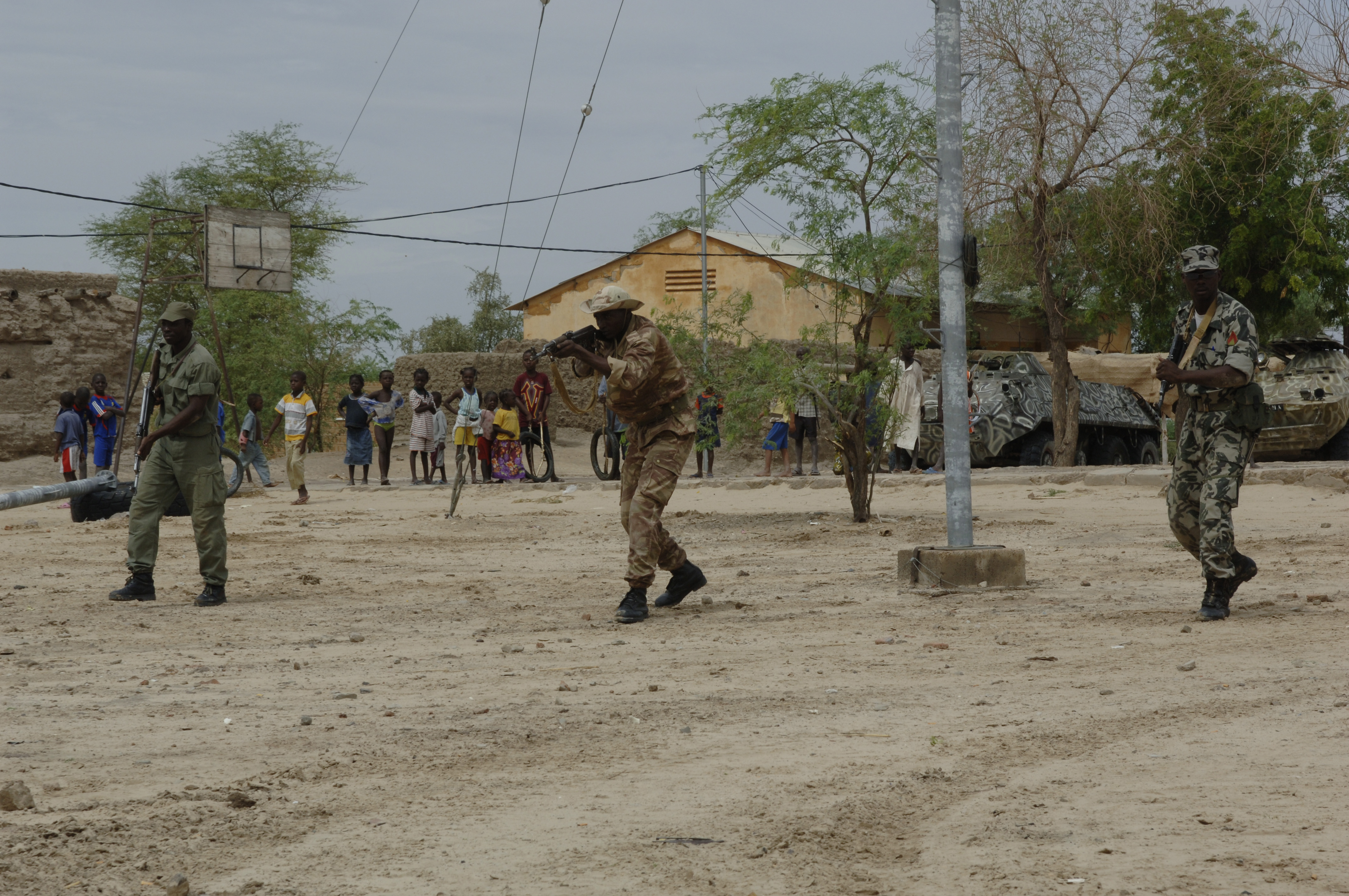
An airstrike is never just a munition falling. Before that, one must identify, confirm, track, arbitrate, and then evaluate. On the Sahelian ground, this chain depends on human relays, drones, listening, local partners, and a fine reading of the tracks. Between Anéfis, Tabrichat, and Gao, the distances are not abstract. The road crosses areas where a convoy can lose its cohesion in a matter of minutes, where a stuck truck becomes a vulnerability, where an armed group can dissolve into a space of encampments, markets, and gold panning sites.
This is why the absence of American soldiers in Mali changes everything. The United States can strike from the outside, with regional or aerial means, but they do not have the daily framework on the ground that allows them to distinguish a JNIM operative from a local notable, a logistical point from a civilian stop, or an operational meeting from a simple passage of motorcycles. From experience, technical intelligence is powerful in the desert when it already knows what to look for. It becomes fragile when the adversary lives within the same social fabric as the population.
The French precedent should cool Washington
The Americans are not arriving on a blank page. France spent nearly a decade tracking jihadist leaders in the Sahel, from Serval to Barkhane. It eliminated several. It also proved one thing that is less comfortable for Paris: killing leaders is not enough when armed groups retain their capacity for recruitment, taxation, intimidation, and mobility. JNIM, affiliated with al-Qaeda, has not only survived this pressure. It has adapted.
The current situation in northern Mali illustrates this brutally. RFI reported that on July 18, in the Tabrichat area, Gao region, an attack on a convoy leaving Anéfis reportedly killed around fifty Malian soldiers. Several sources cited by RFI claim that 18 unarmed soldiers, who had surrendered after their truck got stuck, were summarily executed by JNIM. The Azawad Liberation Front, a tactical ally but not merged with the jihadists according to its own officials, reportedly holds around 200 to 250 Malian military personnel.
These figures remain shrouded in the usual fog of the Malian theater. The Malian army communicates little, armed groups disseminate their images to produce a psychological effect, and local intermediaries each have their own agenda. But the operational signal is clear: JNIM is capable of striking a major military axis, coordinating with other actors, and turning an ambush into a political message.
The Russian presence complicates more than it protects
The other variable is Russian. The Africa Corps, the institutional and political heir of Wagner, accompanies the Malian Armed Forces. For Bamako, this partnership serves to show that the country is no longer dependent on Paris. For Moscow, it offers a strategic presence, influence, and an anti-Western narrative. For Washington, it creates a risk of direct friction.
An American strike against a JNIM target in Mali would not occur in a vacuum. It would require avoiding areas where the Russians operate, obtaining or circumventing Malian authorizations, and managing the immediate political exploitation of any incident. A missed shot, a civilian casualty, or even a simple rumor of secret coordination between Bamako and Washington would be enough to open a crisis. The Malian junta has built part of its legitimacy on regained sovereignty. It cannot appear to subcontract its war to a new Western partner after having expelled the old one.
There is a military irony here. The same authorities that rejected the French presence might be tempted to listen to American offers if they promise strike capabilities that the Africa Corps does not always provide with precision. But they must do so without humiliating Moscow, without reviving the memory of Barkhane, and without giving JNIM an easy propaganda argument.
JNIM does not only live in camps
The mistake would be to believe that the problem is limited to a few leaders hiding in the desert. The report published on July 22 by ACLED on mining in the central Sahel reminds us that the war is also fought around gold. The NGO studied violence related to 44 industrial and artisanal mines. It highlights that about 90% of conflicts related to mining occur not in the concessions themselves, but within a radius of about ten kilometers, on the roads, in neighboring towns, and around markets.
For JNIM, these areas are not just a source of money. They offer semi-permanent bases, fuel stocks, commercial explosives, motorcycle parts, informant networks, and a taxation economy. It is less spectacular than an armed column. It is more sustainable. A strike can destroy a pickup truck, or even eliminate a leader. It does not replace local authority when a market is already paying its tax to an armed group to continue operating.
What Washington can realistically achieve
The most plausible scenario, if the Trump administration were to take the plunge, would therefore be a one-off operation: a targeted leader, an identified camp, a strike announced as a signal. Militarily, this can have value. An experienced leader is not always quickly replaced. A hit on a logistical cell can delay an offensive. And Washington would show that it refuses to let al-Qaeda consolidate a sanctuary in the heart of the Sahel.
But the strategic effect would be narrow. Without a lasting presence, without stable access to local intelligence, without a credible Malian political project, and without control over economic axes, the operation risks joining the long list of tactical strikes that do not change the war. This is exactly what Lebovich suggests when he says that one more intervention would likely not change the situation on the ground.
In the Sahel, the question is not just who can strike. It is who remains on the track after the dust.
The next point to watch is therefore not a triumphant statement from Washington. It is Bamako's posture: discreet authorization, public refusal, or prolonged silence. If attacks on the Anéfis-Gao axes and pressures around the mines continue, JNIM will have already responded in its own way. It will force capitals to choose between the symbol of a strike and the slow, very thankless recapture of territory.
The U.S. is considering airstrikes against the JNIM in Mali in July 2026, following a recent attack that killed 50 Malian soldiers. The JNIM executed 18 disarmed soldiers after they surrendered. The presence of Russian forces in the region complicates U.S. military operations, as they must navigate potential conflicts with Russian interests while addressing the ongoing threat posed by JNIM.
- U.S. is studying airstrikes against JNIM in Mali for 2026.
- 50 Malian soldiers were killed in an attack on July 18.
- 18 disarmed Malian soldiers were executed by JNIM after surrendering.
- The presence of Russian forces complicates U.S. military options in Mali.
- The JNIM has adapted and maintained its operational capabilities despite previous French military actions.