
What Signal Did China's Coast Guard Release While Conducting Law Enforcement Patrols East of Taiwan Island? Expert Interpretation
On June 1, the China Coast Guard conducted law enforcement patrols in the waters east of Taiwan Island. This is the most direct response to the so-called "demarcation negotiations" initiated by Japan and the Philippines—who unilaterally started the so-called "maritime demarcation negotiations" in waters located east of Taiwan Island, seriously infringing upon our interests.
The so-called "demarcation negotiations" by Japan and the Philippines seriously violate China's sovereign rights and interests
On May 28, during a visit to Japan by the President of the Philippines, Japan and the Philippines issued a joint statement announcing the formal initiation of the so-called "demarcation negotiations for the exclusive economic zones and continental shelves between Japan and the Philippines." The so-called demarcation area claimed by Japan and the Philippines is located between the Ryukyu Islands claimed by Japan and the Batan Islands claimed by the Philippines, approximately 400 kilometers apart, situated on the east and south sides of Taiwan Island, respectively. In other words, the proposed demarcation area announced by Japan and the Philippines is located east of Taiwan Island.
In response, Chinese Foreign Ministry spokesperson Mao Ning stated at a regular press conference on May 29 that the so-called "demarcation negotiations" by Japan and the Philippines are completely illegal and invalid, urging Japan and the Philippines to immediately cease any actions that infringe upon China's maritime rights and interests.
The Coast Guard vessels Daishan and Baita conduct law enforcement patrols to demonstrate jurisdiction
After the Foreign Ministry lodged a solemn representation, the China Coast Guard conducted law enforcement patrols in the waters east of Taiwan Island on June 1. The patrol was carried out by the China Coast Guard Daishan Fleet, which includes the CG 2502 (Daishan) and CG 2304 (Baita). This is not only the most direct response to the so-called "demarcation negotiations" that seriously infringe upon our interests but also demonstrates our jurisdiction over the relevant waters east of Taiwan Island.
To carry out such an operation, the China Coast Guard fleet must not only have determination but also capability and strength. The maritime conditions east of Taiwan Island are very complex. This area has a significant topographical drop, with steep and rugged underwater terrain. There are also strong Kuroshio currents with a flow rate of about 1 meter per second, combined with the winter northeast monsoon and frequent summer typhoons, which can easily create huge waves. The complex hydrological and meteorological environment not only threatens the safety of vessel navigation but also interferes with sonar detection and maritime law enforcement, posing a significant test to vessel performance, environmental assessment levels, and operational capabilities.
Our Coast Guard has the capability for regular law enforcement control in this area
What kind of capability did the China Coast Guard demonstrate during the law enforcement patrol in the waters east of Taiwan Island?
Military expert Zhang Junsha stated, this is the first time the China Coast Guard has publicly conducted operations in the waters east of Taiwan Island under the name of independent law enforcement patrols. The maritime conditions in the waters east of Taiwan Island are relatively complex, posing a significant test to vessel performance and law enforcement operational capabilities. Therefore, this operation proves that the China Coast Guard has the strength to conduct regular law enforcement patrols and control in the waters east of Taiwan Island, and it further indicates that China has effectively established a relatively complete system for protecting sovereignty and maritime rights around Taiwan Island and for managing these waters.
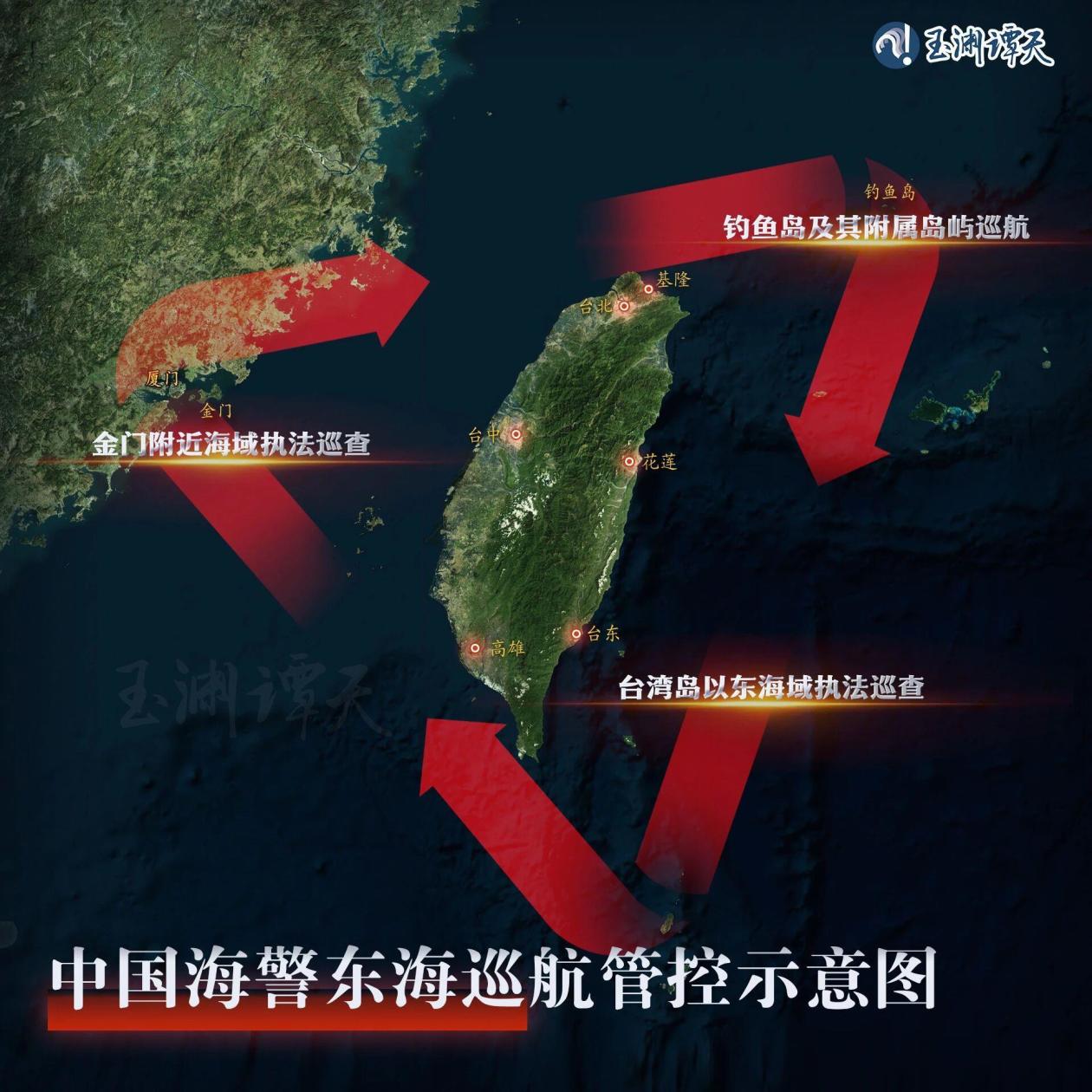
The law enforcement patrol has formed a triangular closed loop, firmly surrounding Taiwan Island
According to a diagram of the China Coast Guard's East China Sea patrol control, the range of the China Coast Guard's patrol law enforcement extends north to the Diaoyu Islands and their affiliated islands, south to the waters east of Taiwan Island, and west to the waters near Kinmen, forming a triangular closed loop that firmly surrounds Taiwan Island.
This action is a direct response to the illegal actions of Japan and the Philippines
What signal did the China Coast Guard's law enforcement patrol in the waters east of Taiwan Island send? What rights did it declare?
Military expert Zhang Junsha: The law enforcement patrol conducted by the China Coast Guard vessels in the waters east of Taiwan Island is a lawful exercise of duties in that area, maintaining national sovereignty and maritime rights, and is a direct response to the illegal actions of Japan and the Philippines in unilaterally announcing the initiation of "demarcation negotiations" in the waters east of Taiwan Island.
Taiwan is an inseparable part of China's territory. According to Chinese domestic law and international law, including the United Nations Convention on the Law of the Sea, China has sovereignty rights and jurisdiction over the territorial sea, exclusive economic zone, and continental shelf in the waters east of Taiwan Island. The unilateral initiation of the so-called "maritime demarcation" negotiations by Japan and the Philippines seriously infringes upon China's maritime rights and interests and severely violates international law and the basic principles of international relations, including the United Nations Convention on the Law of the Sea.
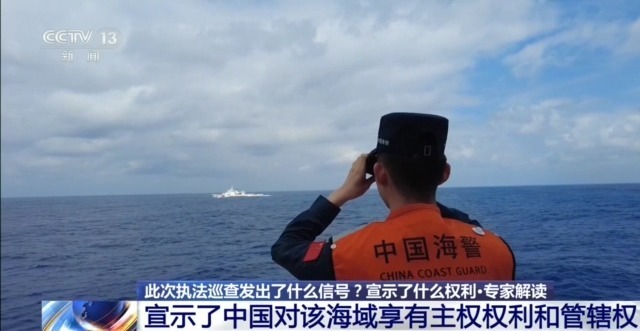
The China Coast Guard's law enforcement patrol in the waters east of Taiwan Island not only declares China's jurisdiction over the relevant waters east of Taiwan Island but also demonstrates China's capability in managing and exercising jurisdiction over these waters, further showcasing China's firm determination and capability to safeguard national sovereignty and maritime rights.
China Coast Guard conducted a law enforcement patrol east of Taiwan Island on June 1, responding to Japan and the Philippines' maritime boundary negotiations. This operation involved two vessels, the China Coast Guard 2502 and 2304, and aimed to assert China's sovereignty in the region. The patrol highlights China's capability to manage and enforce its maritime rights in complex conditions.
- China Coast Guard conducted a law enforcement patrol east of Taiwan Island on June 1.
- The patrol was a direct response to Japan and the Philippines' announcement of maritime boundary negotiations.
- The operation involved two vessels: China Coast Guard 2502 and 2304.
- The area is characterized by complex maritime conditions, posing challenges for naval operations.
- This action signifies China's assertion of sovereignty over the waters east of Taiwan.