
"Who Will Tell the Story of the Red Army if the Descendants of Red Army Martyrs Don't?"
In Zhongfu Village, Changting, Fujian, a land of revolutionary fervor. On the stone tablet in front of the Guanshou Temple, it is clearly engraved with “The Red Ninth Army Corps' Long March 25,000 Miles Zero Kilometer Point,” drawing people's thoughts back to the history that took place here over 90 years ago.
“The stories of the revolution must be told to contemporary people.” Upholding this belief, 63-year-old Zhongfu Village resident and guide Zhong Ming has been engaged in full-time narration for more than ten years. Following Zhong Ming, the reporter and his team listened to the echoes of history at the starting point of the Long March.
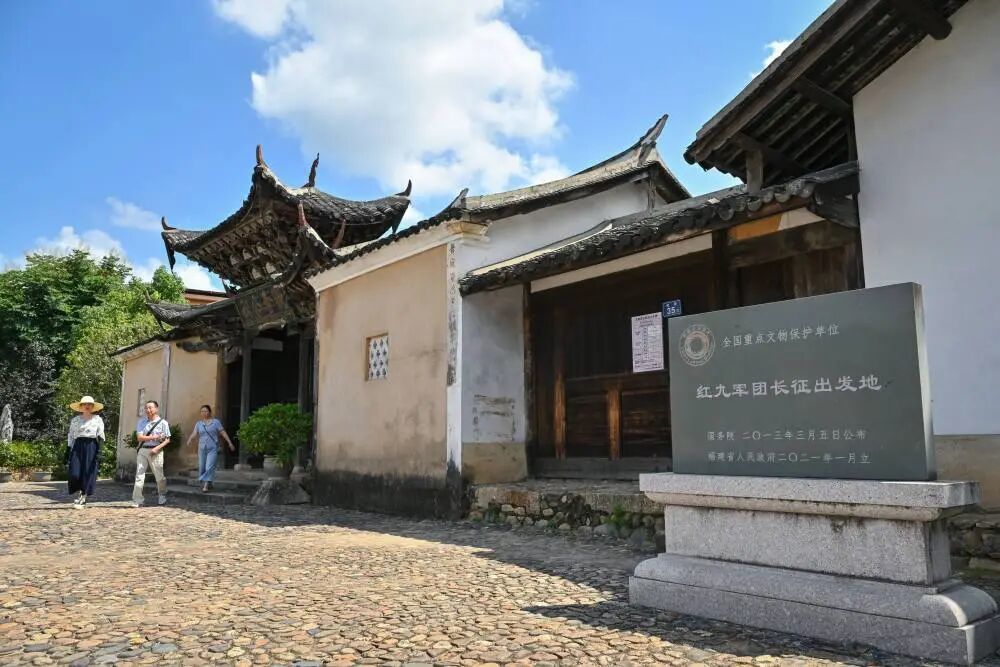
This is the Guanshou Temple photographed in Zhongfu Village, Changting, Fujian. Xinhua News Agency reporter Han Xu photographed it.
In late September 1934, the soldiers of the Red Ninth Army Corps were ordered to ambush the enemy at Songmaoling. After completing their mission, they withdrew to Zhongfu Village to regroup, thus embarking on the long march. Zhongfu Village is therefore honored as “the first village of the Red Army's Long March.”
“The years of construction in the Soviet area before the Red Army's Long March endowed this land with a profound red heritage, leaving behind countless stories soaked in blood and fire,” Zhong Ming lamented.
On the Red Army Bridge, noticeable marks catch the eye. Zhong Ming gestured: “During the Songmaoling battle, one had to be taller than 1.5 meters to enlist. The scale marked here is 1.5 meters, the length of a long gun plus a bayonet. People called it the ‘contour line of life.’”
“At that time, many people eagerly signed up. Some who were not tall enough would desperately stand on tiptoe or secretly stuff straw in their insoles.” Scenes of fathers sending sons, wives sending husbands, and brothers vying to become Red Army soldiers seemed to unfold before our eyes.
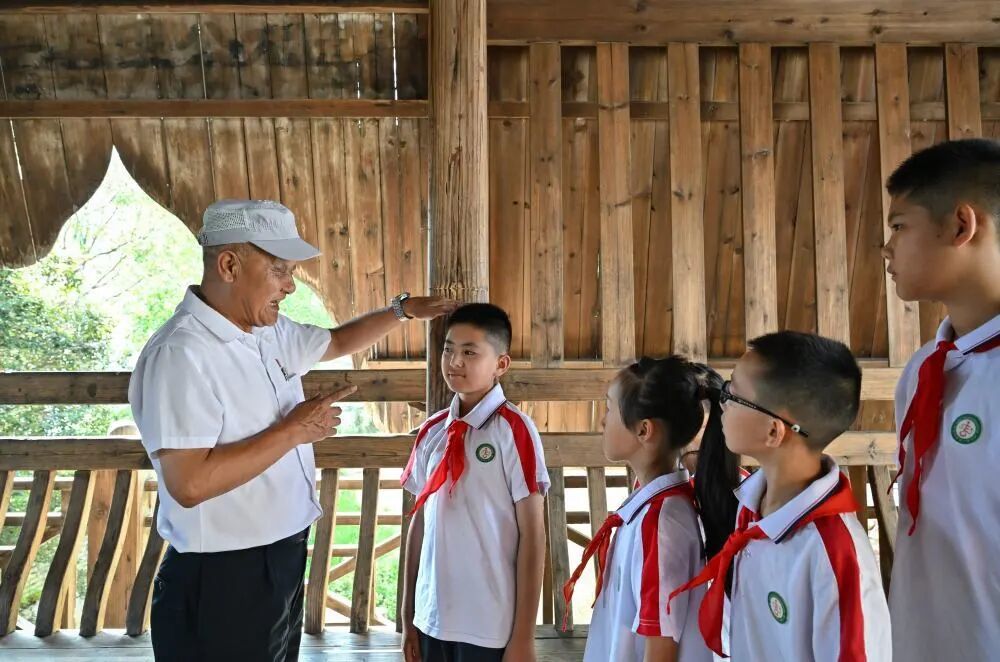
Guide Zhong Ming explains to elementary school students participating in a red study activity. Xinhua News Agency reporter Han Xu photographed it.
In front of the Songmaoling Battle Martyrs Memorial, he recalls the years when the military and civilians in the Soviet area shared hardships; beside the villagers' old houses, he describes the scene of “every household had no idle person, and every door was unbarred”; on the Red Army Bridge and Red Army Street, he elaborates on the origins of slogans like “saving the country knows no age or gender”... Every tile and every tree in Zhongfu Village is familiar to Zhong Ming, and he narrates with great emotion.
For Zhong Ming, this history has been imprinted in his heart since childhood.
“Among my relatives, six were Red Army martyrs. During the revolutionary era, some relatives set out from Zhongfu Village and sacrificed their lives on the Long March.” Zhong Ming often repeats a saying: If the descendants of Red Army martyrs do not tell the stories of the Red Army, who will?
As early as the 1980s, Zhong Ming took the initiative to visit Long March veterans, collect party history materials, and purchase related books, dedicating himself to studying red history.
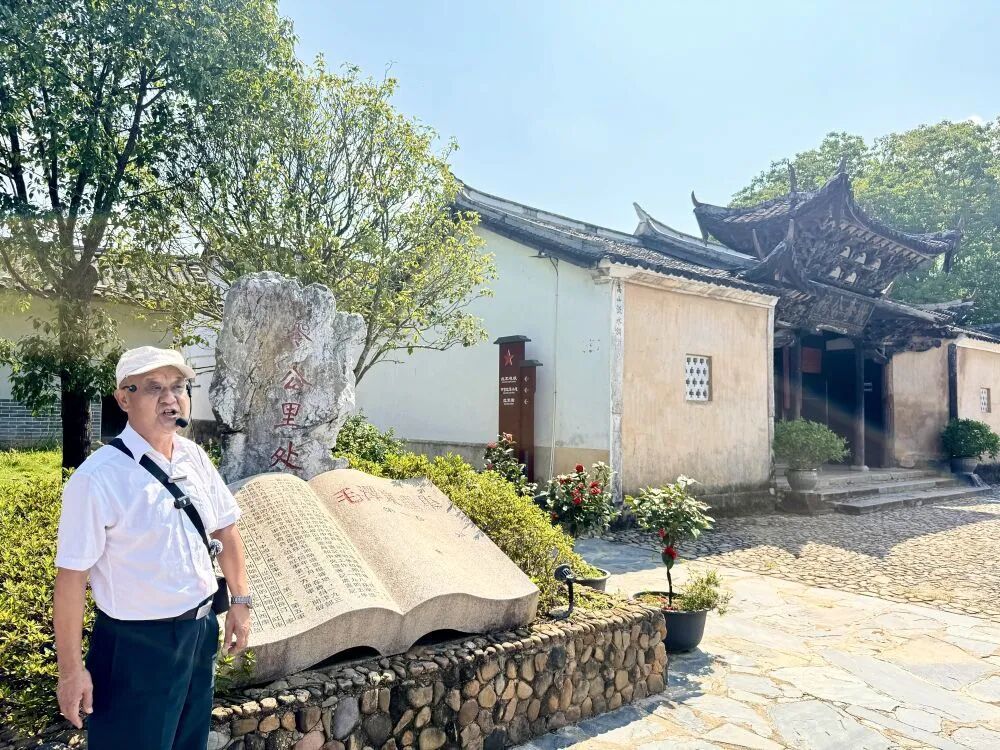
Guide Zhong Ming explains in front of the Guanshou Temple. Xinhua News Agency reporter Xing Tuo photographed it.
After 2012, the local area began planning the protection and construction of red culture, and Zhong Ming participated as a grassroots volunteer. In 2015, he ended his work in another city, returned to the village, and became a full-time guide.
Where are the remains of relatives who sacrificed on the Long March? This question has always lingered in Zhong Ming's mind. Over the years, he has repeatedly embarked on a journey to find his relatives, visiting various martyr memorial facilities.
It wasn't until 2017 that Zhong Ming finally found his relatives' names on the Memorial Archway in Guilin, Guangxi. “Looking at the vast Xiangjiang River, how could they not know that ahead lay sacrifice?” Zhong Ming felt more deeply the tragic nature of the “Blood Battle of the Xiangjiang” and understood the revolutionary martyrs' sentiment that “revolutionary ideals are higher than the sky.”
“As a younger generation, I have the obligation to protect and pass on this history well.” Zhong Ming's determination to tell the stories of the Red Army has become even stronger.
The perseverance of the older generation has inspired the younger generation. Zhong Ming's son, Zhong Zhenhua, returned from Xiamen and became the only undergraduate in the village engaged in guiding work.
“I grew up on Red Army Street. I used to be a ‘listener’ of stories and never thought I would become a ‘storyteller.’” At first, Zhong Zhenhua felt nervous, “worried that my voice condition was not good and that I couldn't deliver effectively.”
But in Zhong Ming's view, his son has strong learning abilities and understands a lot about the internet, “he could manage independently in less than three months.” Zhong Zhenhua also gradually explored his personal narration style and gained a sense of achievement from his work.
Father and son are a team. Zhong Zhenhua helps his father digitize a large amount of literature, allowing red memories to be better preserved; they flexibly adjust their scripts for different groups, teaching micro-party classes for party members and cadres, and sharing more party history stories for youth study groups; keeping up with the changes of the times, they incorporate popular social phrases into their scripts. Zhong Zhenhua is also pondering: can they use artificial intelligence and short videos to make text explanations more vivid?
Today, Zhongfu Village has more than ten full-time guides like Zhong Ming. Zhongfu Village has become a national defense education base, attracting large numbers of party members, soldiers, students, and tourists every year to visit and reflect on the glorious years. During peak times, the Zhong family can host more than 20 teams in a day, working from morning till night.
“We will continue to tell these stories, allowing the red bloodline to be passed down from generation to generation, and let the great spirit of the Long March inspire more people,” Zhong Ming said firmly.
In the sunlight, on both sides of the Guanshou Temple, the slogans “The First Step of the Long March” and “Do Not Forget the Original Intention and Start Again” shine brightly.
Reporters: Xing Tuo, Li Haoze
Zhong Ming, a resident of Zhongfu Village in Fujian, has dedicated over ten years to educating others about the Red Army's history and the Long March. He emphasizes the importance of passing down these stories, especially as a descendant of Red Army martyrs. The village, known for its revolutionary significance, attracts many visitors each year to learn about its historical legacy.
- Zhong Ming has been a dedicated storyteller about the Red Army for over ten years.
- Zhongfu Village is recognized as the 'First Village of the Red Army Long March.'
- Zhong Ming's family has six members who were Red Army martyrs.