
Why 500,000 G95 Assault Rifles Won't Solve the Bundeswehr's Personnel Problem
 Dr. Klaus Weber
Why 500,000 G95 Assault Rifles Will Not Solve the Bundeswehr's Personnel Problem
The Bundeswehr apparently wants to double its order for new assault rifles to half a million units. According to a report by Hartpunkt from August 3, 2026, the procurement office plans to acquire up to 250,000 additional G95A1 and G95KA1 — precisely at the moment when the BAAINBw had called up the full amount of the existing contract for 250,000 rifles on July 6, 2026. At the same time, the Ministry of Defense is pushing to expand the reserve from 60,000 to 200,000 soldiers by the mid-2030s. Only one figure is not growing: personnel. The force counts around 184,000 active members, and the target of 260,000 by 2035 is still far off. This is the core of Germany's rearmament problem — equipment can be purchased, soldiers cannot.
A Rifle for Everyone — and Again for the Reserve

The G95 is the Bundeswehr variant of the HK416 A8 from Heckler & Koch in caliber 5.56 × 45 mm NATO. The short version G95KA1 has a 355-millimeter barrel and weighs 3.3 kilograms, while the long version G95A1 has a length of 419 millimeters and weighs 3.4 kilograms — the shorter KA1 is intended for use from the Puma infantry fighting vehicle, while the longer A1 is designed for combat in open terrain. The rate of fire is around 850 rounds per minute, and the effective combat range is stated to be 450 meters. Both variants are designed for operation with a suppressor and form a complete weapon system with an ELCAN scope and a reflex sight from Aimpoint.
Procurement has significantly accelerated since 2025. After a competition in 2017 and a legal conclusion in 2023, the Bundeswehr awarded the first production contract in May 2025. On December 4, 2025, Heckler & Koch delivered the first 300 G95KA1 to the Panzergrenadier Battalion 122 in Grafenwöhr — a unit of the 45th Armored Brigade being established in Lithuania. On December 3, 2025, the Bundestag raised the framework cap from 118,718 to 250,000 rifles, and on July 6, 2026, the BAAINBw called up the full amount. A second tranche of up to 250,000 additional rifles would therefore not fill a gap but open a new production line, with delivery expected to run until 2032. Neither BAAINBw nor Heckler & Koch have confirmed the plans so far.
The Reserve: 200,000 Personnel That Do Not Yet Exist
On the same day that Hartpunkt reported on the rifle plans, the Deputy Inspector of the Bundeswehr, Dr. Nicole Schilling, presented the expansion of the reserve forces. From currently around 60,000, the number is to increase to 200,000 reservists by the mid-2030s. The upcoming Reserve Strengthening Act is intended to allow compulsory call-ups for training purposes, guarantee employers at least eight weeks' notice, and provide flat-rate payments. The reserve is to no longer be a catchment area for those discharged but a pillar of national and alliance defense — for example, in securing transit routes for allied reinforcements.
But this is where the math begins to fail. A reserve of 200,000 personnel presupposes an active force that can train, lead, and equip them. The active Bundeswehr stands at about 184,000 soldiers — according to the Ministry of Defense, the best recruitment result since the suspension of conscription, but in June 2026, the total strength fell again by around 500. Boris Pistorius has repeatedly affirmed the goal of 260,000 active personnel plus 200,000 reservists by the mid-2030s and explicitly does not want it understood as a ceiling. However, no one says where the people are supposed to come from. Applications are increasing — by about 20 percent in 2026 — but departures remain high, and the number of actual hires is growing slower than planned.
Equipment is the Easy Task
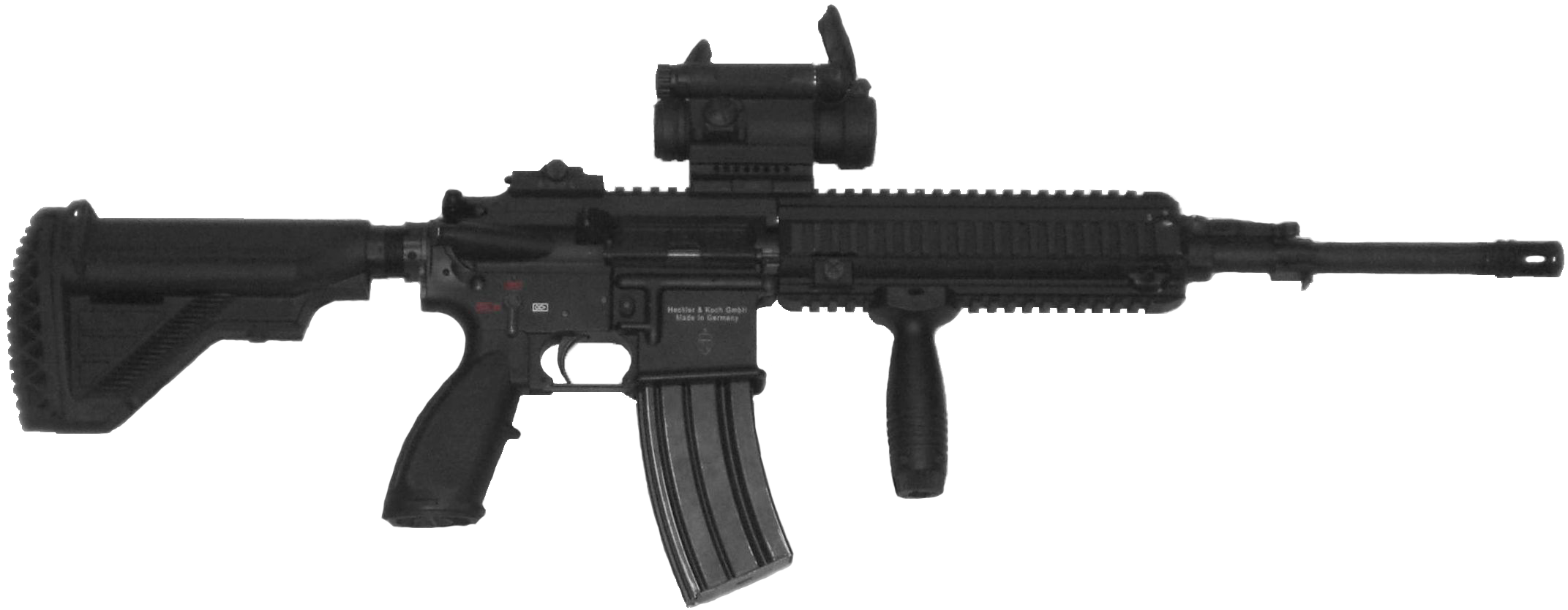
This is exactly where the difference between procurement and capability lies, which the debate has persistently blurred since the turning point. A rifle is an industrial product: Heckler & Koch can ramp up production, the Bundestag can increase the framework, and the BAAINBw can call up quantities. That is a matter of decision, and Berlin has made it. Ordering half a million G95 is politically simple — it is the continuation of budget policy by other means. Personnel, on the other hand, is an institutional issue: training capacities, accommodations, military doctors, family policy, attractiveness of service. None of these levers can be adjusted with a budget note.
The contradiction becomes visible in the 45th Armored Brigade, the flagship of the German NATO deployment in Lithuania. Its first equipment — the first 300 G95KA1 — went to exactly this battalion in December 2025. Yet the brigade is to become fully combat-ready without the necessary positions being permanently filled. The Bundeswehr is getting rifles faster than recruits.
The Institutional Bottleneck
The reserve expansion illustrates the problem in its purest form. Compulsory call-ups, lead times, employer compensation — the Reserve Strengthening Act is an institutional intervention that will take years to take effect. For two decades, the reserve has been treated as a byproduct of the conscription era; the structures to regularly train and integrate 200,000 reservists simply do not exist. Command structures, training places, armories, mobilization planning: all of this must first be built up while the rifles for it are already in the pipeline.
A country like Finland, which mobilizes 280,000 personnel from a reserve of over 900,000 in case of war, took a century to achieve this and has a conscription system that includes every age group. Germany suspended conscription in 2011 and has been discussing models like mandatory service for years — without a decision. Under these conditions, a reserve of 200,000 personnel by the mid-2030s is not a plan but a hopeful value.
A half million rifles are only a military force when there are half a million soldiers behind them. And soldiers cannot be ordered.
The Paradox of the Turning Point
Thus, doubling the G95 order is not wrong — it is even consistent. If the Bundeswehr wants to grow seriously, it needs the equipment for it. But it reveals the asymmetry of German rearmament: the industry can deliver, the state can pay, only society hesitates. Every rifle that rolls into a warehouse without an accompanying soldier is a symbol that the turning point has so far primarily been a procurement shift.
The real project of the coming years is not the purchase of weapons, but the question of whether Germany is ready to bear the institutional costs of personnel — from mandatory service to the attractiveness of reservist service. As long as this question remains open, the Bundeswehr is buying equipment for an army that does not yet exist. And the 500,000 G95 will become the most expensive proof that capability cannot be ordered.
The Bundeswehr plans to double its order of G95 rifles to 500,000 units while struggling with personnel shortages, currently at 184,000 active members. The expansion of reserve forces aims to increase from 60,000 to 200,000 by the mid-2030s. However, the active troop target of 260,000 remains distant, highlighting a significant gap between equipment procurement and personnel availability.
- Bundeswehr plans to double its order of G95 rifles to 500,000 units.
- Current active personnel is around 184,000, far from the target of 260,000 by 2035.
- The G95 is a variant of the HK416 A8, designed for different combat scenarios.
- The reserve force is planned to expand from 60,000 to 200,000 by the mid-2030s.
- The procurement process has accelerated since 2025, with initial deliveries starting in December 2025.