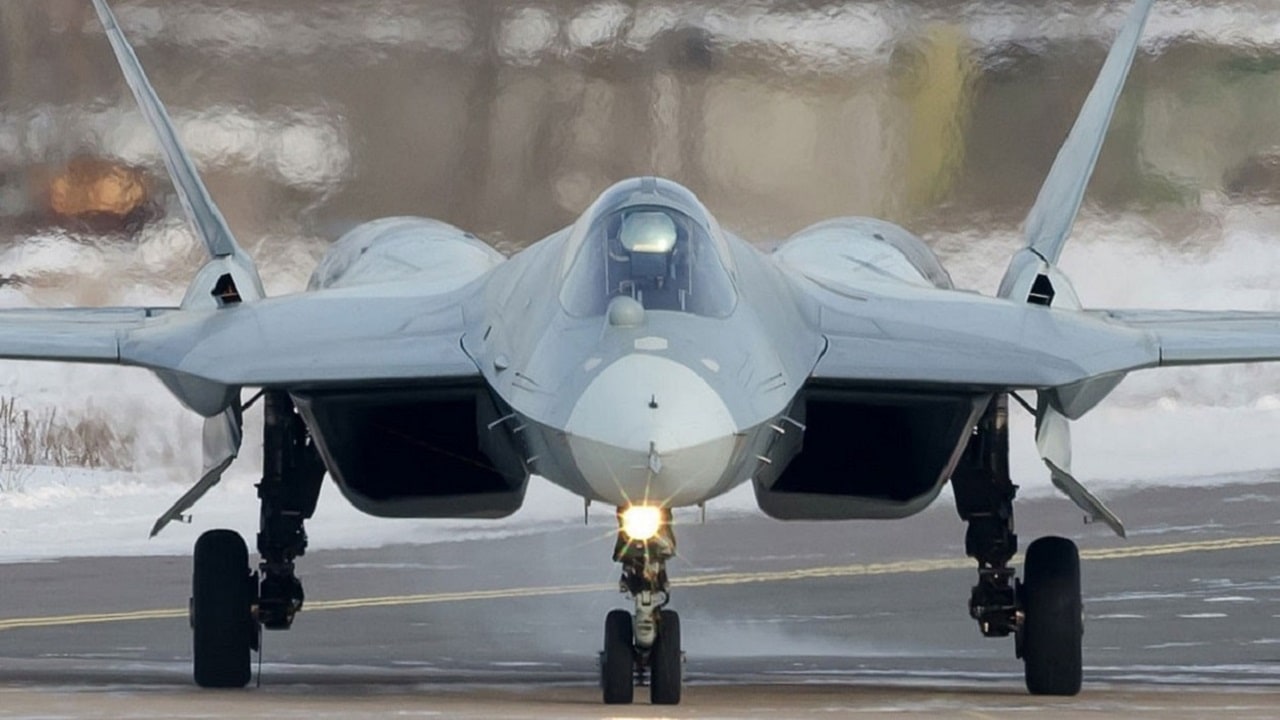
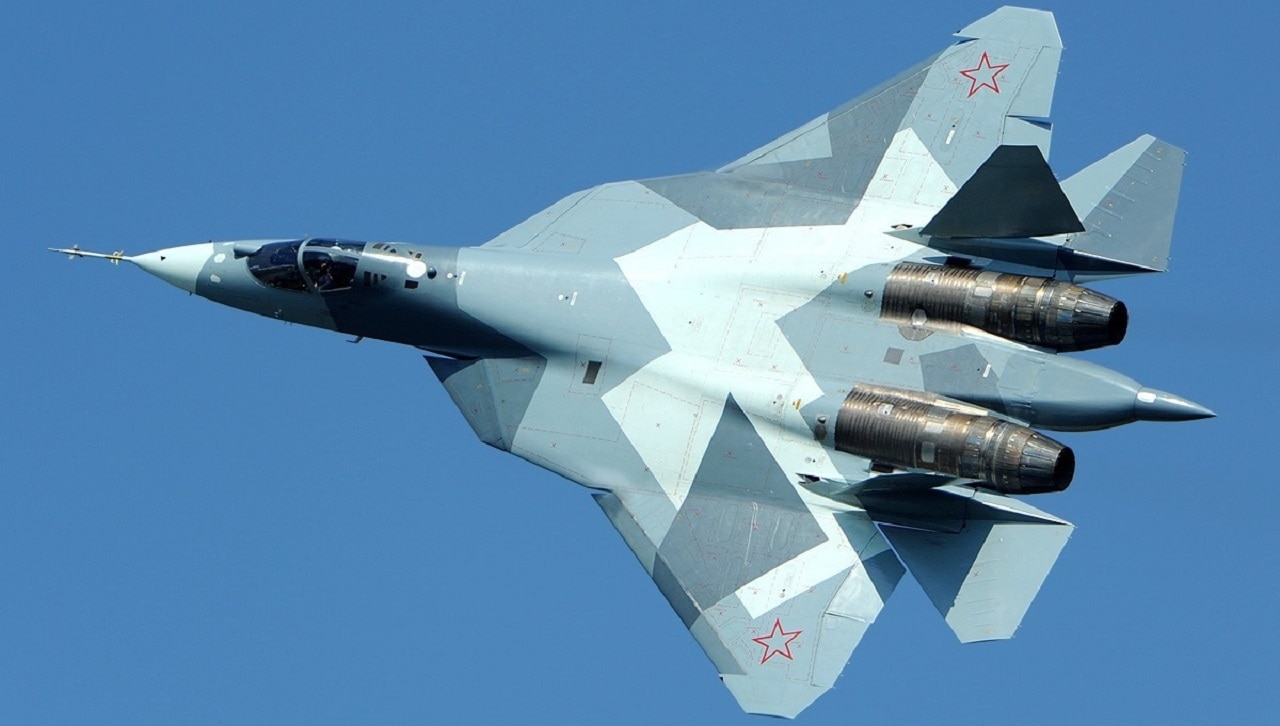
The Su-57 matters less as a fielded capability than as Russia's claim to membership in the fifth-generation club. Roughly three decades after the programme began, the operational fleet is estimated at around twenty combat-ready airframes out of some thirty-two built including prototypes — a force smaller than a single US or Chinese fighter regiment's worth of low-observable aircraft. Sanctions on machine tools, avionics components and composites, combined with the diversion of the Komsomolsk-on-Amur plant's capacity to Su-35 output, have kept annual deliveries in the low single digits. The intended AL-51F1 (Izdeliye 30) engine, which supplies much of the type's claimed supercruise and signature performance, has been flying on test aircraft since 2017 but its arrival on series airframes has slipped repeatedly; most of the fleet still flies on the interim AL-41F1.
Employment over Ukraine has been consistent with that scarcity rather than with the aircraft's stated design intent. Rather than penetrating defended airspace, Su-57s have been used to release Kh-59MK2 and internally carried Kh-69 cruise missiles from launch corridors inside Russian-controlled airspace, so that the airframe never crosses into engagement range of Ukrainian long-range surface-to-air systems. That is a rational way to preserve a small, expensive fleet, but it means the type's low-observable design is largely untested against a peer integrated air defence network, and it makes the platform's contribution hard to distinguish from that of a cheaper Su-34 or Su-35 carrying the same weapons.
The June 2024 Akhtubinsk strike sharpened the point. A pair of Ukrainian one-way attack drones reached a flight-test airfield some 590 km from the front line and damaged at least one Su-57 parked in the open, a reminder that Russia's most valuable air asset is more exposed on the ground than in the air, and that hardened shelters remain scarce across Russian bases. The Algerian order for the export Su-57E is therefore commercially significant out of proportion to its size: it gives the programme its first foreign customer after India's 2018 withdrawal from joint development, and any visible service record in Algerian hands will shape whether other buyers — most of whom face US sanctions exposure under CAATSA — treat the aircraft as a credible alternative to Western or Chinese fifth-generation offerings.