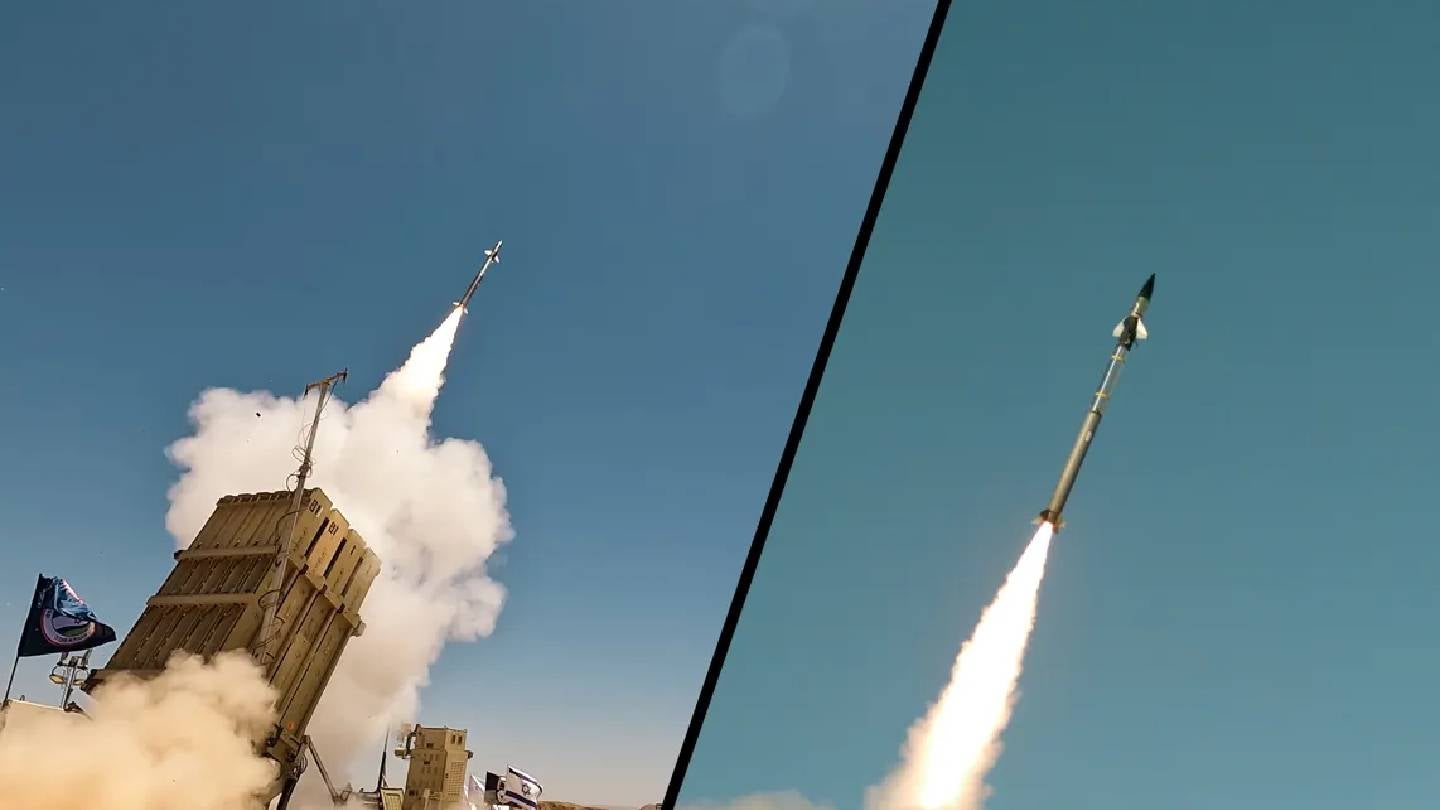
Iron Dome's real innovation is economic rather than kinematic. The EL/M-2084 radar and the mPrest battle management centre compute a predicted impact point for every incoming round and authorise an intercept only when that point falls inside a defended area, so a large share of a salvo is deliberately ignored. That discrimination is what makes a US$40,000-100,000 interceptor affordable against rockets costing a few hundred dollars, and it is also why the widely quoted "~90% success rate" (claimed by Israel) should be read carefully: it describes engagements the system chose to take, not every round fired. Independent analysts have long argued the headline figure is not directly comparable to a conventional SAM's probability of kill.
The campaigns from October 2023 onward tested a different variable. Against Hamas and Hezbollah rocket fire the system's engagement logic held up, but sustained mass salvos consumed interceptors faster than they could be replaced, and by late 2024 US THAAD assets were deployed to Israel to shore up the upper tiers. Iran's 2024 and 2025 ballistic strikes were largely an Arrow and David's Sling problem rather than an Iron Dome one, yet they framed the same underlying question that now dominates assessment of the system: magazine depth and production rate matter more than single-shot performance once an adversary can fire hundreds of rounds in a night. This is the principal argument behind pairing Iron Dome with the Iron Beam laser, whose marginal cost per shot is negligible.
Export and adaptation have followed the same logic. The C-Dome variant strips out the dedicated fire-control radar and packs Tamir into vertical launch cells, giving Sa'ar 6 corvettes a cheap inner layer beneath Barak-8 - a configuration validated in combat in April 2024. In the United States, roughly US$2.6bn of cumulative investment, Raytheon co-production and the Marine Corps' MRIC buy of three batteries and 1,840 interceptors have turned an Israeli point-defence system into a US cruise-missile-defence building block for dispersed expeditionary bases. The recurring caution across all of these users is identical: Iron Dome buys decision time and reduces civilian casualties, but it does not deny an opponent the ability to strike, and its value degrades as the attacker's salvo size grows.