T-72

🇷🇺Russian Federation
Uralvagonzavod
1973 – Present
Spotlight

The most-produced main battle tank since 1945, still the mass of Russia's armoured force

Tank Chats #110: T-72 (The Tank Museum)

Watch on YouTube
Overview
T-72
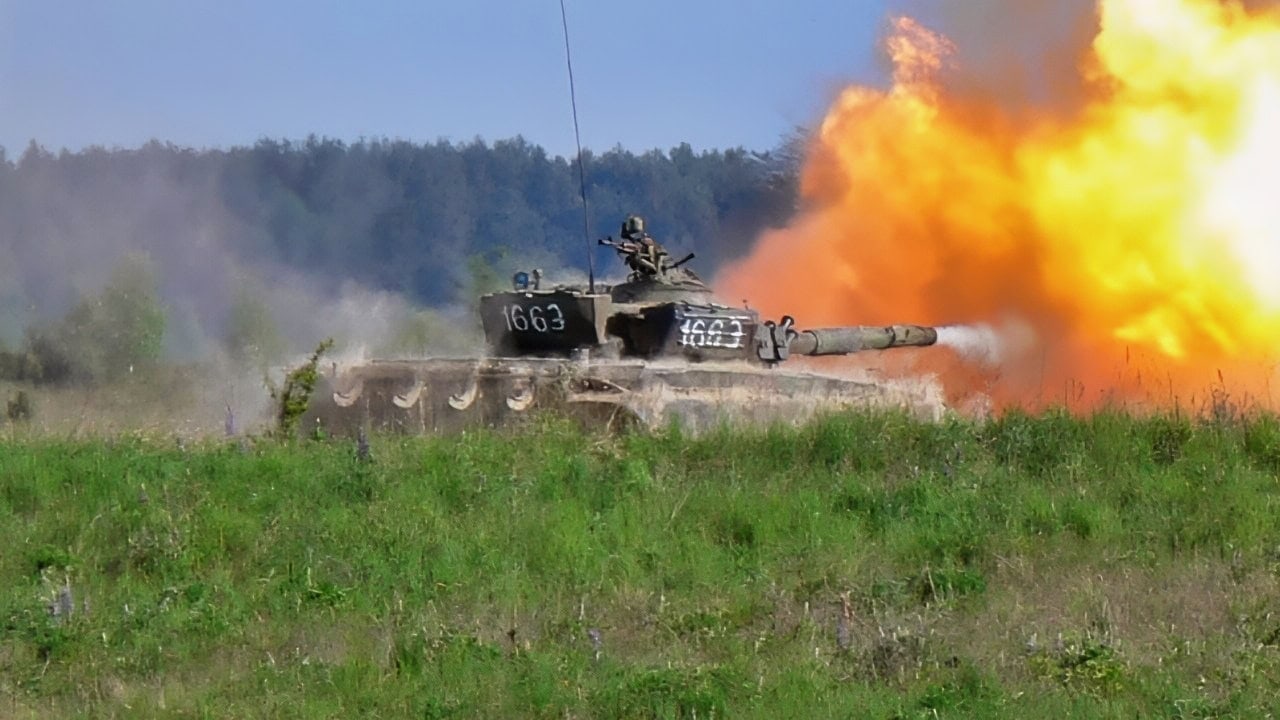
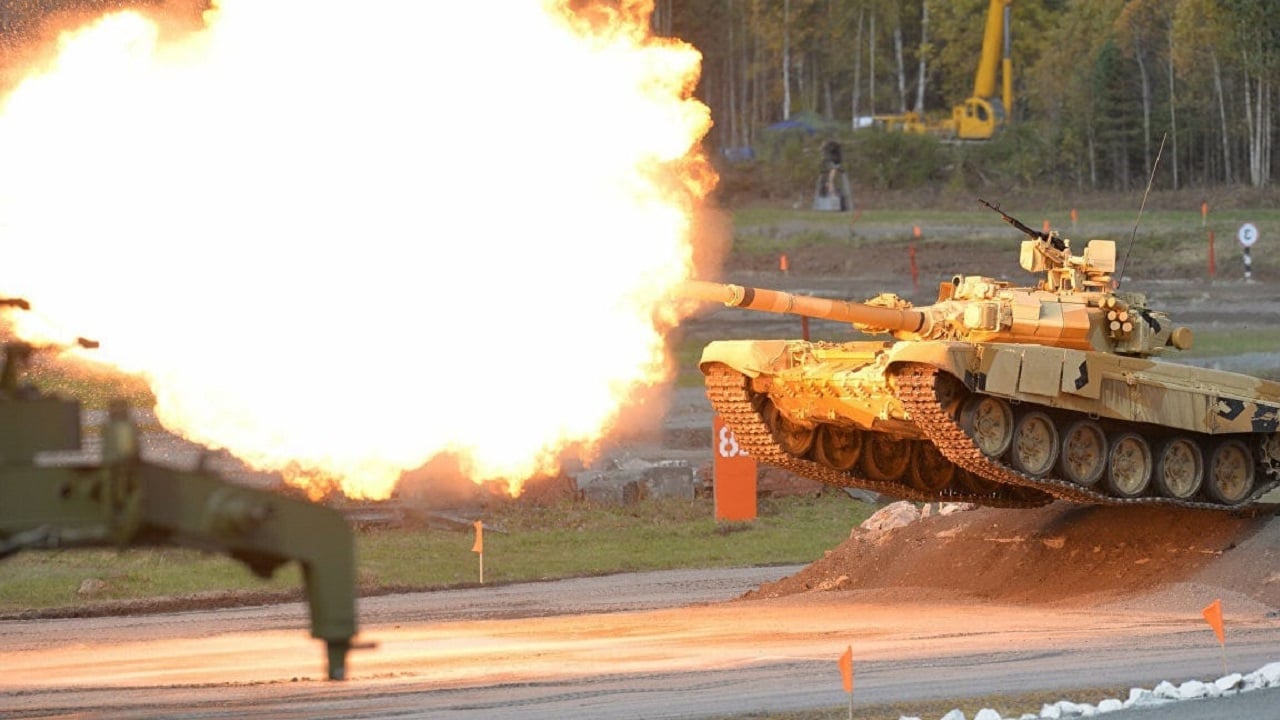
The T-72 is a Soviet-designed main battle tank that has been in production for decades, featuring a 125 mm main gun and composite armor.
Specifications

General

Crew3 (commander, gunner, driver; autoloader replaces the loader)
Armor TypeComposite
Weight Tonnes41 tonnes
Engine Power Hp780 hp
Main Gun Caliber Mm125 mm

Other

Era PackagesKontakt-1, Kontakt-5 or Relikt explosive reactive armour depending on variant
Powerplant B3mV-92S2F diesel, 1,130 hp on T-72B3 obr. 2016 / T-72B3M (Russian industry figure)
Operators Count40+ countries (est.)
Max Road Speed Kmh60
Operational Range Km500–700 (est., higher figure with external fuel drums)
Total Production Units~25,000 (est., all variants including licensed production)
Autoloader Carousel Rounds22 ready rounds in the hull carousel, ~17 additional rounds stowed (est.)
Latest Developments
Oct 12, 2026strong signal
US-Norwegian startup Heaviside launches Tyr loitering munition

Entity 'T-72' mentioned in report

Oct 3, 2026strong signal
Russia’s Shturm robotic tank debut ends stuck in the mud

Entity 'T-72' mentioned in report

Oct 3, 2026strong signal
Russia shows Shturm robotic tank system in big exercise

sending remotely controlled T-72-based vehicles to support assault troops during its Tsentr-2026 strategic exercise.

Sep 21, 2026strong signal
After hitting pilot training goal, resolving shortage will take years, Air Force official says

Air Force officials have floated the idea of consolidating flight training onto one platform: the T-7 Red Hawk

Sep 19, 2026weak signal
Russia’s next-gen Armata tank remains stuck a decade after debut

Entity 'T-72' mentioned in report

Sep 10, 2026strong signal
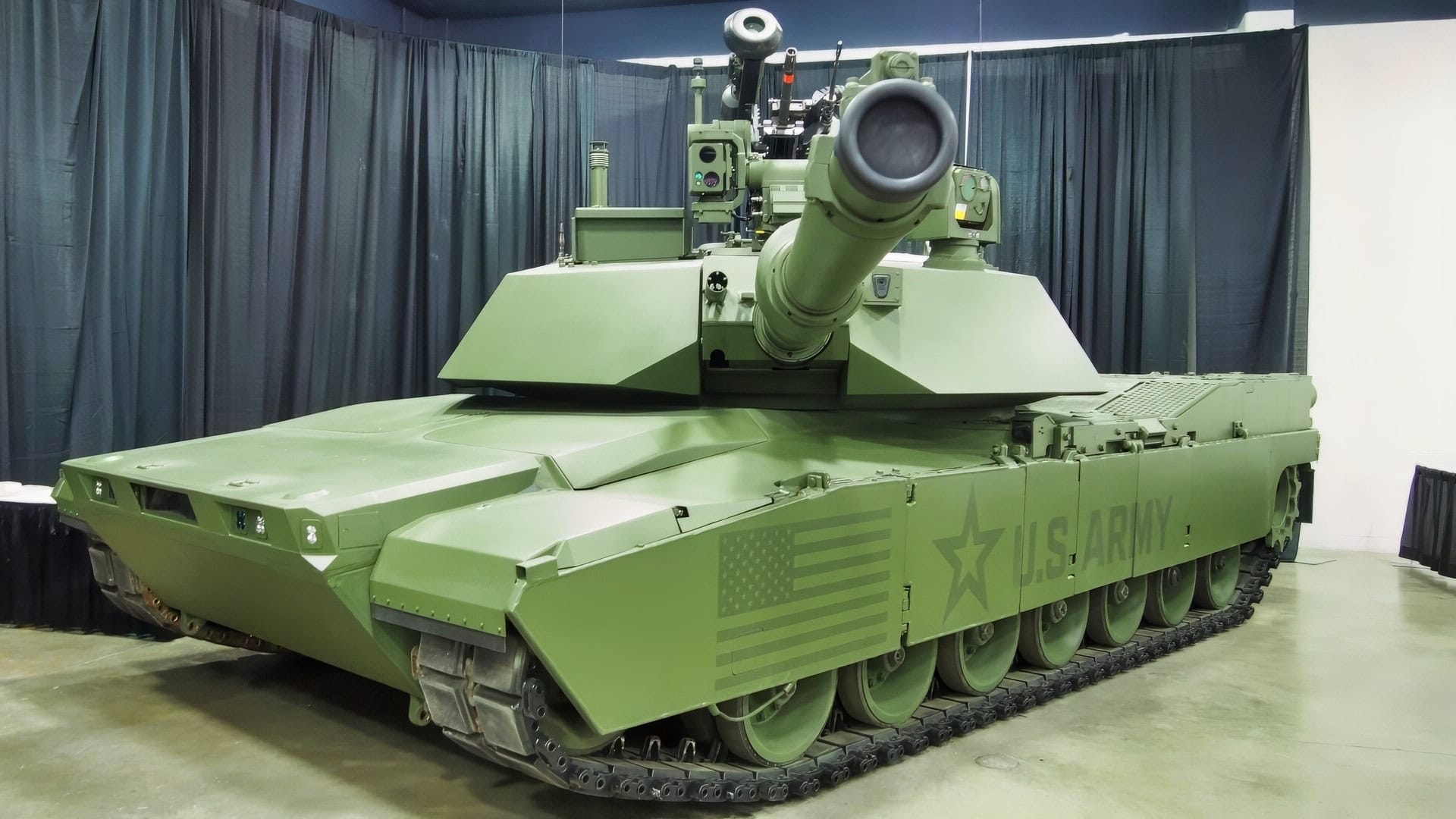
General Dynamics Is Delivering All 250 M1A2 SEPv3 Abrams Tanks to Poland in About 24 Months. Warsaw Ordered Them for $4,750,000,000 Along With 17 Bridge Layers and 26 Recovery Vehicles.

They will eventually replace Warsaw’s Soviet-era T-72 tanks, as well as the older, domestically upgraded PT-91 Twardys.

Featured Coverage
Research Notes

Mass-produced Soviet main battle tank family

medium

The T-72 became one of the most widely produced and exported Cold War main battle tanks, with many variants and modernization paths.

The T-72 is not a single fixed capability but a very large Soviet and post-Soviet tank family. It was designed as a comparatively compact main battle tank with an autoloader, low silhouette, and mass-production logic suited to Warsaw Pact and export needs.

FAS describes the T-72 as a main battle tank family with many variants and users. Uralvagonzavod's modern T-72B3 material shows how the original design continues through refurbishment and upgrade programs rather than only through new production.

For HiWars, the T-72 parent page should be a family overview. T-72 Ural, T-72A, T-72B, T-72M/M1, T-72B3, export versions, and local upgrades can differ greatly in armor, sights, engine, fire control, ammunition, and survivability.

Compact design, autoloader tradeoffs, and upgrade divergence

medium

The T-72's compact layout enabled mass and mobility, but its ammunition arrangement and older optics create major differences between variants.

The T-72 design emphasizes a low profile, a three-person crew, an autoloader, and a relatively compact package compared with many Western main battle tanks. Those choices supported production scale and tactical mobility, but also shaped survivability and ergonomics.

Variant differences are critical. Older export T-72M1 vehicles, Soviet T-72B tanks, and Russian T-72B3 modernizations should not be collapsed into one capability. Fire-control upgrades, thermal sights, reactive armor, communications, engine improvements, and ammunition quality can change battlefield value substantially.

The tank's ammunition storage and autoloader layout have been heavily discussed in relation to catastrophic losses. A careful page should explain this as a design and employment issue without pretending every destroyed tank failed for the same reason.

Quantity, modernization, and combat attrition

high

T-72 relevance today comes from huge inventories, upgrade programs, and losses in modern wars rather than from original Cold War design alone.

The T-72 remains relevant because so many states inherited, bought, upgraded, stored, or captured the type. Large inventories mean the tank can shape wars even when individual vehicles are older than competing designs.

Modern combat has shown both the value and limits of the family. T-72 variants can still provide firepower and protected mobility, but they are vulnerable to mines, artillery, drones, anti-tank missiles, poor maintenance, weak training, and unsupported employment.

HiWars should track T-72 records by exact variant, upgrade, operator, storage or active status, and combat-loss confidence. A raw tank count is less useful than knowing which T-72 standard is being counted and how it is supported.

Key parameters at a glance

medium

Headline figures are open-source estimates unless stated; performance varies widely between the 1973 baseline and current Russian modernisations.

Role
Third-generation main battle tank, mass-production line of the Soviet/Russian armoured force
Service entry
1973(Soviet Army acceptance)
Crew
3(autoloader replaces the loader)
Main gun
125 mm 2A46-series smoothbore, firing APFSDS, HEAT-FS, HE-FRAG and gun-launched ATGMs on later variants
Ready ammunition
22rounds in hull carousel (est.)
Combat weight
41–46t (varies by variant and ERA fit)
Powerplant
V-46 780 hp on early builds, up to V-92S2F 1,130 hp on T-72B3M(Russian industry figure)
Protection
Composite hull and turret armour supplemented by Kontakt-1, Kontakt-5 or Relikt ERA; cage and net anti-drone screens added in Ukraine
Total production
~25,000units (est., incl. licensed production)
Russian losses in Ukraine
~1,620 T-72-family vehicles visually confirmed (reported)of ~4,400 Russian tanks documented

Program milestones

medium

Publicly reported milestones from the Object 172M prototype to wartime stockpile reactivation.

1968Object 172M development

Uralvagonzavod in Nizhny Tagil develops a simplified alternative to the Kharkov-built T-64, substituting a conventional V-2-derived diesel and a carousel autoloader for the T-64's more complex machinery.

1973Accepted into Soviet Army service

The T-72 'Ural' is adopted and enters series production. Its lower unit cost and easier manufacture make it the tank produced in volume for line formations and for export.

1979T-72A

Laser rangefinder, improved fire control and thicker turret armour. The T-72M and T-72M1 export derivatives are licence-produced in Poland, Czechoslovakia, Yugoslavia, India and Iraq, seeding dozens of local variants.

1985T-72B

New composite turret, Kontakt-1 ERA, the 9K120 Svir gun-launched missile system and an 840 hp V-84 engine. The T-72B remains the basis for most later Russian rebuilds.

1991-02Gulf War combat test

Iraqi T-72M/M1 and locally assembled 'Lion of Babylon' tanks engage US M1A1 and British Challenger 1 units at 73 Easting and Medina Ridge. Downgraded export ammunition and fire control contribute to heavily one-sided results.

2013T-72B3 fielded

Russia begins large-scale rebuilds rather than new-build tanks: Sosna-U multichannel gunner's sight, digital radios and refreshed drivetrain, but initially no new engine or ERA package.

2016T-72B3 obr. 2016 / T-72B3M

Relikt ERA on hull and turret sides, the 1,130 hp V-92S2F engine and an improved automatic transmission (Russian industry figures). This becomes the standard Russian modernisation configuration.

2022Ukraine war attrition and stockpile reactivation

Heavy losses on both sides drive Russia to withdraw stored T-72A and T-72B hulls for refurbishment, while NATO members transfer T-72M1, T-72AV and Czech-upgraded tanks to Ukraine.

Strategic significance

medium

The T-72's strategic weight comes from quantity rather than individual capability. Designed to be cheaper and simpler to build than the parallel T-64, it was produced in numbers no post-1945 tank has matched and was licence-built in Poland, Czechoslovakia, Yugoslavia, India and Iraq. That industrial spread left a global fleet in more than forty countries, and a matching global supply of hulls, spare parts and locally evolved derivatives such as the Polish PT-91, the Yugoslav M-84, the Czech T-72M4 CZ and Iraq's 'Lion of Babylon'. It also means both sides in the war in Ukraine operate close relatives of the same vehicle.

The design's defining trade-off is the carousel autoloader. Removing the loader cut the crew to three and allowed a very low silhouette and light combat weight, but it placed propellant charges in an unprotected ring on the turret floor. A penetration that reaches the carousel typically detonates the whole load at once, blowing the turret clear of the hull — the 'jack-in-the-box' effect first widely noted in the 1991 Gulf War and recorded repeatedly on video since 2022. Add-on ERA, cage armour and, on a small number of vehicles, the Arena-M active protection system address the threat of being hit, not the consequences of a hit, and the vulnerability remains inherent to the layout.

Since 2022 the T-72 has become the clearest indicator of the depth of Russia's armoured reserves. Visually confirmed losses run to roughly 1,620 T-72-family vehicles within a documented Russian tank total of about 4,400 (reported), a rate that new production at Uralvagonzavod cannot cover; the shortfall is met by pulling Soviet-era hulls from long-term storage and rebuilding them to T-72B3 and T-72B3M standard. Analysts tracking those storage bases report that the better-preserved T-72B stock has largely been consumed, pushing refurbishment onto older and less complete T-72A hulls (analyst estimate). How long that reserve can absorb attrition — rather than the performance of any single upgrade package — is the more consequential question for the balance of armoured forces in Europe.

Videos

Ukraine & T-72: The Death of the Tank? (The Tank Museum)

Watch on YouTube

Why the Russian Army T-72 Tank Is Worse Than You Think (Task & Purpose)

Watch on YouTube

T-72: the most widely fielded third-generation MBT (Fengren, Bilibili)

Watch on Bilibili
Sources & References
Related Discussions

No discussions about T-72 yet

Start the first discussion