
054B Luhe Ship Crosses Miyako Strait for the First Time, PLA's Shortcomings in Ocean Escort Begin to Be Addressed
 Li Minghui
054B Luohe Frigate Crosses Miyako Strait for the First Time, PLA Navy's Long-Distance Escort Shortcomings Begin to Be Addressed
On May 20, a three-page report released by Japan's Joint Staff Office contained a detail that was more interesting than the training exercise of the Liaoning aircraft carrier in the Western Pacific itself. On May 18, around 11 a.m., the Japan Maritime Self-Defense Force discovered the Chinese Navy's Jiang Kai III-class frigate 545 and the 901-type comprehensive supply ship Hulun Lake, approximately 520 kilometers northwest of Kume Island. It was later confirmed that the two ships crossed the waters between Okinawa Island and Miyako Island into the Pacific Ocean on May 19. The Japanese side specifically noted that this was the first confirmation of a Jiang Kai III-class frigate during the Japan Self-Defense Force's surveillance activities.
The Jiang Kai III-class is commonly referred to as the 054B-class frigate in China. The 545 Luohe frigate is not a large ship, and public interest is far less than that for the 055-class destroyer or the Fujian aircraft carrier. However, I believe that its appearance alongside the 901 supply ship in the Miyako Strait indicates that an old issue with the PLA Navy's long-distance fleet is being addressed: aircraft carrier groups and long-distance training cannot rely solely on expensive large destroyers; medium-sized anti-submarine, surveillance, communication, and supply escort platforms must keep pace.
The Japanese Report Reveals More Than Just a Single Ship Appearance
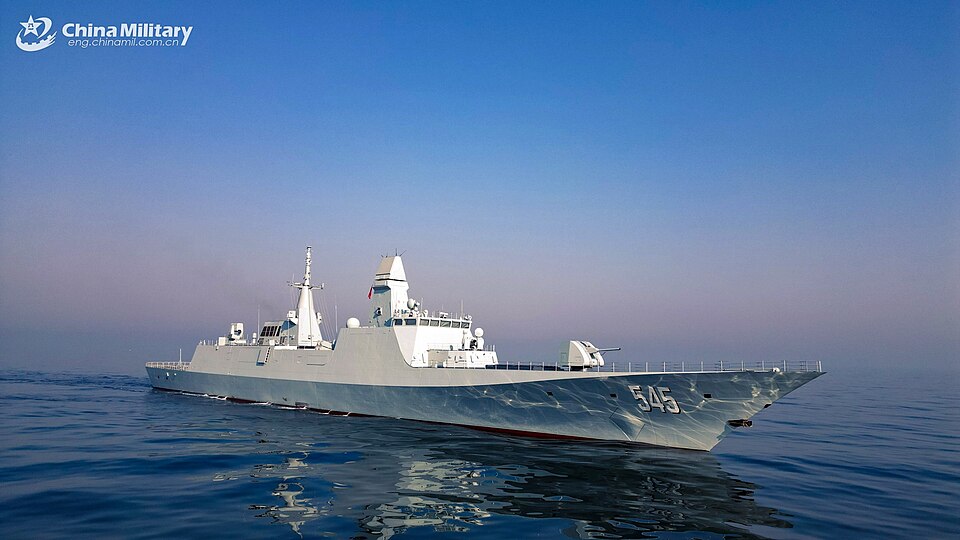
According to the English report from Japan's Ministry of Defense, on May 18, one Jiang Kai III-class frigate, hull number 545, and one 901-type fast combat support ship, hull number 901, were discovered. The two ships moved south from the northwest of Kume Island and entered the Pacific Ocean through the Miyako Strait on May 19. USNI News later confirmed on May 22 that the 545 ship is the Luohe frigate and the 901 ship is the Hulun Lake, observing them in the same context as the Liaoning aircraft carrier group training in the Western Pacific during the same week.
This pairing is worth a closer look. The Hulun Lake is a 901-type large comprehensive supply ship, with a full-load displacement typically considered to be around 40,000 tons, specifically designed for long-distance support of aircraft carrier groups. The 054B Luohe frigate accompanying it appears to be a routine transit, but in reality, it seems more like a test to verify whether the new frigate can undertake the surveillance and escort tasks of a long-distance support ship. In simple terms, an aircraft carrier group not only needs to launch and recover aircraft but also requires support on the periphery for anti-submarine operations, ensuring the safety of supply routes, and communication relay—these are the dirty and labor-intensive tasks.
The 054B Truly Supplements Anti-Submarine and Fleet Coordination
Public information about the 054B remains limited, and one cannot treat online rumors as specifications. What can be confirmed is that the Luohe frigate will be commissioned in 2025, and in January 2026, Chinese military media stated that it had formed a relatively complete integrated combat and diversified task capability. USNI's summary of the ship's technical characteristics is quite cautious: compared to the 054A, the 054B features a new air defense sensor layout, including a rotating array radar on the main mast and a second integrated mast; it retains a 32-cell vertical launch system; it has replaced the 100mm naval gun and missile-based close-in weapon system with different models; and its aviation facilities can accommodate the Z-20 anti-submarine helicopter.
The focus of these changes is not to turn the 054B into a smaller version of the 055. With over 40 units of the 054A already built, it shows that the Chinese Navy does not lack the number of general-purpose frigates. If the 054B is only slightly larger and has newer radar, its significance is limited. What it may truly supplement is the mid-level anti-submarine nodes that are most lacking in aircraft carrier and long-distance fleets. The complex sea conditions in the Western Pacific and the high intensity of US and Japanese submarine activities mean that relying solely on the hull sonar of the 055 and 052D, towed arrays, and helicopter resources is not economical. Allowing the 054B to carry the Z-20 into the open sea distributes the anti-submarine search radius and aviation support capabilities across more hulls.
- 545 Luohe frigate: The first batch of 054B ships, confirmed by Japan for the first time in surveillance around Japan.
- 901 Hulun Lake: A large comprehensive supply ship, serving the sustained operations of long-distance fleets.
- Transit waters: The area between Okinawa Island and Miyako Island is one of the main passages for the PLA to enter the Western Pacific.
- Concurrent context: The Liaoning aircraft carrier group went to the Western Pacific on May 19, with tasks including long-distance tactical flights, live-fire exercises, support cover, and comprehensive rescue.
Why the 054B Instead of the 055
If we only consider the deterrent effect, deploying a 055-class destroyer alongside the 901 ship would be more eye-catching. However, long-distance routine training cannot be configured solely based on visual impact. The 055 is more suitable for fleet area air defense, long-range strikes against sea and land targets, and command nodes; the 052D serves as the backbone for air defense; the value of the 054B lies in filling the outer anti-submarine, short to medium-range air defense, and escort tasks at a relatively low cost. The clearer this division of labor, the more it indicates that the Chinese Navy is shifting from platform display to system operation.
I do not fully agree with interpreting the 054B's crossing of the Miyako Strait as a simple "hard signal" to Japan. The signal certainly exists, especially after Japan participated in "Shoulder to Shoulder 2026" and conducted live-fire anti-ship missile exercises in the Philippines. However, from a technical perspective, the first confirmation of the 054B by the Japanese side seems more like a training milestone: the new ship transitioning from near-sea trials to long-distance fleet operations, putting sensors, data links, onboard helicopters, and supply ship escort processes to the test beyond the first island chain. This process may not be flashy, but it is more important than shouting slogans.
Shortcomings Still Exist in Quantity and Rhythm
The issues with the 054B are also very real. The publicly confirmed number of commissioned units is still small; the Luohe frigate and the Qinzhou frigate are just the beginning. To replace or supplement a large number of 054A ships for long-distance missions, the 054B needs to form a stable batch, rather than just two or three experimental vessels. Another issue is the delivery rhythm of the Z-20 shipborne anti-submarine variant. No matter how advanced the frigate's hangar is, without a sufficient number of anti-submarine helicopters, towed sonar, sonar buoys, and well-trained crews, the anti-submarine capability will still be compromised.
Another easily overlooked detail: the presence of the 054B alongside the 901 supply ship indicates that the Chinese Navy is training the supply ship itself for safe passage in long-distance corridors. However, in actual combat, supply ships are high-value, slow-moving targets that require protection from escort ships, aviation forces, and underwater capabilities. If the 054B becomes a common member of such an escort network in the future, its electronic warfare, anti-submarine helicopter sortie rates, and low detectability will be more worthy of observation than just the number of vertical launch systems.
Normalization Beyond the First Island Chain is Becoming More Detailed
The Liaoning's deployment to the Western Pacific is no longer news. The real new change is that the types of ships accompanying the aircraft carrier are becoming increasingly specialized: the 055 is responsible for long-range air defense and command, the 901 is responsible for continuous supply, the 076 and amphibious ships undertake unmanned and landing direction tests, and the 054B is beginning to appear in key passages. Systematization is not about lining up all advanced vessels for a group photo, but about having each type of ship undertake repeatable tasks in suitable positions.
Sources include the May 20 report from Japan's Ministry of Defense Joint Staff Office regarding the movements of Chinese naval vessels, USNI News' May 22 Western Pacific dynamics, the Chinese Ministry of Defense's May 19 news about the Liaoning aircraft carrier group's training in the Western Pacific, and USNI News' January 29 report on the operational capabilities of the 054B Luohe frigate.
What is truly worth watching next is not whether the 054B will cross the Miyako Strait again, but whether in the next Japanese report, it will appear alongside the aircraft carrier, the 901 supply ship, and the 055 destroyer on the same long-distance track. Only then will the 054B be considered a fixed component within the system rather than just a new ship making an appearance.
On May 19, the People's Liberation Army Navy's 054B-class frigate 545 (Luohe) and 901-class supply ship (Hulun Lake) traversed the Miyako Strait into the Pacific Ocean. This marks the first confirmation of the 054B-class frigate by Japanese forces, highlighting China's ongoing efforts to enhance its naval operational capabilities. The operation underscores the importance of logistics and support in long-range naval engagements.
- The 054B-class frigate 545 (Luohe) and 901-class supply ship (Hulun Lake) were confirmed to have crossed the Miyako Strait.
- This is the first confirmation of the 054B-class frigate by Japanese forces.
- The vessels were observed moving from the northwest of Kume Island into the Pacific Ocean.
- The operation is part of the Chinese Navy's efforts to enhance its long-range operational capabilities.
- The presence of the supply ship indicates a focus on logistics and support for naval operations.