
2026 PLA GJ-21 Completes Shipboard Takeoff and Landing, Type 076 Sichuan Ship Shifts to Unmanned Combat Node
 Li Minghui
2026 PLA GJ-21 Completes Shipboard Takeoff and Landing, Type 076 Sichuan Ship Transitions to Unmanned Combat Node
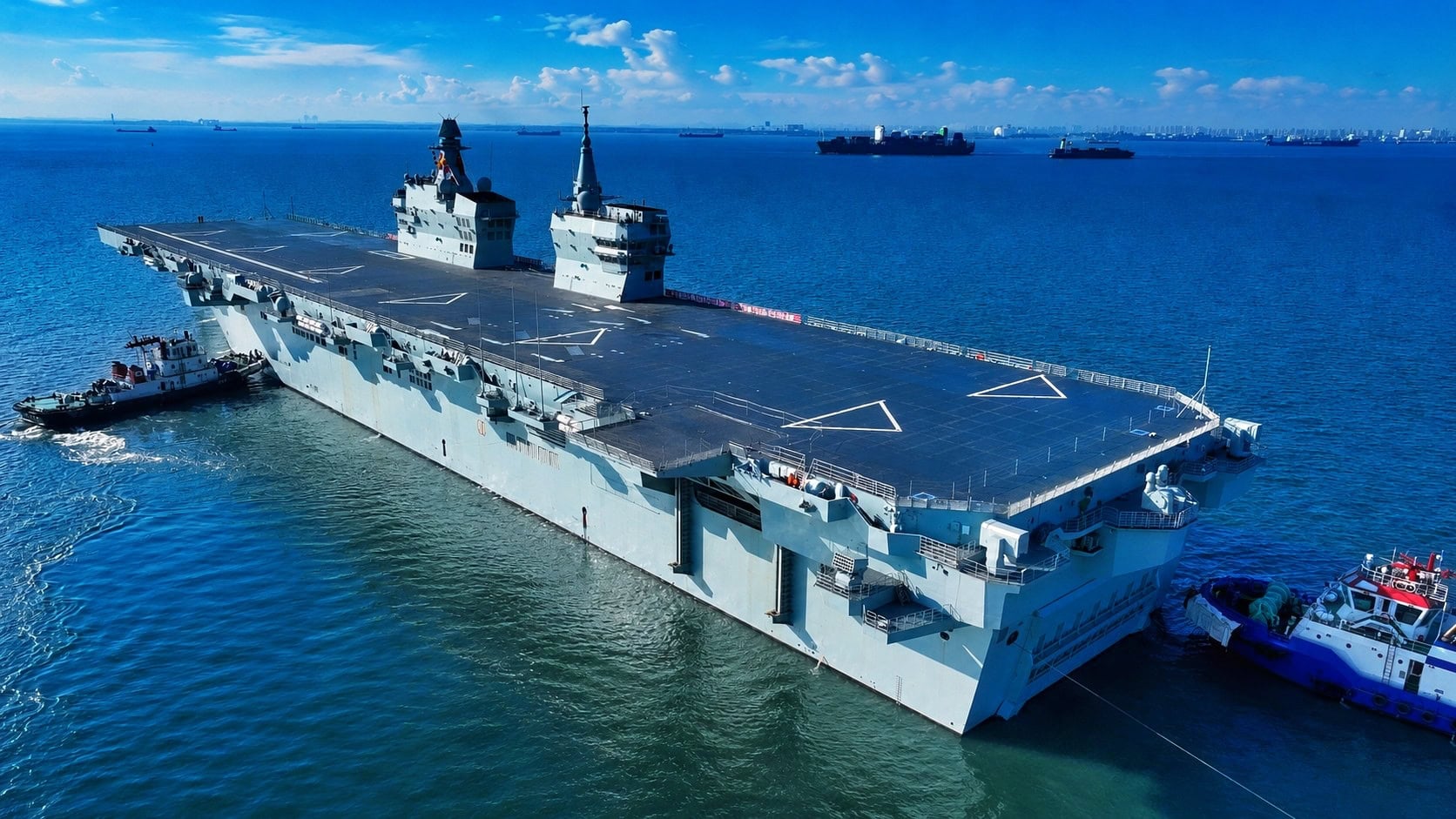
On October 30, relevant accounts of the PLA disclosed that the GJ-21 stealth unmanned combat aircraft recently completed its first takeoff and landing on the Type 076 amphibious assault ship Sichuan. The U.S. publication "The War Zone" subsequently verified this claim based on satellite imagery and public information, but as of the time of publication, the PLA has not released details on the test date, location, or number of flights, nor has it published any on-site photos or videos. Therefore, this is a piece of information with relatively high credibility, still awaiting official imagery for reinforcement.
This is not an ordinary drone boarding a ship
The GJ-21 is generally regarded as a carrier-based flying wing unmanned combat aircraft, with its technical foundation related to the land-based GJ-11. Its key aspect is not whether it can taxi off the deck, but whether it can accept electromagnetic catapult launches, use arrestor wires for recovery, and complete folding, transport, maintenance, and redeployment on board. In publicly available images, the GJ-21's nose landing gear is visible with a tow bar used for catapult launches, distinguishing it from ordinary vertical takeoff and landing drones.
The Sichuan ship, hull number 51, is approximately 263 meters long and 43 meters wide, with a publicly assessed full-load displacement exceeding 40,000 tons, equipped with an electromagnetic catapult and arrestor system. The U.S. Navy's Office of Naval Intelligence vessel identification data, along with previous measurements of satellite imagery by "The War Zone," indicate that its flight deck is significantly wider than that of the Type 075 amphibious assault ship. In simple terms, although this ship is still classified as an amphibious assault ship, its aviation operational logic is already approaching that of a dedicated drone mothership.
From Transport Platform to Maritime Aviation Node
The electromagnetic catapult allows the Sichuan ship to operate fixed-wing unmanned aircraft that are not suitable for vertical takeoff and landing. For the PLA Navy, such platforms can primarily undertake long-range reconnaissance, maritime target designation, and communication relay, expanding the fleet's perception range; in a conflict environment, stealth flying wings may also carry reconnaissance or strike payloads to execute forward missions in high-risk directions. More importantly, carrier-based unmanned aircraft do not need to be designed around pilot life support, cockpits, and ejection systems like manned combat aircraft, theoretically allowing for sustained operations with lower personnel risk.
However, do not equate a single takeoff and landing with the formation of combat capability. Shipboard takeoff and landing is merely a threshold; the real challenges lie in deck scheduling under changing sea conditions, catapult reliability, arrestor wire lifespan, unmanned aircraft autonomous landing algorithms, and the stable supply of fuel, spare parts, and data links. The Chinese Navy has already validated the electromagnetic catapult system on the Fujian ship, while the Sichuan ship transfers this technology to a vessel type that emphasizes unmanned aircraft and amphibious support. If the two can form synergy, the 075 and 076 fleets may achieve a reconnaissance radius greater than that of traditional helicopter amphibious assault ships.
Strategic Impact Depends on Scale, Not Single Tests
"The War Zone" cited satellite imagery from Planet Labs and Vantor indicating that the Sichuan ship briefly left the Shanghai shipyard in mid-October and returned around October 26; the arrestor devices and flight markings on the deck also suggest that test preparations have been ongoing for some time. This timeline is more valuable than a sudden promotional message, as it indicates that the GJ-21 shipboard tests may be part of a continuous engineering project rather than a one-time demonstration.
My judgment is that the Sichuan ship is more like a technology validation vessel for the PLA Navy's unmanned aviation in the short term, rather than an "unmanned aircraft carrier" capable of independently undertaking air superiority missions. Its value lies in bringing unmanned aircraft from land-based runways into distant maritime formations, exploring combinations of reconnaissance, decoy, electronic warfare, and limited strike capabilities. The U.S. Navy has publicly advanced carrier-based unmanned refueling and unmanned combat aircraft projects, but currently, the major navies in the Western Pacific are asymmetrical in their public progress on large carrier-based stealth unmanned aircraft, which may give the PLA a lead in experimental advantages.
The question is how many 076 ships or aircraft carriers the PLA will expand this capability to, how many sorties each can maintain, and what payload and range the GJ-21 actually possesses. Without this data, the so-called "unmanned aircraft carrier" remains just a title; however, if subsequent continuous sea trial imagery and batch carrier-based aircraft support facilities emerge, the Sichuan ship will no longer just be a new vessel but will become the starting point of the PLA's maritime unmanned combat system.
Sources
On October 30, 2026, the GJ-21 stealth drone successfully completed its first takeoff and landing on the Type 076 amphibious assault ship, Sichuan, marking a significant advancement in naval drone operations. The Sichuan, equipped with electromagnetic launch systems, is expected to enhance the People's Liberation Army Navy's operational capabilities in reconnaissance and strike missions. Ongoing testing indicates a continuous development project rather than a singular event.
- GJ-21 stealth drone successfully took off and landed on Type 076 amphibious assault ship Sichuan.
- The Sichuan ship is equipped with electromagnetic catapults and arrestor wires.
- The GJ-21 is designed for carrier operations, distinguishing it from typical vertical takeoff drones.
- The report suggests ongoing testing rather than a one-time event.
- The Sichuan ship's capabilities may enhance the PLA Navy's reconnaissance and strike operations.