
2026 South Korea MH-60R Sale Exposes the Alliance ASW Gap
 Marcus Chen
2026 South Korea MH-60R Sale Exposes the Alliance ASW Gap
Twenty-four additional MH-60R Seahawks sound like a big number until you put them against the water South Korea has to watch. The U.S. State Department's May 18 approval of a possible $3 billion sale would take the Republic of Korea Navy's planned Seahawk inventory from 12 to 36 aircraft. That is a serious expansion. It is also an admission that 12 helicopters were never enough for the job.
The Korean Peninsula is not a clean blue-water problem. It is a cluttered anti-submarine warfare fight in shallow seas, heavy merchant traffic, fishing fleets, islands, coastal clutter, and short missile timelines. North Korea's submarine force is old in many places, but old submarines in bad water still create operational work. Add Pyongyang's submarine-launched missile ambitions, Chinese naval movement through the Yellow Sea and East China Sea, and the U.S. Navy's own stretched ASW capacity, and the sale becomes more than a Korean procurement story.
It is a capacity correction for an alliance that has been underbuying airborne ASW.
The Package Is Built for Persistent Operations
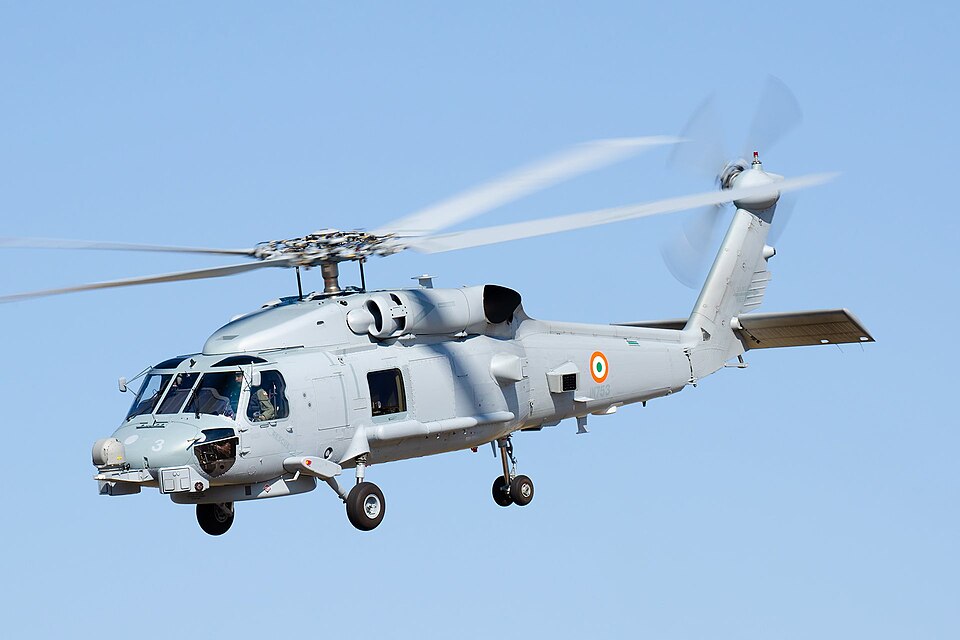
According to Army Recognition's summary of the Foreign Military Sale notification, the proposed package includes 24 MH-60R helicopters, 24 Airborne Low Frequency Sonars, APS-153(V) maritime surveillance radars, AN/ALQ-210 electronic support measures systems, AN/AAS-44C(V) electro-optical and infrared systems, missile warning gear, countermeasure dispensers, mission planning tools, trainers, spares, support equipment, and contractor logistics support.
That list matters. A token buy would stop at airframes and a thin training package. This one buys the equipment needed to generate detachments, train crews, maintain aircraft, and keep shipboard ASW packages moving. Seoul is not just replacing aging Super Lynx helicopters. It is trying to build a larger common fleet that can deploy from destroyers and frigates while keeping aircraft at home for maintenance and crew development.
Anyone who has served around shipboard aviation knows the arithmetic is unforgiving. A 36-aircraft fleet does not mean 36 aircraft available tonight. Some will be in deep maintenance. Some will be tied to training. Some will be in transit, inspection, or modification. If half to two-thirds are mission-capable on a given day, that is a better force than 12 aircraft, but it is not a magic blanket over the Yellow Sea, Korea Strait, and Sea of Japan.
The Old Fleet Was Too Fragmented
The ROK Navy already operates a mixed rotary-wing ASW force, including Super Lynx Mk.99/Mk.99A helicopters acquired in the 1990s and a small AW159 Wildcat fleet. The problem is not that these aircraft are useless. The problem is that small, aging, mixed fleets consume maintenance energy and training bandwidth while producing uneven coverage.
The MH-60R gives Seoul a more coherent architecture. The AN/AQS-22 Airborne Low Frequency Sonar lets the helicopter dip into the water and actively search in real time. The APS-153(V) radar, with periscope detection and discrimination features, is designed for small maritime targets in clutter. The aircraft can fuse acoustic, radar, electronic, and infrared inputs and pass the picture through datalinks to ships and aircraft. It can also prosecute contacts with Mk 54 lightweight torpedoes rather than merely localizing them for somebody else.
That is the right direction. But a larger Seahawk fleet also raises the alliance's expectations of South Korea. If Seoul fields 36 MH-60Rs, it will be expected to contribute more than coastal defense. It will be expected to help sanitize operating areas for U.S. carrier strike groups, amphibious forces, logistics ships, and Korean surface action groups under wartime pressure.
The Submarine Threat Is Not Just North Korean
The North Korean submarine problem is immediate because it sits close to Korean ports, naval bases, and missile-defense nodes. Sinpo-class and follow-on submarine-launched ballistic missile work gives Pyongyang a political weapon even before it becomes a fully reliable operational system. A diesel-electric submarine does not need to dominate the sea to complicate a naval campaign. It only needs to force escorts, helicopters, patrol aircraft, and command staffs to spend time proving water is safe.
But the wider geometry points south and west. The Yellow Sea is a hard operating area for U.S. and allied forces because it is close to Chinese land-based air and missile coverage. The East China Sea ties Korean ASW to Japanese and U.S. maritime patrol networks. In a Taiwan crisis, the U.S. Navy would not have unlimited P-8A sorties, destroyer sonar time, and helicopter detachments to spare for every allied task group. Korean MH-60Rs would become part of the coalition's undersea screen whether Washington says that plainly or not.
This is where the $3 billion approval fits the broader Indo-Pacific pattern. Singapore's P-8A interest, Japan's ASW aviation depth, Australia's submarine and P-8 enterprise, and South Korea's Seahawk expansion all point to the same conclusion: the alliance system is trying to buy sensors faster than China and North Korea can create underwater ambiguity.
Thirty-Six Seahawks Still Do Not Solve the Math
The useful way to look at 36 MH-60Rs is not as a fleet total but as a sortie-generation pool. Assume a conservative wartime planning figure: perhaps 18 to 24 aircraft available for operations after maintenance, training, and attrition buffers. Divide those across shipboard detachments, shore-based surge coverage, training pipelines, and contingency reserves. The number shrinks quickly.
A single destroyer or frigate detachment can consume one or two helicopters depending on mission design and deck capacity. Sustained ASW requires crews, fuel, sonobuoys, torpedoes, maintenance personnel, and command integration. The helicopter is only the visible end of a chain that includes acoustic processing, intelligence preparation of the environment, underwater sensors, maritime patrol aircraft, and surface combatants able to act on the contact.
That is why the sale is important but not decisive. It improves South Korea's ability to keep more sensors in the air and at sea. It does not remove the need for more P-8-class patrol capacity, unmanned surface and underwater sensors, better seabed awareness, and tighter U.S.-Japan-Korea information sharing. ASW is a network sport. Buying helicopters without the network only produces expensive flight hours.
The Real Test Is Integration
The political story is easy: Washington approved a major sale, Seoul is investing, and the alliance is stronger. The operational story is harder. South Korea has to absorb the aircraft, train crews, build maintenance depth, integrate shipboard procedures, and connect its undersea picture with U.S. and Japanese systems fast enough to matter before the next crisis.
The MH-60R is the right helicopter for that job. It is common with the U.S. Navy, mature, well understood, and built around the ASW mission rather than adapted to it as an afterthought. A 36-aircraft fleet would give Seoul real weight in the undersea fight around the peninsula.
But the sale should not be oversold. It is not a shield. It is a bill coming due after years of assuming allied ASW capacity could be stretched across too much water. Thirty-six Seahawks give South Korea a better hand. They do not change the basic problem: in the western Pacific, the side that can find submarines repeatedly, at night, in bad water, under missile threat, gets to move fleets. Everyone else is guessing.
The U.S. State Department approved a $3 billion sale of 24 MH-60R helicopters to the Republic of Korea Navy, increasing its fleet to 36 aircraft. This expansion aims to enhance South Korea's anti-submarine warfare capabilities in the Yellow Sea and East China Sea, addressing the operational challenges posed by North Korean and Chinese naval activities. The acquisition includes advanced sonar and radar systems, indicating a significant upgrade in South Korea's maritime defense posture.
- The U.S. State Department approved a $3 billion sale of 24 MH-60R helicopters to South Korea.
- The sale will increase the Republic of Korea Navy's Seahawk inventory from 12 to 36 aircraft.
- The acquisition aims to enhance South Korea's anti-submarine warfare capabilities in a complex operational environment.
- The package includes advanced equipment for persistent operations and training.
- The expansion reflects a broader alliance strategy to counter submarine threats from North Korea and China.