
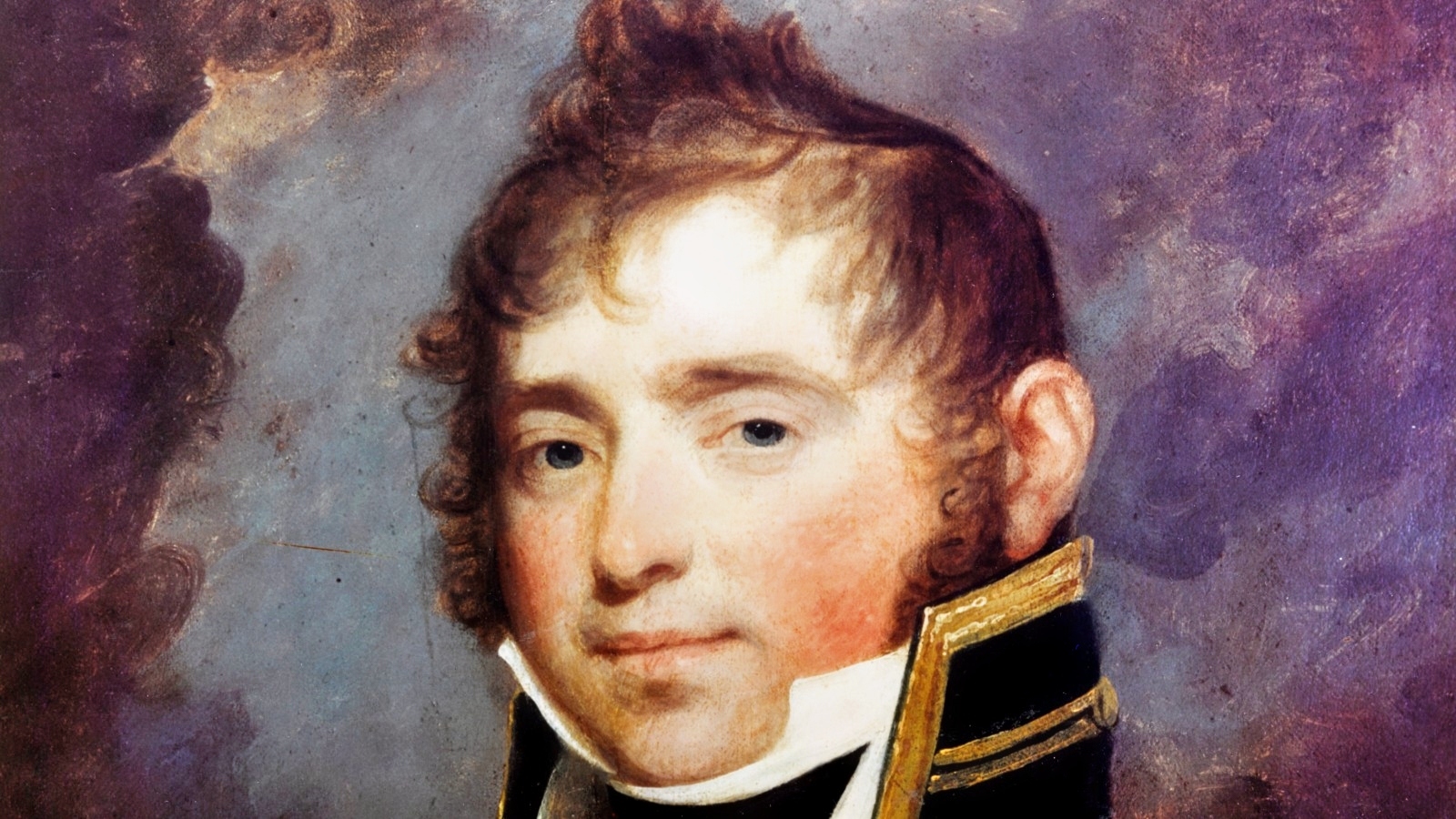
 Captain James Lawrence
Summary and Key Points: “Don’t give up the ship.” Captain James Lawrence said it on 1 June 1813, off Boston, as his men carried him below with a musket ball in him, and it became the most quoted line in the history of the United States Navy. The circumstances are almost never quoted with it.
Military Quote of the Day: “Don’t give up the ship!” – Captain James Lawrence
Along with “The Star-Spangled Banner,” Capt. James Lawrence’s declaration, “Don’t give up the ship,” was one of the most iconic moments of the War of 1812. Lawrence said this as he was taken away during the Battle of Boston Harbor in June of 1813.
According to the Naval History and Heritage Command website’s account, Lawrence was born in New Jersey in 1781.
His mother died when he was an infant, while his father fled to Canada, leaving the future captain to be raised by his older sister.
After studying law, Lawrence joined the Navy in 1798, at 17, first as a Midshipman.
He served in several wars, including the undeclared conflict with France and the War with Tripoli. In 1810, he was named Master Commandant.
According to his American Battlefield Trust biography, Lawrence came from a family of Loyalists, and unlike many who fought in the War of 1812, he had no family members who fought in the Revolutionary War.
“From the beginning of the War of 1812, Lawrence and Hornet cruised actively, capturing the privateer Dolphin in July 1812,” the naval history account said, making him the first American captain in that war to capture a British vessel. “Later in the year Hornet blockaded the British sloop Bonne Citoyenne at Bahia, Brazil, and on 24 February 1813 captured HMS Peacock.”
That March, Lawrence returned to the U.S. and was promoted to captain, taking command of the frigate Chesapeake and heading towards Boston.
How History Was Made
Almost immediately after leaving port, the Chesapeake engaged the Royal Navy frigate, Shannon.
In that fight, the captain was struck by small arms fire.
“The Chesapeake was the larger ship and more heavily armed, but it had suffered heavy damage in recent years and was quickly repaired to make it seaworthy,” the Battlefield Trust account said. “The two ships fired on each other at close range, but it soon became clear that the British vessel had far better command of the sea, and did heavy damage to the Chesapeake’s officers and gun crews.”
The battle itself was short, lasting only 11 minutes by some accounts.
“Don’t give up the ship” he said, as he was carried below; he died on June 4. The British soon overwhelmed the ship and took it to Halifax, Nova Scotia.
However, in heeding their captain’s dying command, none of his men surrendered to the British.
Lawrence was described as “incredibly popular and generous with his peers, superiors, and subordinates,” and his death was widely mourned.
Legacy
The captain’s friend, Oliver Hazard Perry, had a special battle flag named with the phrase and later named his flagship the USS Lawrence.
Indeed, five ships have been named after Lawrence, per the Naval History website: “U.S. Brig Lawrence (1813-1825); U.S. Brig Lawrence (1843-1846); USS Lawrence (Destroyer # 8); USS Lawrence (DD-250); and USS Lawrence (DDG-4).”
Perry would fly that battle flag from the USS Lawrence later that year, during the Battle of Lake Erie, which was a victory for the United States.
Before the battle, Perry “gathered his men and pointed to the banner, telling them they would fight under Lawrence’s dying words.”
“It’s not just a USNA slogan; it’s a promise, a mindset, and a rallying cry that has guided the Navy for more than two centuries,” the Naval Academy tourism website says. Both the original flag and a replica hang at the Naval Academy today.
“It’s a rallying cry and inspires us to do more, to not give up, but also it stands for our core values of honor, courage, and commitment,” Midshipman First Class Kara Yingling, Class of 2012, said at the time of the flag.
Lawrence was buried first in Halifax, after the battle, but his remains were ultimately brought back to the United States, and he was buried at Trinity Church Cemetery in New York.
An elementary school in his hometown of Burlington, N.J., is named for the captain.
A long list of cities and towns throughout the country, called either “Lawrence” or “Lawrenceville,” are named for him, including in New Jersey, which is 26 miles from where Lawrence was born.
And to this day, “Don’t Give Up the Ship” remains the Navy’s watchword.
About the Author: Stephen Silver
Stephen Silver is an award-winning journalist, essayist, and film critic, and contributor to the Philadelphia Inquirer, the Jewish Telegraphic Agency, Broad Street Review, and Splice Today. The co-founder of the Philadelphia Film Critics Circle, Stephen lives in suburban Philadelphia with his wife and two sons. For over a decade, Stephen has authored thousands of articles that focus on politics, national security, technology, and the economy. Follow him on X (formerly Twitter) at @StephenSilver, and subscribe to his Substack newsletter.