

The A-12 Avenger II, The Navy’s Flying Dorito, Never Had a Chance to Shine
The US Navy made history about ten years ago by launching the stealthy X-47B demonstrator drone from the deck of an aircraft carrier.
But the Navy had long-sought-after technological capability intended to usher in a new era of carrier air attack.
In 1983, the Air Force unveiled the first stealth aircraft, the F-117 Nighthawk.
The Navy wanted its own stealth attack aircraft to replace the A-6 Intruder.
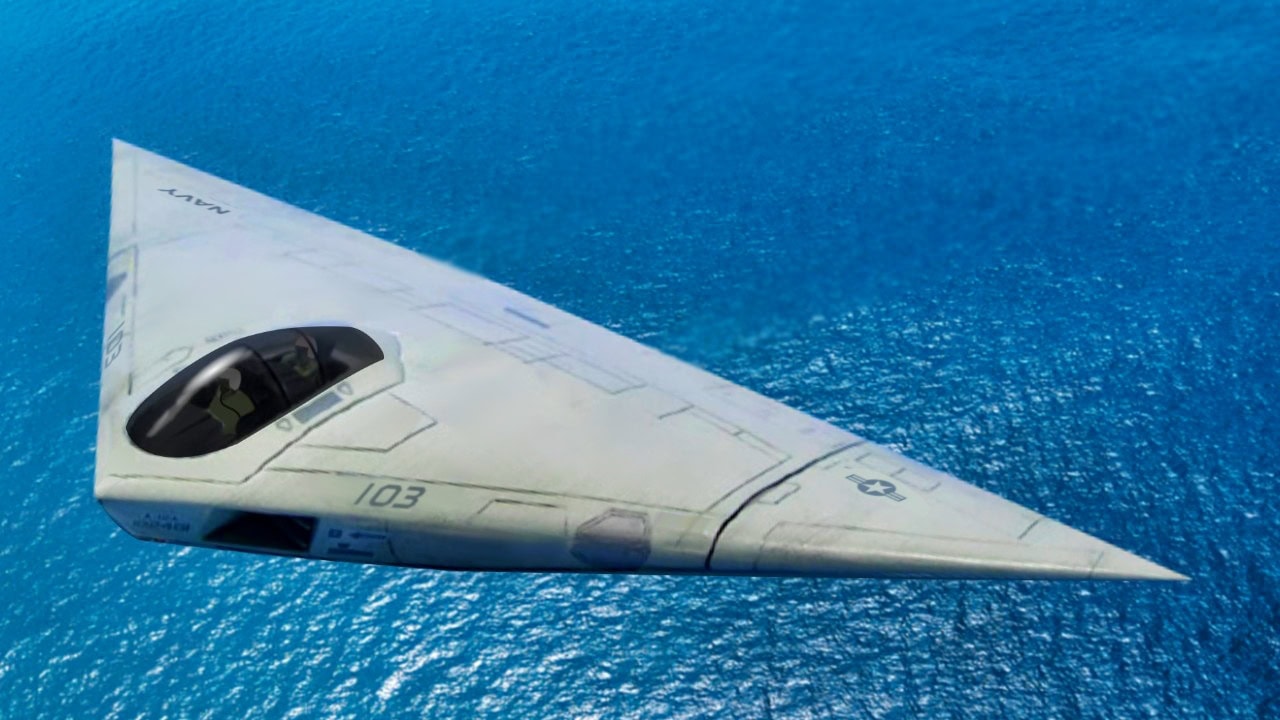
A-12 Avenger II. Image Credit: Creative Commons.
The result was the intriguing A-12 Avenger II, known as “The Flying Dorito,” due to its triangle, flying wing shape.
The A-12 Avenger II was a proposed American stealth, flying-wing attack aircraft intended for the U.S. Navy and Marine Corps to replace the A-6 Intruder.
The A-12 program was a joint venture developed by McDonnell Douglas (now Boeing) and General Dynamics.
It was canceled in 1991 due to cost overruns, weight issues, and technological hurdles, particularly the difficulty of landing a drone on a moving carrier, despite already having spent $5 billion.
Meet The A-12 Avenger II
Around the same time that the F-117 was being developed, as part of the Advanced Tactical Aircraft (ATA) program in 1983, the A-12 was envisioned to replace the A-6 Intruder with the new stealth capabilities.
The McDonnell Douglas/General Dynamics team was selected in 1988 to develop the A-12.
The Northrup/Grumman/Vought team dropped out and did not bid.
The goal for the first flight was December 1990. The A-12 was named Avenger II after the Grumman TBF/TBM torpedo bomber from World War II.
Initially, the Navy wanted 620 A-12s, the Marines wanted 238, and the Air Force considered 400 A-12 variants. The A-12 was considered as a replacement for the retiring F-111s by the Air Force.
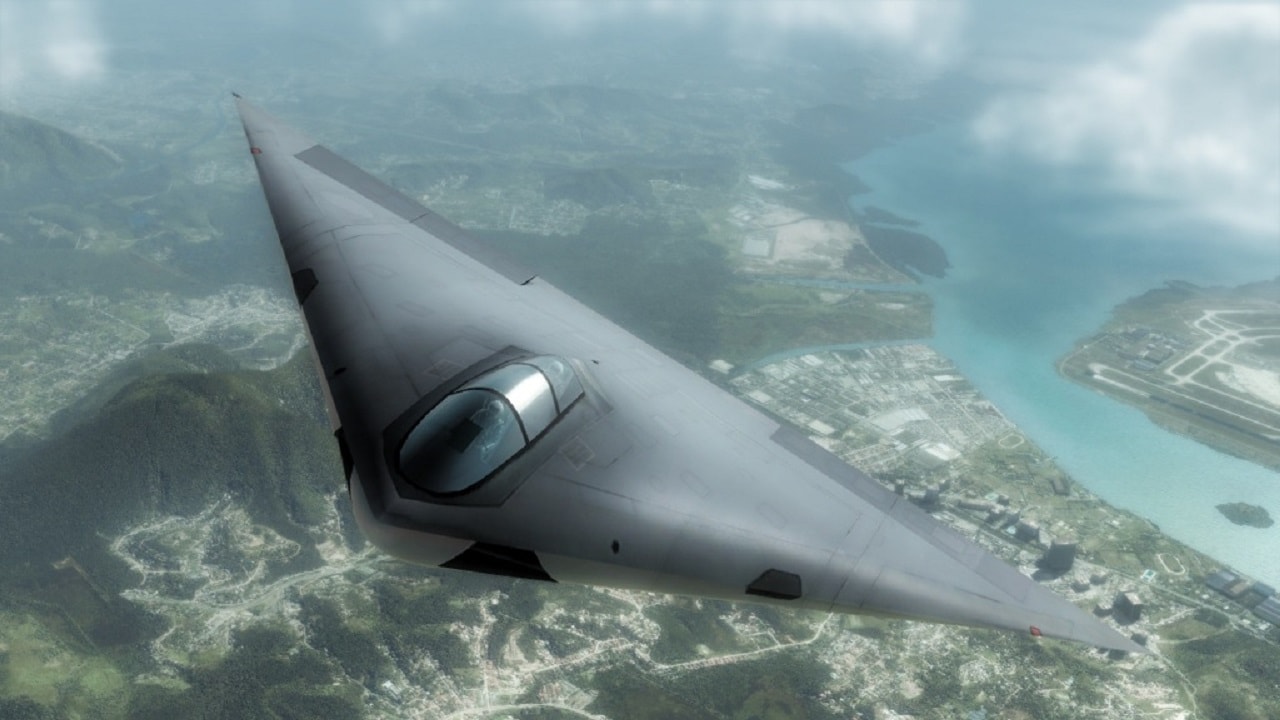
A-12 Avenger II. Image Credit: Creative Commons.
When the A-12 was being developed, Vice Admiral Richard Dunleavy, the Deputy Chief of Naval Operations (Air), on March 5, 1990, stated, “I like what I see and [it] will be a good airplane.”
Designers envisioned a flying wing design shaped like a triangle. It was this triangular shape that earned the A-12 the nickname of “Flying Dorito” after the Frito-Lay brand triangular corn chip.
Intended as a carrier-borne aircraft, the A-12 Avenger II was slightly more than 37 feet long, with a wingspan of a shade more than 70 feet. These dimensions would have made the A-12 significantly shorter than the 55-foot-long Intruder, while having a far wider wingspan that extended just far enough to allow two A-12s to sit side-by-side on adjacent catapults on a carrier flight deck.
In fact, the A-12’s wingspan would have even dwarfed the F-14 Tomcat’s extended sweep wings by a good six feet.
The Payload Was Small Compared To The Intruder
The A-12 didn’t have a large payload; however, it could carry only 5,150 pounds of ordnance, far less than the Intruder’s 18,000 pounds.
The Avenger II would carry two air-to-air missiles; it was also intended to have two AGM-88 HARM air-to-ground missiles.
The AGM-88 was an anti-radiation missile, meaning it could home in on the electromagnetic emissions from early-warning radar arrays and surface-to-air missile platforms.
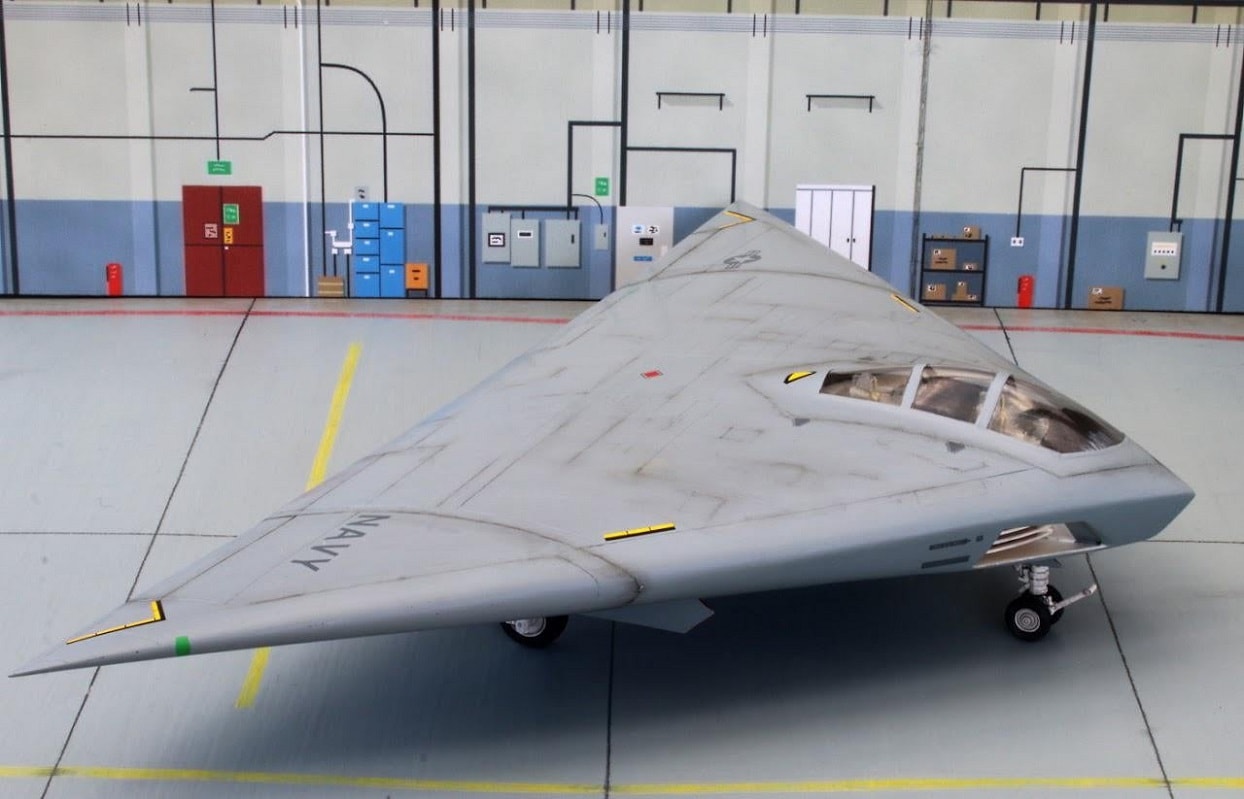
Artist Rendering of A-12 Avenger II. Image: Creative Commons.
In terms of projected use, the A-12 Avenger II would have been able to serve in a similar capacity to today’s F-35 Joint Strike Fighters in contested airspace.
It wouldn’t have been a bomb truck like the A-6, but a fighter that would appear and take out a target quickly by dropping precision munitions.
The A-12 Avenger II Program Was Canceled By Dick Cheney
However, in 1991, the project was canceled by the Pentagon and former Vice President Dick Cheney for cost overruns, weight challenges, and other technological complications, according to an article by Dr. Brent Eastwood.
“Cheney saw it as an expensive albatross that was getting more costly each year,” Eastwood said.
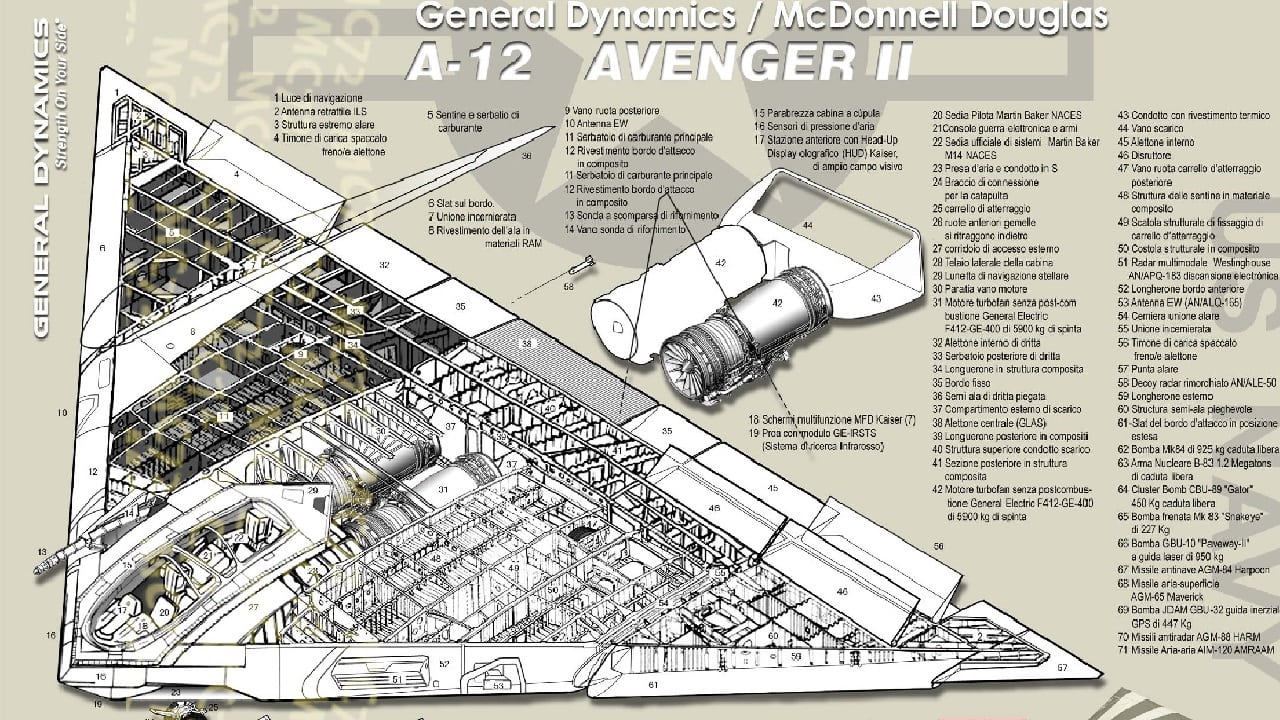
A-12 Avenger diagram. Image Credit: Creative Commons.
“The Cold War was ending, and maybe another bomber just wasn’t in the cards. Cheney likely considered the number of bombers across the military sufficient during Operation Desert Storm, and that the Navy could get by with cruise missiles. Taking all this under consideration, he requested Congress to cease funding for the A-12.”
The once-promising A-12 Avenger II program was ultimately abandoned in favor of the F/A-18 Hornet, which proved to be an outstanding, versatile aircraft. However, the cancellation left the Navy with gaps.
The A-12 Avenger II’s Cancellation Came At A Cost
The cancellation of the McDonnell Douglas A-12 Avenger II in 1991 left a significant, multi-decade gap in US Naval aviation, specifically eliminating the Navy’s planned dedicated low-observable (stealth), long-range, deep-strike capability.
The “Flying Dorito” was intended to replace the aging A-6 Intruder, but its termination forced the Navy to rely on the F/A-18 E/F non-stealth aircraft for decades until the arrival of the F-35C.
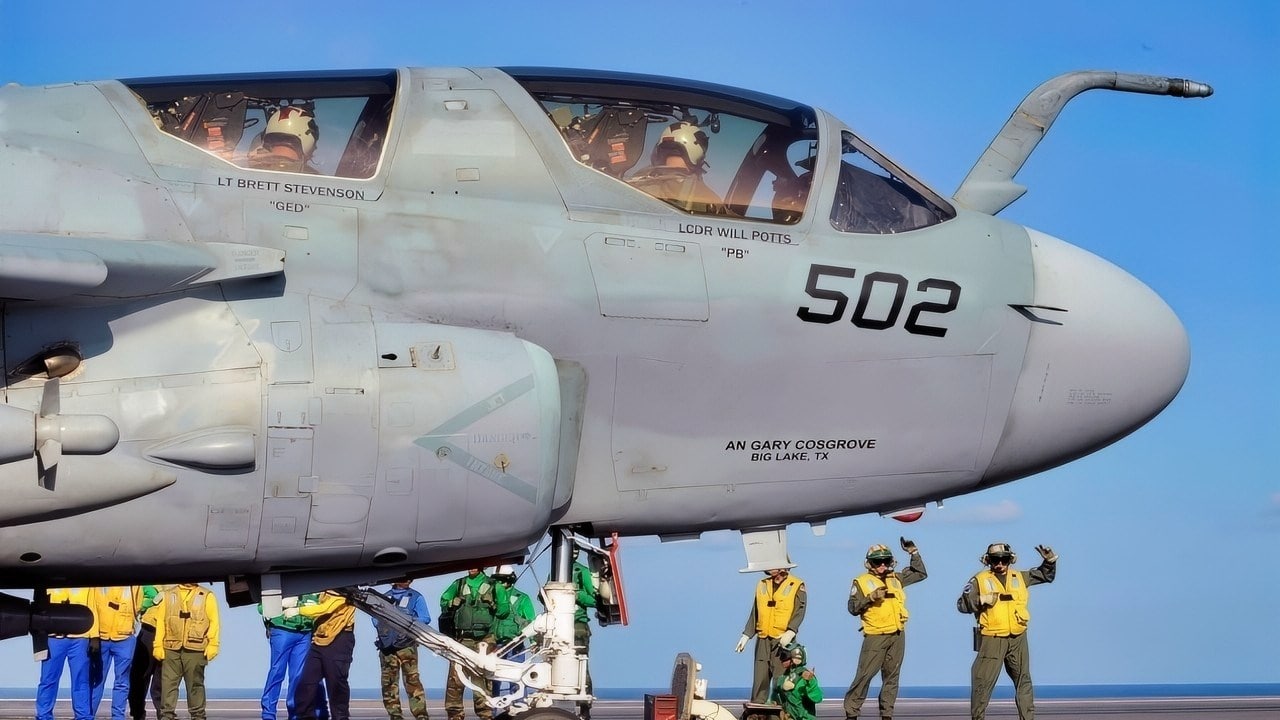
A-6 Intruder U.S. Navy Photo. Image Credit: Creative Commons.
This shifted the Navy’s plan from having a specialized stealth strike bomber to having multirole fighters. Without the A-12 and until the F-35C fielded, carrier air wings were optimized more for regional deterrence and “presence missions” than for independent, deep-strike operations against peer adversaries.
It left the Navy without a penetrating stealth aircraft for nearly 20 years.
While the program was a failure, the technological advances of the A-12, however, did lead to the successful fielding of the F-35C and paved the way for unmanned carrier-based concepts, such as the X-47B.
MORE – AUKUS – The Submarine Deal That Can’t Fail
MORE – The USS Gerald R. Ford Isn’t the Only Nuclear Aircraft Carrier to Have a Fire
About the Author: Steve Balestrieri
Steve Balestrieri is a National Security Columnist. He served as a US Army Special Forces NCO and Warrant Officer. In addition to writing on defense, he covers the NFL for PatsFans.com and is a member of the Pro Football Writers of America (PFWA). His work was regularly featured in many military publications.