

USS Hartford Hit USS New Orleans and Required $102.6 Million in Repairs – On March 20, 2009, USS Hartford, a 362-foot Improved Los Angeles-class nuclear attack submarine, collided with USS New Orleans, a 684-foot San Antonio-class amphibious transport dock, in the Strait of Hormuz. Hartford was submerged at periscope depth. New Orleans was entering the Persian Gulf.
Fifteen Hartford sailors suffered minor injuries. The submarine rolled roughly 85 degrees, damaging its sail, periscopes, and port bow plane. New Orleans suffered a ruptured fuel tank, damage to two ballast tanks, and a hole initially measured at 16 by 18 feet. Around 25,000 gallons of marine diesel escaped into the strait.
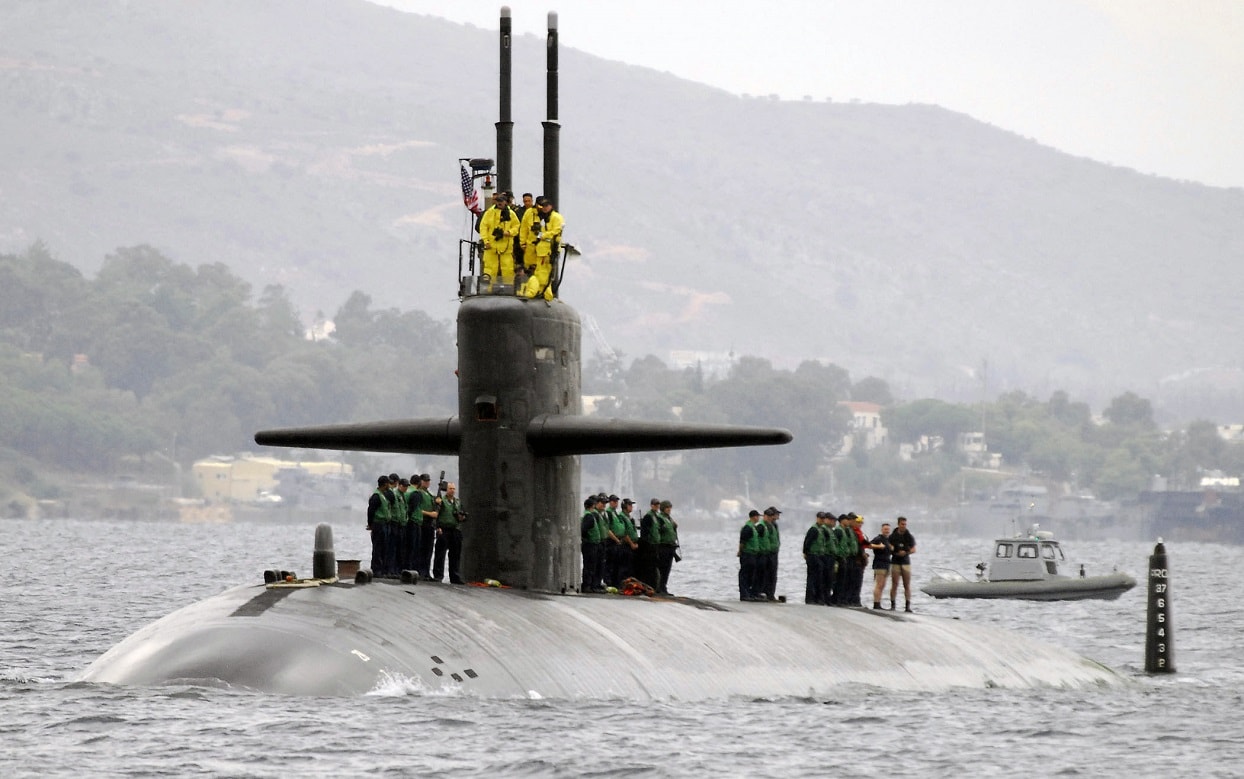
SOUDA BAY, Crete, Greece (Oct. 15, 2007) – Los Angeles-class submarine USS Oklahoma City (SSN 723) arrives in Souda Harbor for a port visit. The submarine was operating in the Central Command area of responsibility for the past five months since departing their homeport of Norfolk, Va. U.S. Navy photo by Mr. Paul Farley (RELEASED)
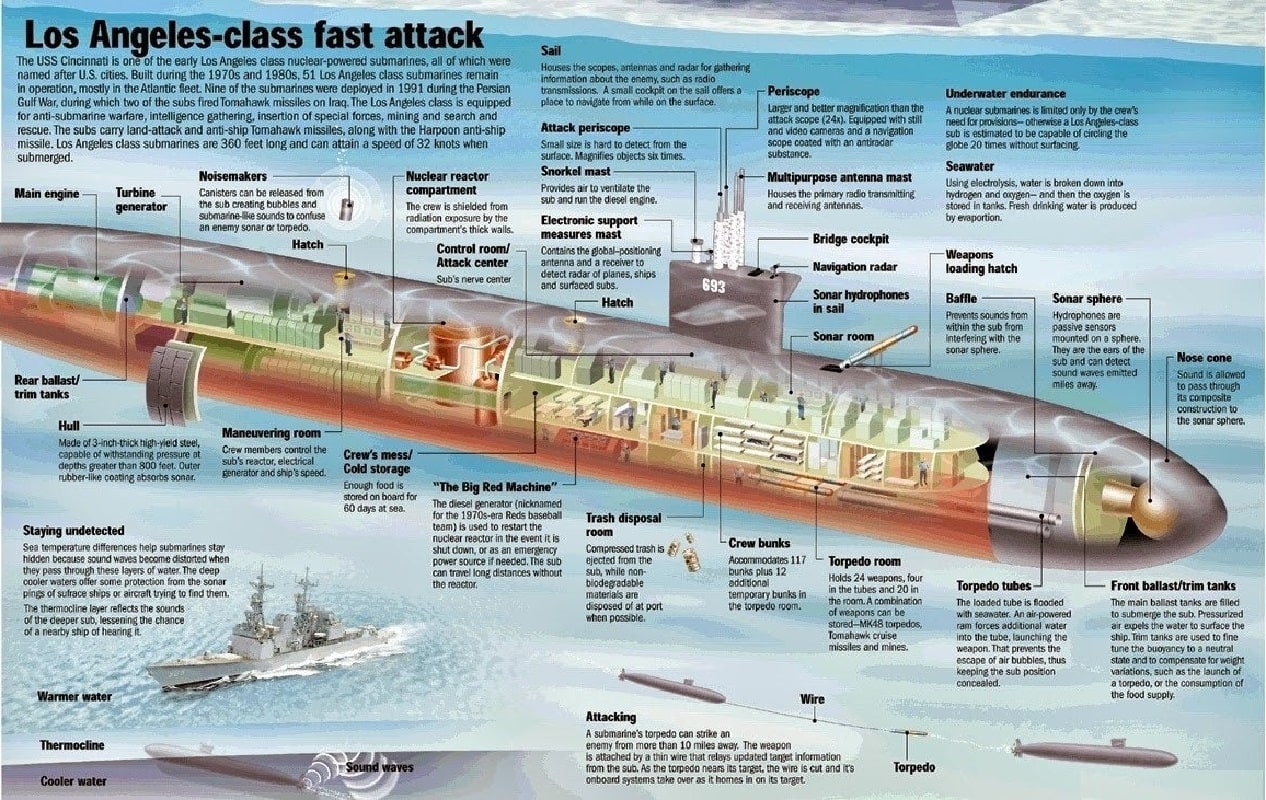
Los Angeles-Class diagram. Image Credit: US Navy.
The Navy awarded three major repair contracts totaling $102.6 million for Hartford. Repairs to New Orleans cost $2.3 million. Together, the two repair figures reached at least $104.9 million.
The money tells only part of the story. The Navy’s investigation found no failed sonar, bad navigation equipment, or hidden contact. Hartford possessed the sensor information needed to avoid the ship.
Failures in planning, contact management, supervision, and watchstanding led to one American warship colliding with another.
Hartford Was Crossing the Strait at Periscope Depth
The collision occurred at 12:58 a.m. local time. Hartford was heading south across the established traffic lanes. New Orleans was traveling west toward the Persian Gulf as part of the Boxer Amphibious Ready Group.
Operating at periscope depth in the crowded strait demanded tight coordination among sonar operators, fire-control technicians, the officer of the deck, and the periscope operator.
Hartford used periodic “dip scope” searches, raising a periscope for a brief visual sweep before lowering it again. The submarine had started another interrupted search shortly before impact.
New Orleans crossed its track while Hartford’s watch team failed to maintain a coherent picture of the contact.
Nearly 30 Errors Led to One Collision
The formal Navy investigation identified nearly 30 tactical, watchstanding, and supervisory errors during the hour before impact. Correcting any one of them might have broken the chain.
Commander Ryan Brookhart had not developed or communicated a comprehensive plan for crossing the strait.
Watch responsibilities shifted informally. Two fire-control technicians lacked a clear division of contacts.
The auxiliary sonar operator left the sonar space for extended periods, while informal conversations distracted watchstanders.
Periscope operators worked 30-minute rotations instead of the recommended 15 minutes. The officer of the deck assumed contact-management duties without a formal turnover and failed to look through the periscope again before impact.
The captain was not in the control room during the crossing.
The Navy assigned sole responsibility to Hartford. Investigators found no contributory fault aboard New Orleans and no equipment or doctrine failure behind the accident.
Hartford Rolled 85 Degrees
The collision raked Hartford’s sail against the underwater hull of New Orleans. The force rolled the submarine nearly onto its side. The reactor and propulsion plant remained safe, but the port bow plane went out of service, and both periscopes stopped working.
Hartford’s crew sounded the collision alarm, checked for flooding, and prepared to surface. The submarine eventually surfaced about 3,000 yards from New Orleans. Its damage ended normal submerged operations.
New Orleans slowed as its crew assessed a starboard list. Two ballast tanks flooded to the waterline, and seawater entered a fuel tank. Damage-control teams stabilized the list at roughly 1.5 degrees.
The ship’s stability was not endangered.
One Ship Returned in Weeks; Hartford Needed Nearly Two Years
New Orleans entered dry dock at the Arab Shipbuilding and Repair Yard in Bahrain. Workers repaired its hull, ruptured fuel tank, and ballast tanks. The ship returned to sea fully mission-capable on May 13, less than two months after the collision.
Hartford received temporary work in Bahrain before beginning a surface transit to Groton, Connecticut. Electric Boat fabricated and installed a new sail, bridge-access trunk, port retractable bow plane, and hull patch.
The three principal repair contracts reached $102.6 million.
The loss of one attack submarine came at a higher price. The Navy built 62 Los Angeles-class boats, but retirements and slow Virginia-class production have made every surviving Los Angeles-class submarine more valuable.
The accident also joined a troubling series of undersea mishaps. USS San Francisco struck an underwater mountain in 2005, killing one sailor and crushing its bow. USS Connecticut hit a seamount in 2021, leading to a repair effort lasting about five years.
The Chain of Command Paid the Price
The Navy relieved Brookhart in April 2009 for loss of confidence in his ability to command.
The chief of the boat was removed, while the executive officer, weapons officer, and other sailors faced nonjudicial punishment or administrative action.
The official finding went beyond one missed contact. Investigators described a command climate where unauthorized watch reliefs had become routine, standards went unenforced, and watch-team members lacked a questioning attitude.
The collision reinforced a basic undersea rule: formal contact ownership, disciplined watch turnovers, and independent cross-checks matter as much as sensor performance.
Hartford had the technology to avoid New Orleans. Its crew did not use the information in time.
New Orleans resumed operations on May 13, 2009.
Hartford did not return to duty until February 2011, nearly 23 months after the collision in the Strait of Hormuz.
About the Author: Harry J. Kazianis
Harry J. Kazianis (@Grecianformula) was the former Senior Director of National Security Affairs at the Center for the National Interest (CFTNI), a foreign policy think tank founded by Richard Nixon based in Washington, DC. Harry has over a decade of experience in think tanks and national security publishing. His ideas have been published in the NY Times, The Washington Post, The Wall Street Journal, CNN, and many other outlets worldwide. He has held positions at CSIS, the Heritage Foundation, the University of Nottingham, and several other institutions related to national security research and studies. He is the former Executive Editor of the National Interest and the Diplomat. He holds a Master’s degree focusing on international affairs from Harvard University.