
China Used Typhoon Dolphin to Rehearse a Taiwan Strait Blockade
 Marcus Chen
China Used Typhoon Dolphin to Rehearse a Taiwan Strait Blockade
At 6 p.m. on August 6, the Guangdong Maritime Safety Administration ordered every ship heading north through the southern entrance of the Taiwan Strait to submit to "traffic control measures." The stated reason was Typhoon Dolphin, the thirteenth storm of the season, moving through the Ryukyus toward the East China Sea. Vessels were told to "strictly comply with traffic control requirements" and "obey the instructions of on-site maritime management agencies."
Anyone who has stood on the bridge of a warship in those waters knows what that announcement really was. Typhoons do not hand a coastal bureaucracy jurisdiction over an international strait. This was not maritime safety. It was a dry run for a blockade, and it was not the first one Beijing has run this summer.
What Guangdong Actually Ordered
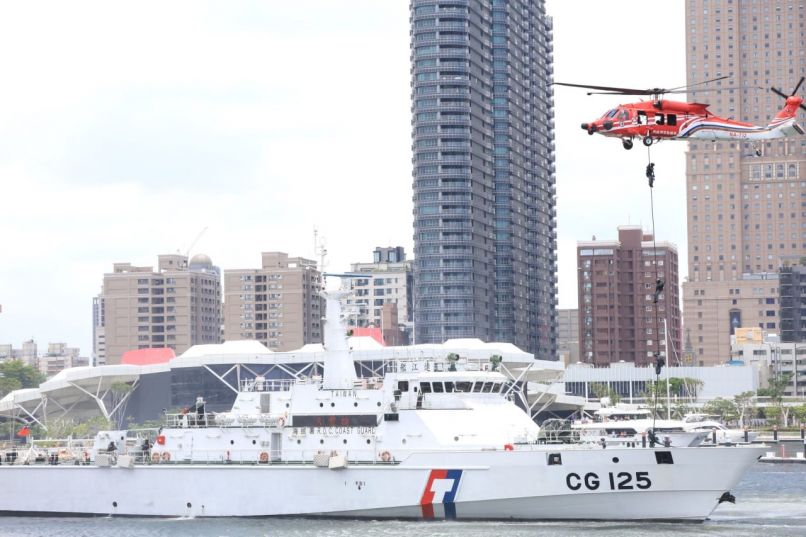
The notice, issued as navigation warning GD471/26, took effect at 18:00 on August 6 and applied to northbound traffic entering the strait from the south, where the waterway narrows to roughly 130 kilometers. Taiwan's Coast Guard Administration rejected it in unusually blunt terms: the Taiwan Strait is an international waterway, Beijing has no authority to control it, and merchant vessels should "disregard" Chinese radio instructions and report any interference. The Mainland Affairs Council called the order "utterly ridiculous," accusing Beijing of trampling international norms "under the pretext of a typhoon." The U.S. State Department weighed in on August 10, saying Washington "opposes any actions that interfere with high seas freedoms of navigation and overflight that apply in the Taiwan Strait."
Not Weather. Jurisdiction.
This was not an isolated improvisation. From June 6 to 10, Guangdong MSA ran a "maritime law enforcement" mission east of Taiwan, hailing commercial ships to assert its authority. China Coast Guard vessels have patrolled east of Taiwan continuously since June 1. During Dolphin, the CCG did something more pointed: ship 2307 approached the Japanese Coast Guard cutter Urado, which had taken shelter from the storm in the southern strait, and shadowed it up and down the waterway from August 6 to 10. Taiwan's Ocean Affairs Council deputy minister called it what it was: an attempt to use an emergency refuge to challenge sovereignty and jurisdiction.
"Taiwan allows vessels of all nationalities, including PRC ships, to seek shelter in Taiwan-administered waters in emergencies." — Taiwan Ocean Affairs Council Deputy Minister Sung Cheng-en
Read the pattern and the logic is obvious. Each episode is small: a notice, a patrol, a shadowing. Each one is deniable. And each one does the same thing — it conditions the international shipping community to treat the Taiwan Strait as Chinese regulatory space.
The Math Behind the Rehearsal
The strait is roughly 180 kilometers wide at its widest point and about 130 at its narrowest. Nearly all of it lies beyond any 12-nautical-mile territorial sea. Under UNCLOS, a coastal state has no authority to impose traffic control on foreign-flagged vessels transiting its exclusive economic zone. Legally, the Guangdong order was built on sand.
Operationally, it did not matter. The strait carries a substantial share of global container traffic, and more than 90 percent of Taiwan's energy arrives by sea. A blockade does not need to be airtight; it needs to be habitual. If foreign masters comply with Guangdong MSA in August 2026 because it is "just a typhoon," they will comply in a crisis because it is "just a quarantine zone." Beijing is not building a blockade in a single exercise. It is building the baseline of obedience that makes a future blockade cheap to impose.
The Response Problem
Washington answered with a State Department statement. Taipei answered with patrols and radio broadcasts. Tokyo has been quiet about the Urado shadowing. Statements do not change the baseline. A freedom-of-navigation operation through the strait would. A joint Taiwan-U.S.-Japan escort exercise for merchant shipping would. Neither happened.
That is the asymmetry that should keep planners awake. Beijing's measures — MSA notices, CCG patrols, radio hails, shadowing of allied cutters — cost almost nothing and compound daily. The response is a press release each time. The closer China gets to normalizing control of the strait in peacetime, the more expensive and politically explosive any U.S. response to an actual blockade becomes.
The Bottom Line
The blockade of Taiwan will not begin with a missile salvo. It begins with a notice to mariners that everyone obeys, then a traffic-control scheme nobody challenges, then a "law enforcement zone" ships avoid by habit. August 6 was step two. If Washington, Tokyo, and Taipei keep answering with statements, there will not be a step five — because by then, the strait will already be closed in every way that matters.
China rehearsed a blockade of the Taiwan Strait on August 6, 2023, by issuing traffic control measures for vessels under the pretext of Typhoon Dolphin. The Guangdong Maritime Safety Administration's order was rejected by Taiwan, which asserted the strait's status as an international waterway. The U.S. State Department condemned China's actions, highlighting concerns over navigation freedoms. This rehearsal is part of a broader strategy to normalize Chinese control over the strait.
- China issued traffic control measures in the Taiwan Strait under the guise of Typhoon Dolphin.
- Taiwan's Coast Guard rejected China's authority over the strait, calling it an international waterway.
- The U.S. State Department opposed China's actions, emphasizing high seas freedoms.
- China Coast Guard vessels have been patrolling east of Taiwan since June 1, 2023.
- The blockade rehearsal aims to condition international shipping compliance.