
Africa Corps strikes Kyrnia in Mali in 2026 — 8 civilians killed in a risky air war
 Marie Dubois
Africa Corps strikes Kyrnia in Mali in 2026 — 8 civilians killed in a risky air war
On June 15, in Kyrnia, in the Mopti region, a plane identified by two Malian military sources as a Su-24 dropped at least two munitions on a village held for several years by the Support Group for Islam and Muslims, the JNIM. This information is not a jihadist claim: it comes from an investigation published on July 31 by Human Rights Watch, which states that eight civilians were killed, including three children, with no Islamist fighters known among the dead.
This detail changes the interpretation of the incident. In central Mali, many villages live under jihadist constraint, trade under tax, sometimes host armed fighters, and then remain civilian spaces on market days. On the ground, it is precisely in this gray area that counter-insurgency wars are won or lost. In Kyrnia, according to HRW, it was this area that was bombed.
Kyrnia was not a simple target
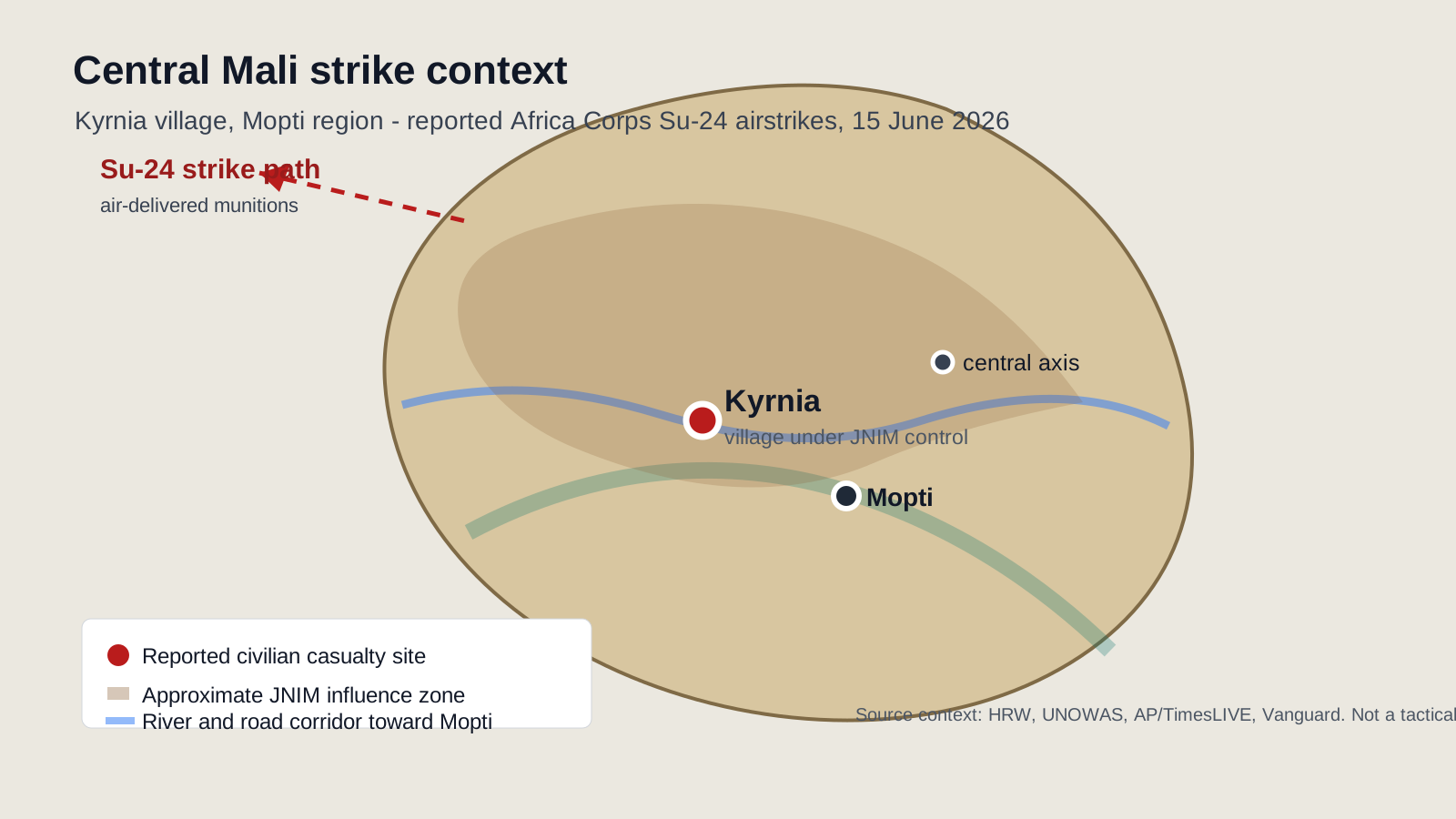
The first impact reportedly struck the vicinity of the village chief's residence, killing his wife, two of his children, and another child. The second reportedly hit a small cattle market located about twenty meters away, killing four men and injuring others. HRW states it interviewed 19 people between June 24 and July 14, including six witnesses, and analyzed satellite images, a video published by Africa Corps, and photographs later disseminated by an Islamist group.
The investigation cites two craters about twelve meters in diameter in the southern part of the village. It also mentions drone surveillance the day before. This matters. An improvised strike from a fast aircraft is one thing; a strike preceded by observation is another. It implies that someone saw, classified, and transmitted a target. The question is therefore not only whether JNIM fighters were present. They probably were. The military question is why the munitions fell on the house and the market, not on the mosque or the gathering point indicated by the witnesses.
The presence of JNIM does not turn the entire village into a target
According to witnesses cited by HRW, about 100 JNIM fighters were in Kyrnia at the time of the strike, notably near the mosque and a shop close to the market. Some were armed, others were riding motorcycles. The village is also described as a commercial hub where JNIM buys fuel, food, and supplies. In the Malian war, this type of locality is not rare: the state no longer really administers it, the armed group imposes order, and civilians continue to sell cattle because they need to survive.
This presents a tempting target for armies reasoning from the air. But experience shows that a market under enemy influence is not an enemy base. A truck similar to those used by JNIM in front of a notable's house is not enough to turn that house into a military objective, especially on a market day. If HRW's information is accurate, the strike on Kyrnia resembles less a tactical decapitation than a pressure action, with intelligence too crude for the targeted terrain.
The distinction between "jihadist control" and "combatant presence at the strike point" is decisive. In the inner Delta of Niger, confusing them amounts to bombing the civilian economy that keeps the villages alive.
The Su-24 signals a new Russian depth
The choice of aircraft is significant. HRW reports that two Malian military sources identified a Sukhoi Su-24. The Russian Ministry of Defense had already stated it was using this type of aircraft against militants, and observers had noted the presence of Su-24s supporting Malian forces since at least 2025. Officially, Bamako speaks of regained sovereignty; operationally, the strike chain seems increasingly dependent on Russian means that the Malian army did not possess at this level before.
This marks a break from the Barkhane period, not because French strikes were free of errors, but because the framework of control and justification has changed. Paris had to account publicly, sometimes poorly, often late, but within an identifiable political space. Africa Corps operates in a more opaque area. Wagner has been rebranded, then absorbed under more direct control from Moscow, but on the Malian ground, the effect for villagers is the same: Russian men and means are fighting alongside the Malian Armed Forces, with a margin of ambiguity that Bamako finds politically useful.
The AES chooses Moscow as pressure increases
The timing makes the matter heavier. On July 9, in Niamey, Russia and the Sahel States Alliance asserted that Moscow would continue to strengthen the operational capabilities of Mali, Burkina Faso, and Niger. The message was clear: after the expulsion of French and UN forces, the juntas are assuming the Russian pivot. But on July 31, the publication of HRW reminds us of the tactical price of this option when it relies on air firepower rather than on a patient ground network.
Mali is also in a phase of unusual military pressure. Simultaneous attacks on April 25 targeted Bamako, Kati, Gao, Kidal, and Mopti, according to the UN briefing on West Africa and the Sahel. AP, reported by TimesLIVE, describes tactical coordination between JNIM and the Azawad Liberation Front, two actors with different objectives but united against the Malian army and its Russian partners. ACLED sees a 35% increase in deaths related to militant attacks in the first seven months of 2026 compared to 2024. These figures do not tell the whole story, but they say enough: Russian air power has not reversed the dynamics.
The operational risk for Bamako
For Bamako, a strike like that in Kyrnia poses three problems. The first is legal: if allied forces commit a violation of the law of war on Malian territory, the Malian government cannot simply say that the plane was Russian. The second is tactical: each family affected in a given market gives JNIM a recruitment argument more effective than a communiqué. The third is political: the AES promises sovereignty, but civilians sometimes see sovereignty arriving in the form of a bomber and an investigation from Nairobi.
One must remain cautious. HRW has not received a response from the Russian Ministry of Defense, and Bamako has not provided a detailed public investigation. Africa Corps claims to have struck a terrorist gathering place and asserts that it killed commanders. At this stage, these claims are not confirmed by independent evidence. In an area controlled by JNIM, any information gathering is imperfect. But the imperfection of intelligence does not erase the central fact: eight civilian names are now associated with Kyrnia.
The next alert should be sought along the Mopti-Sevare axis and in the market-villages of the center. If Africa Corps and the FAMa continue to treat areas under jihadist control as shooting surfaces, JNIM will not need to win many conventional battles. It will only need to remain present after each strike, help retrieve the bodies, and then remind the survivors who bombed the market.
Africa Corps conducted an airstrike in Kyrnia, Mali, on June 15, 2026, resulting in the deaths of 8 civilians, including 3 children. Approximately 100 JNIM fighters were present in the village at the time of the strike. The aircraft involved was identified as a Sukhoi Su-24, indicating Russian military support. Human Rights Watch reported on the incident, highlighting the complexities of targeting in areas under jihadist influence.
- Africa Corps conducted an airstrike in Kyrnia, Mali, on June 15, 2026.
- The airstrike resulted in the deaths of 8 civilians, including 3 children.
- Approximately 100 JNIM fighters were present in the village during the strike.
- The aircraft used was identified as a Sukhoi Su-24.
- Human Rights Watch conducted interviews and analyzed satellite imagery related to the incident.