
After Training in the Taiwan Strait, Fujian Ship Exposes Key Shortcomings: PLA's Three Aircraft Carriers Still Lack at Least 100 Carrier-Based Aircraft
 Li Minghui
Fujian Ship Exposes Key Shortcomings After Taiwan Strait Training; PLA's Three Aircraft Carriers Still Lack at Least 100 Carrier-Based Aircraft
On June 23, the Fujian ship crossed the Taiwan Strait, and Taiwan's defense department subsequently released a high-altitude black-and-white photograph. The most interesting detail in the photo is not the ship itself, but the absence of any visible carrier-based aircraft on the deck. This detail may easily be drowned out by propaganda, but it is more valuable for assessing the combat capability of the PLA's aircraft carriers than the phrase "three aircraft carrier era."
The South China Morning Post reported on July 2 that the significance of China's advanced carrier-based fighter jets being used on multiple aircraft carriers is increasing. The Diplomat previously pointed out that the completion of training in the Taiwan Strait by the Fujian ship does not mean that the Chinese Navy has developed a mature three-carrier rotation capability. The author believes that both reports point to the same issue: while the number of hulls is increasing rapidly, whether the carrier aviation system can keep up has not been publicly answered.
Why Compatibility Suddenly Matters
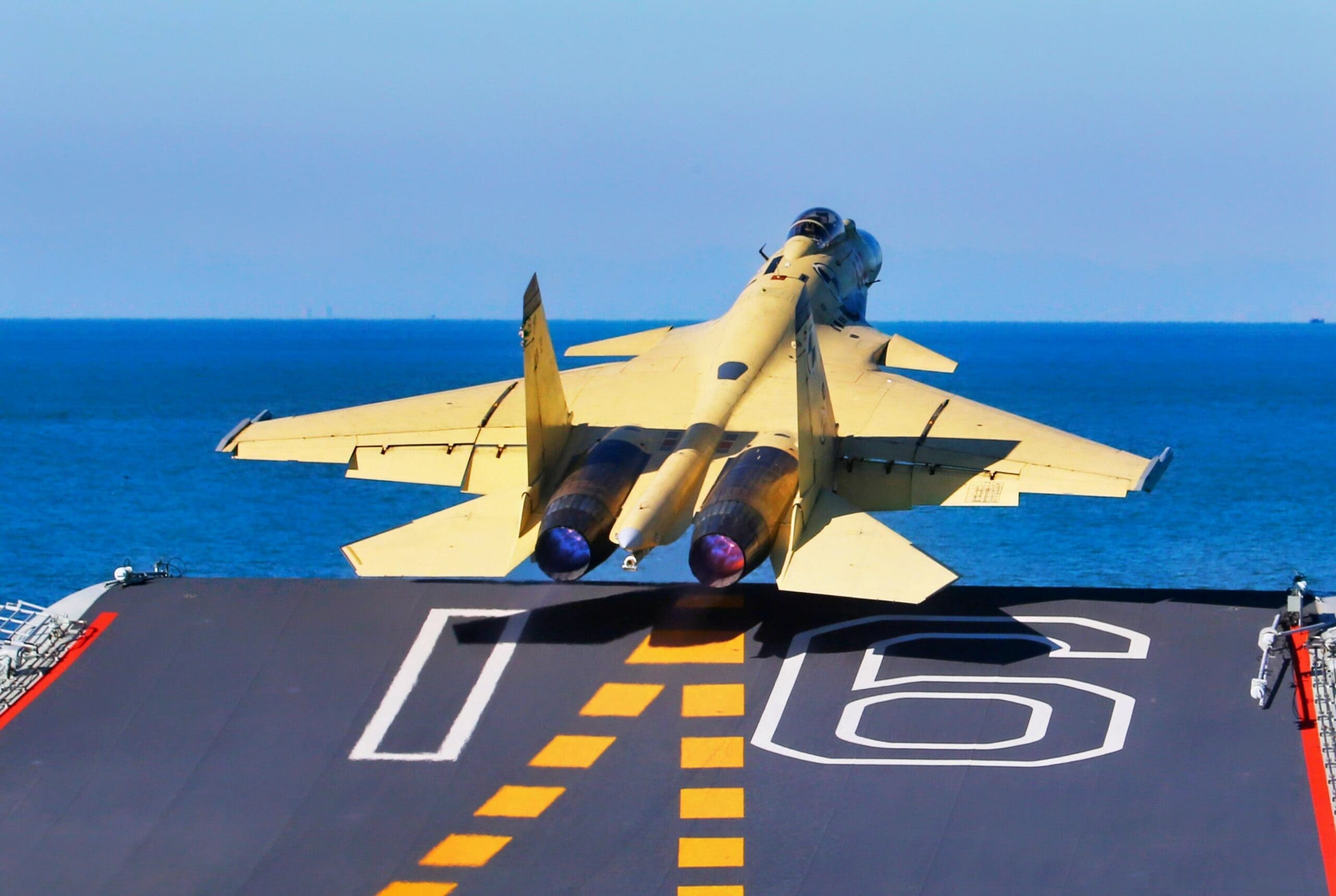
The Liaoning and Shandong ships use ski-jump takeoff, while the Fujian ship uses electromagnetic catapults. This is not just a simple difference in runway length, but two sets of logic for flight, maintenance, and deck scheduling. The J-15 series has primarily served ski-jump carriers in the past, while the J-15T, J-35, KJ-600, and J-15D are generally regarded as the core combination of the Fujian ship's air wing. If these models can train across platforms or form common support standards, the Navy's conversion costs will decrease; conversely, if each aircraft carrier requires an independent human-machine system, the three carriers will become three parallel consumption systems.
In simple terms, an aircraft carrier is not just about the island and deck; it also depends on whether the aircraft can be scheduled, whether pilots can be rotated, and whether spare parts can be shared. This logic is similar to a factory production line; just because equipment is purchased quickly does not mean that skilled workers, quality control, and after-sales systems are also developed simultaneously.
100 Aircraft is Just the Entry Threshold
The Diplomat estimates that if the Fujian ship carries about 40 fixed-wing aircraft, and the Liaoning and Shandong ships maintain a complete air wing, the Chinese Navy will need at least about 100 deployable aircraft, not including training aircraft, backup aircraft, maintenance turnover, and combat loss replacements. This number does not seem exaggerated, but it is a high threshold for carrier-based aircraft because each aircraft requires qualified pilots, landing command, deck personnel, and a maintenance chain for engines and radars.
- The Liaoning and Shandong ships still primarily use the J-15 system, suitable for maintaining ski-jump takeoff training and long-range presence.
- The Fujian ship needs to verify the combination efficiency of electromagnetic catapults, arrestor recovery, and new carrier-based aircraft.
- If the J-35 enters mass production, issues such as stealth coating, maritime corrosion, and onboard maintenance space must also be addressed beyond production capacity.
- The maturity of the KJ-600 will directly affect the long-range early warning radius of the carrier group, which is more critical than the performance of a single fighter jet.
Reports have mentioned that the number of J-35s in Shenyang may have exceeded 30, but this claim should be viewed with caution. Even if the number is accurate, it does not necessarily mean they all belong to the Navy's production model, nor can it automatically be converted into a deployable carrier aviation wing. The judgment in the style of Li Minghui is that production capacity may not be the biggest bottleneck; the training cycle is the more significant bottleneck.
The Fujian Ship's Actions in the Taiwan Strait Are More Like a Stress Test
The Fujian ship's recent passage through the Taiwan Strait certainly carries political signals, but its technical significance deserves closer examination. It may be pushing the training area from the near shore towards the South China Sea, gradually establishing a training loop between the Taiwan Strait, South China Sea, and Western Pacific, leveraging the support conditions of Sanya and Hainan. The Liaoning ship returned to port after over 40 days of activity in the Western Pacific, while the Shandong ship is reportedly still undergoing a lengthy maintenance cycle, indicating that the Chinese Navy is attempting to rotate rather than having all three carriers operate at full capacity simultaneously.
This precisely indicates that the PLA's aircraft carrier construction has entered a more challenging phase. The first phase is "whether there are any," the second phase is "whether they can operate far," and the third phase is "whether they can sustain operations." Now, the Fujian ship is transitioning from the second phase to the third phase, but this transition itself will amplify shortcomings: pilot night landings, deck scheduling in complex sea conditions, reliability of the catapult system, engine lifespan of carrier-based aircraft, and spare parts supply—each of these cannot be proven by a single crossing of the Taiwan Strait.
Actual Impact on the First Island Chain
If the J-15T, J-35, and KJ-600 can ultimately stabilize their operational cycles on the Fujian ship, China's aircraft carriers will significantly enhance their sustained aerial coverage beyond the first island chain. This may not immediately change the military balance in the Taiwan Strait, but it will alter how the U.S., Japan, and Taiwan assess risks. Previously, outsiders could view Chinese aircraft carriers as "training platforms," but in the future, they must be seen as a set of long-range aviation systems approaching practical application.
However, I do not agree with interpreting this as China already possessing U.S. Navy-style carrier battle groups. The U.S. Navy's issue is shipbuilding and maintenance, while the Chinese Navy's issue is establishing a carrier aviation culture from scratch to scale. The shortcomings of the two are different and cannot be simply compared. What truly deserves attention is not where the Fujian ship will appear next, but when it can operate with a complete air wing, launching and recovering aircraft continuously at night and in adverse sea conditions. Until that day arrives, the "three aircraft carrier era" is more like a construction goal rather than an already realized combat capability.
Public information is still insufficient to confirm the mass production rhythm of the J-35 carrier-based variant. Only if future official or satellite images show the Fujian ship's deck simultaneously featuring the J-15T, J-35, and KJ-600 will it provide more concrete evidence for judging that China's aircraft carrier system has entered a new phase.
The Fujian aircraft carrier's training in the Taiwan Strait on June 23 revealed significant deficiencies in the Chinese Navy's carrier-based aviation capabilities, indicating a need for at least 100 additional aircraft. The training highlighted compatibility issues among different aircraft types and the operational readiness of the fleet. The Chinese Navy is moving towards establishing a more effective carrier-based aviation system, but challenges remain in achieving sustained operational capability.
- The Fujian aircraft carrier lacks sufficient carrier-based aircraft, needing at least 100 more.
- The training in the Taiwan Strait highlighted operational shortcomings.
- Compatibility issues exist between different aircraft types and carrier systems.
- The Chinese Navy is transitioning from initial operational capability to sustained operational readiness.
- The J-35's production and deployment remain uncertain.