
Deputy Captain of Fujian Ship, Can Operate Fighter Jets, Can "Operate Aircraft Carriers"!
Exploring the Growth Trajectory of Navy Fujian Ship's Deputy Captain Wang Tao —
From Airborne Eagle to Aircraft Carrier Commander
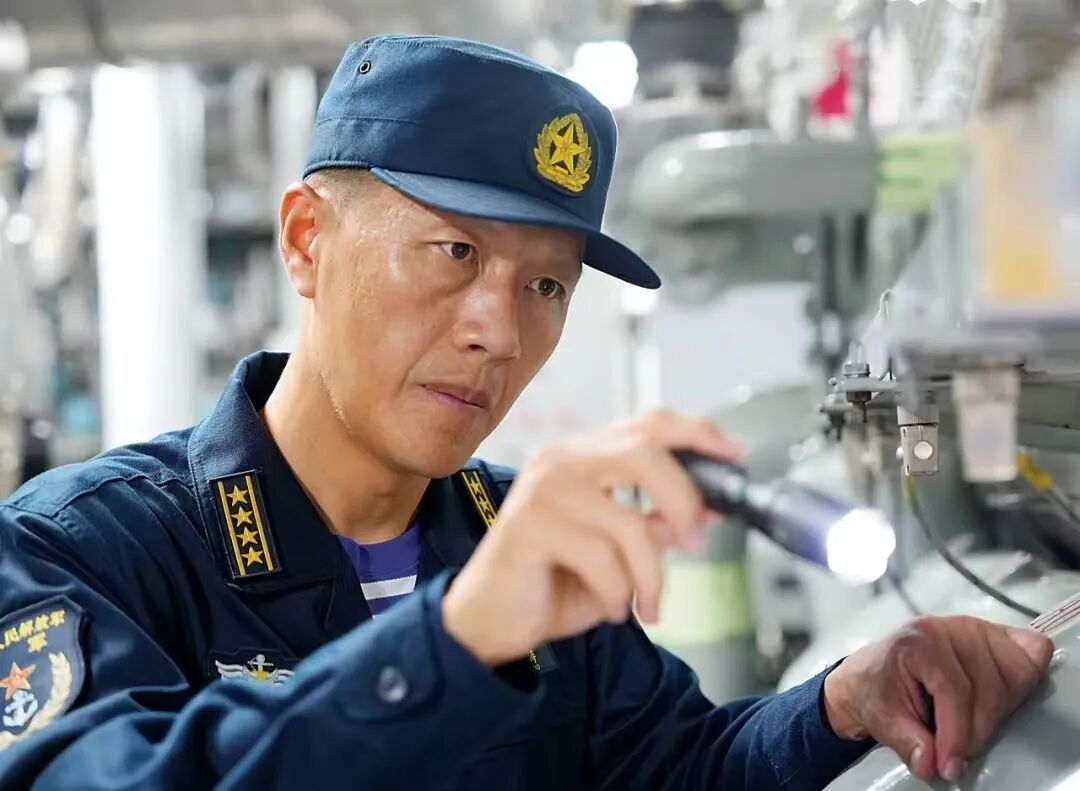
Wang Tao inspecting equipment (Photo by Wen Zidong)
Vast ocean, waves rolling and clouds flying.
The Fujian aircraft carrier formation cuts through the waves, with fighter jets trailing orange flames, roaring into the sky along the electromagnetic catapult track.
On the flight deck, Deputy Captain Wang Tao's gaze follows the fighter jets into the distance. After 25 years of service, from piloting combat aircraft in the skies to maneuvering warships into the deep blue, and now commanding on the aircraft carrier deck with composure, Wang Tao has repeatedly embarked on a path of transformation, growing each time in his new role.
Stepping into a new journey, this versatile commander, who can "pilot in the sky and operate ships at sea," writes a strong military answer sheet for a new era revolutionary soldier with his fighting spirit of continuous transformation and advancement between sea and sky.
“As a pilot, one must not only dare to fight but also fly skillfully, so that one can rise to the occasion when the motherland calls.”
Wang Tao's military career began in the sky.
In 2001, at the age of 18, he was admitted to the former Air Force Changchun Flight Academy and was assigned to the "Airborne Eagle Regiment" after graduation. Over the next decade, he flew seven types of aircraft, including the J-10, accumulating over 1,700 hours of safe flight, gradually growing from a flight student to a top-level pilot.
Piloting is like dancing on the edge of a knife. Once, he took off urgently, and just as the aircraft left the ground, a loud bang echoed — a sudden bird strike emergency. The aircraft shook violently, and the instrument needles swung wildly. At that moment, the aircraft was only a few meters off the ground, and any operational error could lead to disaster.
Quickly checking for hazards, precisely controlling the rudder and maintaining speed... Wang Tao gripped the control stick tightly, his mind exceptionally clear. Relying on the muscle memory formed during training, he calmly handled the situation and ultimately landed the aircraft safely.
During those years, as a pilot, Wang Tao honed his psychological quality and emergency response skills through repeated readiness duties and combat exercises, becoming a skilled and resilient flying backbone. Moreover, he trained dozens of mature pilots, providing many good candidates to brother units. “As a pilot, one must not only dare to fight but also fly skillfully, so that one can rise to the occasion when the motherland calls,” Wang Tao said with bright eyes when discussing his flying career.
If it weren't for that glimpse from ten thousand meters in the sky, Wang Tao might have continued in the pilot position indefinitely.
On a return mission, the lead pilot suddenly said over the radio to Wang Tao: “Look to your lower left.” Wang Tao turned his head — on the vast blue waves, the Liaoning ship formation was cutting through the waves, with carrier-based aircraft poised like eagles ready to take flight.
“Seeing that scene, my chest surged with pride and an indescribable yearning,” Wang Tao recalled. At that moment, he realized how close the sea and sky were.
On April 12, 2018, the Central Military Commission held a naval parade in the South China Sea, and President Xi called for “efforts to build the People's Navy into a world-class navy.” Soon after, the Navy Party Committee made a significant decision to cultivate composite command talents that integrate ship and aircraft operations.
Upon hearing the news, Wang Tao resolved to transform. On one side was the familiar flying career, and on the other was the completely unfamiliar field of naval vessels. His comrades advised him: “You’ve been flying for over a decade, why start from scratch learning about ships?”
“If I only think about guarding my ‘comfortable nest’ and hesitate when the motherland needs me, that would be a real regret,” Wang Tao said. To this day, the image of the Liaoning ship formation cutting through the waves still excites him.
“Wherever I am needed, I will go.” Wang Tao firmly submitted his application for the captain training class.
“No one is born strong; there are no shortcuts to developing abilities, only hard work.”
That year, Wang Tao entered the Dalian Naval Ship Academy.
Someone calculated that it typically takes a naval officer 15 years to grow from graduation to becoming a destroyer captain. However, Wang Tao had less than five years.
On the first day of school, facing dozens of naval courses he had never encountered before, this skilled top-level pilot, who was adept at “riding eagles,” felt like a new recruit entering the military.
“No one is born strong; there are no shortcuts to developing abilities, only hard work.” Wang Tao set three principles for himself: completely reset his mindset; actively seek advice from others when encountering difficulties; and move forward step by step.
During those two years, Wang Tao became the most “persistent” student at the academy. He asked the most questions in class, pursued instructors for advice after class, and was the last to leave the study room. Ship control, tactical application, emergency command at sea... Unbeknownst to him, he filled over 30 notebooks with study notes.
Ultimately, Wang Tao graduated with excellent results. However, the military academy diploma was merely a ticket to entry; the real test awaited him on the ship.
After boarding the Shaoxing ship, Wang Tao quickly familiarized himself with the work by touring each cabin during the day, learning about pipelines, memorizing valves, and recognizing equipment; at night, he repeatedly hand-drew cabin layout maps, not stopping until he could visualize the entire ship's pipeline layout in his mind.
Transitioning from a top-level pilot to a warship commander, Wang Tao insisted on starting from basic positions such as duty officer and watch officer, actively seeking advice from officers and soldiers when he encountered things he didn’t understand. A comrade asked him: “Why is the deputy captain still doing duty work?” Wang Tao explained: “Only by rooting myself in the cabins and on the deck can I feel confident when sitting in the command room.”
Rooting down and growing up. Wang Tao successfully passed a series of assessments and certifications: in June 2022, he obtained the qualification for independent operation of a certain type of ship, and in February 2023, he obtained the qualification for full training as a captain... In June 2023, Wang Tao was appointed as the captain of the Xiangtan ship. In just a few years, he completed the transformation from pilot to ship commander.
The advantage of being a pilot gave Wang Tao a unique “dual perspective of sea and air.” After taking office, he innovated training models, integrating air force tactical thinking into naval training, leading the ship to conduct joint training with various types of aircraft. Under his leadership, the Xiangtan ship successfully completed multiple major tasks, paving new paths for the practical application of new domain and new quality combat forces.
“I am very fortunate to have caught the great era of transformation and development of the People's Navy.”
This summer, Wang Tao became the deputy captain of the Fujian ship.
Over the years, from the Liaoning ship to the Shandong ship, and now to the Fujian ship, the People's Navy's aircraft carrier program has achieved three historic leaps. Almost on the same timeline, Wang Tao has also completed his transformation: from pilot to destroyer captain, and now to aircraft carrier commander. “I am very fortunate to have caught the great era of transformation and development of the People's Navy,” Wang Tao said.
Transformation means starting over. “The Fujian ship's operational platform is larger, and the weapon systems are more complex, requiring more coordinated forces,” Wang Tao admitted. “After stepping into the position of deputy captain of the Fujian ship, many things have to be learned from scratch.” After taking office, he brought out the same enthusiasm he had during his studies at the Dalian Naval Ship Academy, entering cabins and taking positions, diligently studying every system of the Fujian ship and its operational processes.
Compared to the first transformation, his experience as a destroyer captain gave Wang Tao confidence in quickly adapting to the new position. Moreover, as a former pilot, he understands both the tactical language of the air force and the command processes of naval vessels, enabling him to build an efficient communication “bridge” between sea and air. This “dual perspective of sea and air” is particularly valuable in the aircraft carrier formation's system operations.
“On the battlefield, the enemy won’t give advance notice; we must hone our ability to win battles at any time,” Wang Tao told reporters. Looking towards the future battlefield from the “dual perspective of sea and air,” he often contemplates how to further enhance the effectiveness of ship and aircraft coordination and how to explore new tactics in the context of intelligent and unmanned warfare.
From ten thousand meters in the sky to the vast ocean, from airborne eagle to aircraft carrier commander, each of Wang Tao's transformations resonates with the strategic transformation of the People's Navy. His identity changes, his position changes, but Wang Tao's unwavering loyalty to guarding the motherland's sea and sky remains the same. He writes his efforts in the tracks of advancing into the deep blue, in the roar of catapult launches, and in every restart after “resetting his mindset.”
“When I applied for the captain training class from the pilot position back then, it was to understand more and see further; now, stepping from destroyer captain to aircraft carrier deputy captain, it is to contribute as much as I can to the integration of sea and air on a larger platform.” Looking at the fighter jets catapulting into the sky, Wang Tao's gaze crosses the deck, reaching towards the farther sea and broader sky.
Source: PLA Daily
Authors: Sun Fei, Ding Feiyu, Qian Xiaohu
Wang Tao has transitioned from a pilot to the deputy commander of the Fujian aircraft carrier, showcasing his extensive military experience. He has flown over 1,700 hours in various fighter jets and has played a significant role in training new pilots. The People's Liberation Army Navy is currently undergoing a transformation, with Wang Tao's leadership being pivotal in this process.
- Wang Tao has over 25 years of military experience, transitioning from a pilot to a naval commander.
- He is currently the deputy commander of the Fujian aircraft carrier.
- Wang Tao has flown over 1,700 hours in various fighter jets.
- He has been involved in training and mentoring other pilots.
- The People's Liberation Army Navy is undergoing significant transformation and modernization.