
Air Force chief: F-35s and F-15s may take over A-10’s combat search and rescue role
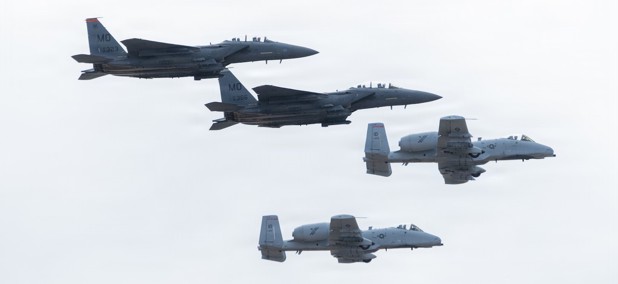
F-15 Eagles and F-35 Lightning II fighters may take on future combat search and rescue missions, as the Air Force aims to retire the last A-10 Thunderbolt IIs by 2030, service officials told lawmakers Wednesday.
The A-10 “Warthog” has been the cornerstone close air support aircraft of the military’s combat search and rescue formations, or “sandy package,” for decades. Gen. Kenneth Wilsbach, the Air Force’s top uniformed leader, faced questions from several lawmakers during a House Armed Services Committee hearing about how the service will maintain that capability.
“The reason why the A-10 is really good at that is because it's a core mission of that platform, and as we transition with putting the A-10 in the retirement phase, there will be other platforms that it will become their core mission,” Wilsbach said. “So F-35s, F-15s, other platforms have the capability."
Warthogs have been used heavily in the Iran war, from strafing boats in the Strait of Hormuz to the daring rescue operation of a downed F-15 airman. Last month, the Air Force announced it will keep three squadrons flying: one through 2029 and the other two through 2030. But as the service eyes replacement platforms, other pilots will have to be trained on how to do the combat search and rescue mission.
"The A-10 pilots are specifically trained for combat search and rescue,” said Rep. Austin Scott, R-Ga.. “Are we going to specifically train F-35 and other pilots for combat search and rescue?”
“We’ll have to,” Wilsbach said. “It’s our mission.”
In response to similar questions from Rep. Sarah Elfreth, D-Md., Wilsbach said the fiscal year 2027 budget asks for $10 billion in flying hours, which would cover additional combat search and rescue training for the service’s pilots.
“The mission of the A-10 is close air support, but part of that subset of close air support is combat search and rescue,” Wilsbach said. “And we can do close air support, and we can do combat search and rescue support from other platforms, and it's unacceptable to have a gap if you have somebody down behind enemy lines, like you saw with Dude 44 Bravo, you have to go get them.”
The White House, Congress, and Defense Secretary’s work to extend the A-10’s retirement to 2030 “allows us to make sure that we don't have a break in that capability,” said Air Force Secretary Troy Meink.
Dan Grazier, a Stimson Center senior fellow and the director of the nonprofit's national-security reform program, is skeptical.
"Firstly, it is highly doubtful that neither the F-35 or the F-15 will ever be able to match the A-10's capabilities,” Grazier said. “Secondly, Gen. Wilsbach said the quiet part out loud. He admitted that the F-35, even though it was sold as a replacement for the A-10, still isn't a viable replacement."
The F-35 was first pitched as a substitute for the A-10’s close air support mission. Internal tests involving the two aircraft raised concerns about whether it could be an effective replacement, according to a report obtained by the Project on Government Oversight. Additionally, during the F-15’s development, the phrase “not a pound for air-to-ground” was used to describe the program’s pivot away from bombing missions. But both platforms have been significantly upgraded and have been branded as multirole fighters capable of numerous missions, including close-air support, ISR, and air-to-air operations.
Rep. Derrick Van Orden, R-Wis., pointed out that the F-35’s price tag, loiter time, and flight hour costs are all significantly higher than the A-10.
“So having been on the ground as a United States Naval SEAL in combat, loiter time matters,” Van Orden said. “We cannot have a gap in close air support, a close air support platform, that will be able to kill the enemy that is in that hallway, vice dropping something from an F-35.”
The U.S. Air Force plans to transition combat search and rescue missions from the A-10 Thunderbolt II to F-15 Eagles and F-35 Lightning II fighters by 2030. This decision follows the announcement of the A-10's retirement, with a budget request of $10 billion for additional training for pilots on the new platforms. Concerns have been raised regarding the effectiveness of the F-35 as a replacement for the A-10's capabilities in close air support and rescue operations.
- The Air Force plans to retire the A-10 Thunderbolt II by 2030.
- F-15s and F-35s will take over combat search and rescue missions.
- $10 billion is requested for additional combat search and rescue training in the FY 2027 budget.
- Concerns were raised about the effectiveness of F-35s as a replacement for A-10s.
- The A-10 has been a key aircraft for close air support and rescue operations.