
Air Force Secretary doubles down on space-based radar bet amid key aircraft losses in Iran
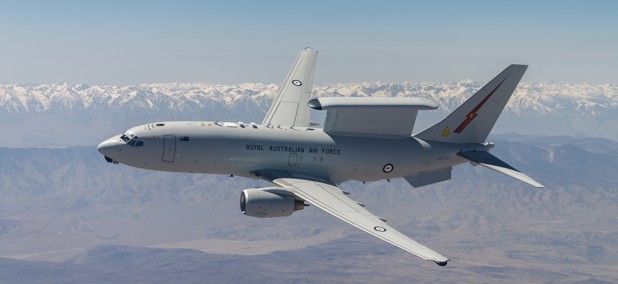
COLORADO SPRINGS, Colo. — Air Force officials are pursuing a space-based system to detect airborne threats and pushing off additional funding for battlespace awareness aircraft in the 2027 budget, even as the service’s fleet of radar planes is in Iran’s sights.
A base contract has been awarded for a new space-based airborne moving target communication capability, Air Force Secretary Troy Meink said Wednesday during his keynote address to the Space Symposium here. During a follow-up roundtable with reporters, the service leader said they’ve selected a pool of vendors and are progressing towards the first award. While he didn’t provide a specific timeline, Meink said it could be sooner than anticipated.
“We expect that system to field very rapidly,” Meink said. “These are programs that are ready to execute and ready to execute rapidly, to be honest, as soon as the money is fed down to the system.”
Meink’s support is backed by roughly $7 billion in funding for space-based Air Moving Target Indicator, or AMTI, satellites in the latest 2027 budget request. By comparison, the service’s E-7 Wedgetail radar plane was, once again, not funded. Yet military and defense experts told Defense One that the capability is seen as crucial to upgrade battlespace awareness in chaotic combat zones and there is an immediate need for it in conflict.
The Air Force’s fleet of the existing radar plane, the E-3 Sentry, is down to only a handful of serviceable aircraft after one was hit in a recent Iranian missile attack last month.
The significant damage to the E-3 Airborne Early Earning and Control System aircraft, or AWACS, in Iran alarmed former military officials.
“They're going after the tankers. They went after the E-3,” a former military official told Defense One. “The bad guys understand that if we blind the eyes and handicap the ability to project power, then we don't have to deal with the fighters.”
The former official added they hope the lack of E-7 funding, and next-generation tanker capabilities is not permanent and the budget is “not a final version.”
When asked if the losses in Iran underscored the need to fund the E-7 or other similar air capabilities, Meink backed the space-based system once again—while keeping Wedgetail funding open for discussion.
“Some of those losses highlight the importance of a survivable platform right now,” Meink said. “The capability that the E-7 will provide is an important capability, and so we need to look at what we're going to do going forward. We're finalizing those decisions within the Pentagon about how we want to do that, and we'll roll that out to the Hill when it's appropriate.”
Last year, Defense Secretary Pete Hegseth criticized the E-7’s survivability and made a push for space-based systems; the Air Force’s 2026 budget request cut funding for the program. Congress added back a little more than $1 billion into that year’s defense spending bill. Last month, the service awarded $2.3 billion in contracts to Boeing for Wedgetail development.
Meink expressed confidence in the space-based AMTI system and said the capability has already been demonstrated, but did not elaborate further.
“Space-based AMTI, I think, will probably be far and away the most capable AMTI system ever built,” Meink said. “That doesn't mean it's going to do the entire job. There are many other systems that come into play, as you do data fusion to get the bigger picture.”
The U.S. Air Force is advancing a space-based system for detecting airborne threats, with a $7 billion budget request for space-based AMTI satellites. Following recent losses of E-3 Sentry radar planes in Iran, the Air Force Secretary highlighted the urgency of enhancing battlespace awareness. Despite the lack of funding for the E-7 Wedgetail radar plane, discussions about its importance continue within the Pentagon.
- Air Force is developing a space-based airborne moving target communication capability.
- $7 billion is allocated for space-based AMTI satellites in the 2027 budget.
- The E-3 Sentry radar plane fleet is significantly reduced due to recent losses in Iran.
- The E-7 Wedgetail radar plane was not funded in the latest budget request.
- Military experts emphasize the need for upgraded battlespace awareness capabilities.