
America Copied Iran's Shahed to Build Its New Drone Fleet
 Alexandra Reeves
America Copied Iran's Shahed to Build Its New Drone Fleet
The Pentagon spent three decades betting that expensive, precise weapons win wars. Its newest combat organization in the Middle East is built on the opposite assumption — and the drone at the center of it isn't even an American design. It's a knockoff of Iran's Shahed-136.
On August 13, U.S. Central Command announced Task Force Falcon Strike, what it bills as the first-ever multi-domain, multinational attack drone task force. The unit will field one-way attack drones operating from the air, on the sea, and below it — crewed by American support staff alongside unnamed regional partners.
What Falcon Strike Actually Is
Strip away the branding and this is an attempt to industrialize one very specific kind of warfare. Falcon Strike is the successor to Task Force Scorpion Strike, the unit CENTCOM stood up in December 2025 as the U.S. military's first dedicated one-way attack drone squadron in the Middle East. Scorpion Strike pulled off the first aerial attack drone launch from a U.S. Navy warship, deployed one-way drones during Operation Epic Fury, and in July sent unmanned attack vessels against Iranian port facilities.
The new task force is meant to scale all of that. Personnel from Special Operations Command Central, headquartered at MacDill Air Force Base in Tampa, will run a staff drawn from the United States and partners across CENTCOM's 21-country area of responsibility. The stated goal, in the words of CENTCOM commander Adm. Brad Cooper, is a "unified multi-domain, multinational deterrent."
The Uncomfortable Detail
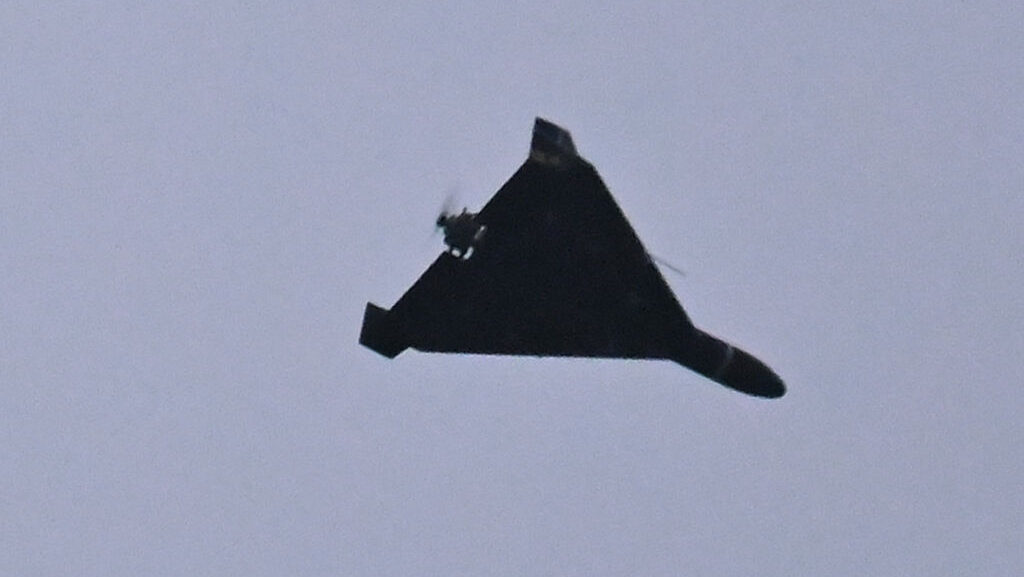
Here's the part Washington would rather not dwell on. The drone Scorpion Strike was built around — the Low-cost Unmanned Combat Attack System, or LUCAS — is reverse-engineered from a captured Iranian Shahed-136. U.S. developers took apart a downed Shahed and built their own version. A U.S. defense official told CNN the LUCAS was reverse-engineered from the Iranian weapon, and Military Times has reported the same lineage.
The LUCAS, built by SpektreWorks, has a wingspan of about eight feet, flies in swarms, and launches from trucks, catapults, or rocket boosters. That is the Shahed playbook almost line for line: cheap, simple, mass-producible, and meant to be expended. The Pentagon didn't invent this approach. It copied it from the adversary it is currently fighting.
Why This Is Happening Now
The timing isn't subtle. The United States is at war with Iran, and that war has chewed through its stockpile of expensive interceptors. Military Times reported in July that the conflict had depleted U.S. Patriot missile stockpiles and created readiness problems. When an interceptor that costs millions is chasing a drone that costs tens of thousands, the math eventually forces a rethink. Falcon Strike is that rethink.
This isn't a spontaneous idea, either. It follows Defense Secretary Pete Hegseth's earlier memo demanding rapid integration of drone technology across every service, and it comes as CENTCOM has spent months running a technology task force aimed at getting new autonomous systems to troops faster. Falcon Strike is the organizational form of that push.
Ukraine wrote the manual. Cheap drones have repeatedly struck targets that cost orders of magnitude more to defend. Russia internalized the lesson with the Geran-2, its own Shahed-derived loitering munition. Now the United States is reaching the same conclusion, a few years late and on a different front.
"Task Force Falcon Strike will expand on Scorpion Strike's success given the tremendous innovation happening among our regional allies and partners," Cooper said. "Integrating and deploying our new capabilities together will help us rapidly realize the new possibilities that are on the horizon."
The Multinational Part Is the Part to Watch
Cooper's emphasis on partners is doing a lot of work. CENTCOM says it has begun formally inviting regional partners to join, but it won't name them. That vagueness matters, because a multinational attack drone network is not just a defensive club — it's a technology-transfer pipeline. The Gulf states are being invited into a program built around a weapon whose whole point is that it's cheap and easy to replicate.
That cuts both ways. Folding partners into American drone operations binds them closer to Washington and spreads the cost of deterring Iran. It also accelerates the spread of loitering munitions in a region already saturated with them. Iran spent a decade exporting the Shahed to proxies across the Middle East. The United States is now, quietly, doing something structurally similar with its own copy of that same drone.
The Drones Aren't the Real Story
The drones are the headline, but they're not the point. The point is that the most advanced military on earth has concluded a cheap Iranian knockoff is a better fit for the next decade of warfare than the exquisite systems it spent a generation perfecting. That's not a procurement decision. It's an admission.
Washington spent years mocking the Shahed as crude, disposable, and indiscriminate — which it is. Now the Pentagon is fielding its own version, building a multinational task force around it, and calling the whole thing a deterrent. So watch what CENTCOM does next. If Falcon Strike actually scales — if the partner list fills in and the drones start flying in numbers — the real story won't be that America copied Iran's drone. It'll be that America decided Iran's way of fighting was the future, and built an alliance to make it permanent.
The U.S. Central Command announced the formation of Task Force Falcon Strike on August 13, 2025, aimed at utilizing reverse-engineered drones based on Iran's Shahed-136. This multinational task force will focus on one-way attack drone operations across various domains, reflecting a shift in U.S. military strategy in response to ongoing conflicts. The LUCAS drone, developed from captured Iranian technology, is central to this new approach.
- The U.S. has established Task Force Falcon Strike, a multinational drone task force.
- The drones used are reverse-engineered from Iran's Shahed-136.
- The task force aims to industrialize one-way attack drone warfare.
- The U.S. is adapting its military strategy in response to the conflict with Iran.
- The LUCAS drone is designed to be cheap, simple, and mass-producible.