
Belgium and the Netherlands Lose Their Submarine Defense in 2030 — Europe's Defense Cooperation Fails Due to Schedule
 Dr. Klaus Weber
Belgium and the Netherlands will lose their submarine defense by 2030 — Europe's defense cooperation fails due to the timeline
Belgium has a defense budget of 3.2 billion euros for three new frigates. Nevertheless, the joint Dutch-Belgian program faces exactly what has hindered European defense cooperations for decades: the ships are arriving too late, while the existing capability will expire by 2030. Brussels is therefore considering Italian FREMM EVO and French FDI frigates. This is not an unfriendly gesture towards The Hague, but a fundamental capability decision.
A cooperation with a structural timing problem
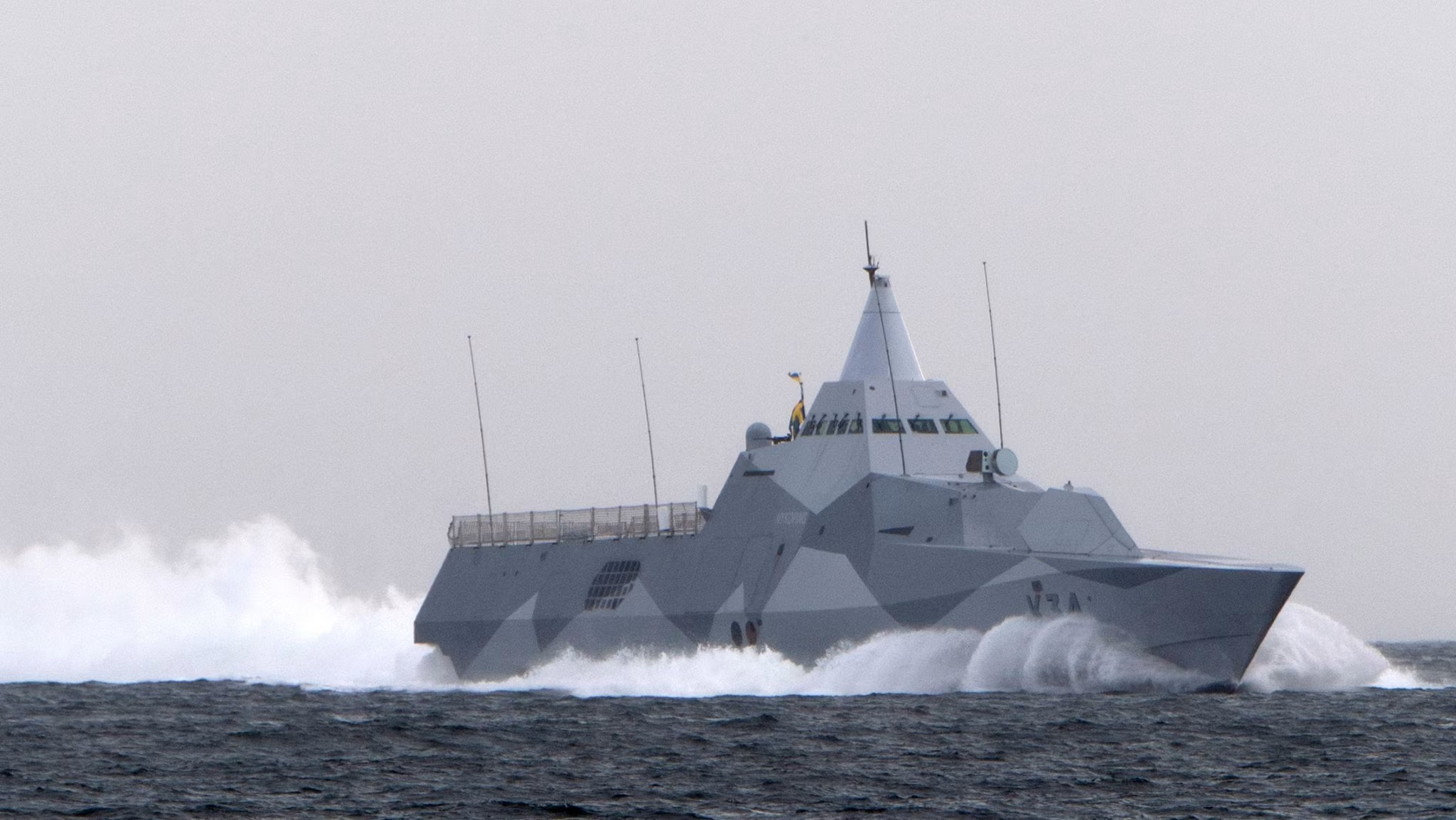
The project was originally intended to produce four ships: two for the Dutch Navy and two for Belgium. The Netherlands increased its order in 2024 to four units, while Belgium increased its order in 2025 to three. The political rationale was clear. Joint procurement was supposed to increase quantities, reduce costs, and stabilize maritime division of labor between two closely connected NATO states.
The reality looks different. The program led by Damen has been delayed due to increasing construction and structural stability issues. The planned displacement rose from approximately 5,500 to 6,400 tons. The first delivery, once scheduled for around 2025, is now expected no earlier than 2033 according to the Dutch material plan. This means Belgium will lose its previously promised delivery by at least three years by 2030.
For Brussels, this is not just a scheduling issue. The Leopold I and Louise-Marie are former Dutch Karel Doorman-class frigates from the 1980s and will reach the end of their service life by 2030. They are the only major combat ships of the Belgian Navy. If this capability is lost, Belgium will no longer be able to fulfill its tasks in the North Atlantic, the North Sea, and within NATO independently.
FREMM against FDI and the logic of readiness
An internal analysis of the Belgian Navy sees Fincantieri's FREMM EVO as the best alternative. The first unit could therefore be delivered in 2030 and remain within the Belgian budget for three ships. Naval Group's FDI frigate is also being considered, but the French shipyard is already heavily committed due to orders from France, Greece, and Sweden. Belgian Chief of Staff Frederik Vansina thus articulated the crucial benchmark: Belgium must maintain its operational capability.
This is the point where military planning differs from industrial policy. A larger and technically more ambitious ship is not automatically the better solution if it arrives only after the loss of the existing capability. For submarine defense, not only radar, sonar, and missiles count, but also trained crews, maintenance chains, operational doctrine, and continuous presence at sea. A three-year gap cannot be compensated by a later performance increase.
The Netherlands is therefore seeking interim solutions with Belgium, including a smaller ship as a transition. Such interim solutions are expensive and militarily imperfect. However, they show that the supposed savings from joint procurement are quickly consumed by the costs of the delay.
The European contradiction between priorities and delivery
The case falls in a politically unfavorable week for the European Union. Member states have prioritized five joint defense projects in the areas of drones, drone defense, air and missile defense, space, maritime surveillance, and the eastern flank. Initially, 325 million euros from the European Defence Industry Programme are available for this; long-term investment intentions are estimated at up to 190 billion euros by 2036. The European Commission calls this a breakthrough.
However, strategic priorities do not equate to military capabilities. The EU can declare maritime and underwater defense as a focus on paper, while a concrete joint frigate program remains stuck in the construction and design phase. This is precisely where Europe's institutional problem lies: political decisions are made quickly enough, but industrial responsibility and risk distribution are clarified too late.
The Dutch-Belgian program was from the beginning less a classic competition than a politically desired cooperation with Damen and Thales Nederland. The construction grew, deadlines shifted, and the industrial commitment remained in place. In a normal procurement process, a delivery date would be a hard capability parameter. In European cooperation programs, it often becomes a negotiation result that is adjusted afterward.
What Germany and the EU must learn from this
The comparison with Germany's failed F126 program is uncomfortable. There, too, delays, cost increases, and uncertainties between clients and contractors led to a course change. Two cases do not prove a general law, but they contradict the convenient assumption that joint procurement is automatically more efficient.
First, European programs need a binding capability calendar that does not depend on industrial convenience. Second, states must clarify before contract signing who bears the risk in case of design flaws, additional costs, and delivery delays. Third, a cooperation must include a realistic exit option. Belgium is now considering FREMM EVO and FDI because it needs this option. This is institutionally healthy, even if it appears politically as a setback.
The lesson is not that Europe cannot build joint ships. The lesson is that cooperation without shared responsibility is merely a joint press release. The EU can announce 190 billion euros in long-term investments. However, if Belgium finds itself without an operational frigate in 2030 and the replacement ships arrive in 2033, the strategic calculation is clear: more joint planning has not closed a single gap at sea.
Sources
- Defense News, October 1, 2026, report on the Dutch-Belgian ASW frigates and possible FREMM EVO alternative.
- VRT NWS, September 20, 2026, internal Belgian assessment of FREMM EVO and FDI.
- Dutch Ministry of Defense, Material Plan 2026, delayed delivery of the first ASW frigate to no earlier than 2033.
- Defense News, September 28, 2026, EU projects of common defense interest and EDIP funding.
Belgium and the Netherlands are experiencing significant delays in their joint frigate program, jeopardizing their anti-submarine warfare capabilities by 2030. The first delivery of new frigates is now expected in 2033, which is three years later than planned. Belgium is exploring alternatives such as FREMM EVO and FDI frigates to maintain its naval capabilities as its current frigates will be decommissioned by 2030.
- Belgium's defense budget is €3.2 billion for three new frigates.
- The first delivery of the new frigates is now expected in 2033, three years late.
- Belgium's current frigates will reach the end of their service life by 2030.
- The Belgian Navy is considering alternatives like FREMM EVO and FDI frigates.
- The joint program has faced delays due to construction and stability issues.