
Both Sides Just Killed the Sierra Madre Resupply Deal
 Marcus Chen
Both Sides Just Killed the Sierra Madre Resupply Deal
Fifteen incident-free resupply missions in two years. That was the Provisional Understanding on Rotation and Resupply — the quiet 2024 arrangement that kept a 1944-era tank landing ship and its Marine detachment alive at Second Thomas Shoal without triggering a major-power collision. This week, both governments publicly blew it up.
On Thursday, the Philippine DFA defended the arrangement while insisting it “does not, and never did, restrict or limit the exercise of Philippine sovereign rights.” The AFP said the same day that no foreign approval is needed to resupply BRP Sierra Madre. In Beijing, the response was sharper: the China Coast Guard published evidence of what it calls “deliberate provocations and attacks on Chinese personnel” at Ren’ai Jiao, and the Ministry of National Defense demanded the ship’s removal “as soon as possible.”
That’s not a spat. That’s the end of the deal.
The 15 Missions That Weren’t Free
Here’s the part Manila doesn’t like to say out loud: every one of those 15 missions happened under Chinese terms. Advance notification. On-site inspection. No construction materials. Beijing calls it “humanitarian accommodation” — a favor, not a right, extended while the ship remains what China calls an illegal occupation.
Philippine media conceded the point last week, acknowledging the 15 “safe” resupply missions took place under the China-Philippines provisional arrangement. The DFA’s counter — that RORE never limited Philippine sovereign rights — is legally true and operationally meaningless. The CCG has been running the inspection regime, not the Philippine Coast Guard. Whether the arrangement “restricted” Manila’s rights under international law is a question for the tribunal; on the water, the restriction was real.
The Evidence Release Changes the Script
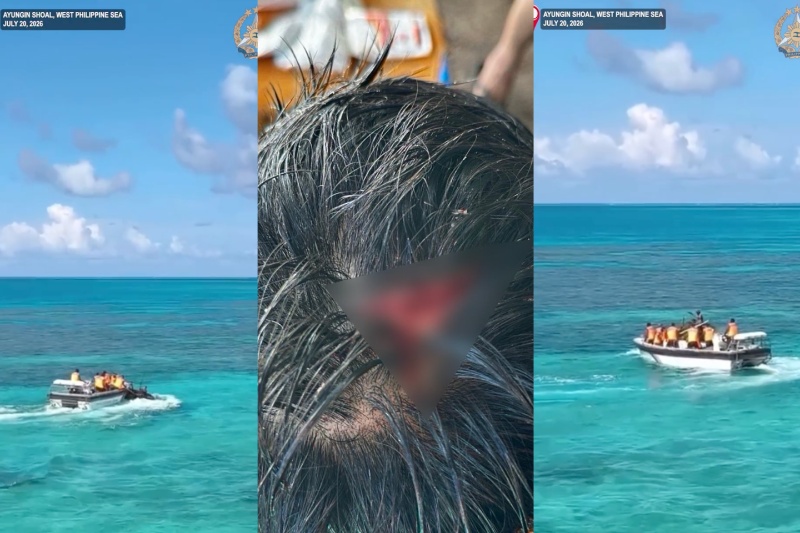
The new element is the evidence. Beijing says the CCG has released footage of Philippine personnel attacking Chinese personnel at the shoal — and imagery from Ayungin Shoal dated July 20 that is now circulating shows the kind of close-quarters contact that doesn’t happen during routine patrols: small boats in shallow reef water, injuries, no gray hulls in between.
This is the first time in this cycle the CCG has published personnel-injury evidence rather than just water cannon footage. The message is deliberate: if the Philippines abandons the notification regime and forces the next resupply through, the incident will be framed as Philippine aggression, with video to prove it.
Australia Picked a Side but Not a Posture
Australia’s defense minister met Manila’s this week and signed a joint statement expressing “serious concern” over CCG actions and urging “professional and safe” operations. That’s alliance language doing real political work — Canberra is now on the record at Second Thomas Shoal.
But a joint statement doesn’t put a hull between the Sierra Madre and the CCG fleet. Australia has no surface combatant parked near the Spratlys, and no one in Canberra is volunteering one. Washington’s contribution this cycle is a State Department statement on the parallel Huangyan Dao dispute — more press releases, same absence of hulls. The statements raise the political cost of escalation for Beijing without changing the tactical math at the shoal.
The Reset That Isn’t
Marcos, meanwhile, is selling a “reset”: go back to dialogue when tensions rise, lower the language, explore joint oil and gas in the West Philippine Sea. The terms of reference for joint exploration are reportedly progressing.
Read that against the MND’s Friday statement: China “will continue to conduct rights-protection and law enforcement activities” and the Philippines “should remove the illegally grounded warship as soon as possible.” You cannot reset a relationship toward joint oil exploration while your coast guard publishes evidence of the other side’s attacks and your defense ministry restates the removal demand. One of these tracks is theater.
The Math of the Next Resupply
Here’s the calculation that matters. The Sierra Madre’s garrison needs food, water, and fuel on a regular schedule. Under the dead arrangement, that meant telling Beijing first and accepting inspection. The alternatives — airdrops, drones, fast boats — were studied and set aside, according to the DFA’s own statement this week.
So what’s the plan when the food runs out? Force a run through without notification, and the CCG has already telegraphed the response: countermeasures it describes as “professional, restrained and beyond reproach” — which in practice means water cannon, hull contact, and now, possibly, boarding teams. Accept notification again, and Manila has publicly conceded the exact point it just denied.
That’s the trap both governments built this week. The deal died because neither side could afford to keep it deniable — Manila because domestic politics demanded it assert sovereignty, Beijing because it needed to show the arrangement was a concession, not a surrender.
The 16th resupply mission will decide what replaces it. If it goes through under notification, the “reset” has a pulse. If it doesn’t, the South China Sea’s most dangerous shoal just went back to the collision physics of 2024 — with video evidence as the opening salvo.
The deal is dead. The question is whether anyone in Manila noticed.
The Philippines and China have publicly terminated the resupply deal for the BRP Sierra Madre at Second Thomas Shoal, escalating tensions over sovereignty and military operations. China has accused the Philippines of provocations, while the Philippines asserts its sovereign rights. Australia has expressed concern but has not committed military support. The next resupply mission will be pivotal in shaping future relations between the two nations.
- The resupply deal for the BRP Sierra Madre has been terminated by both the Philippines and China.
- The Philippines insists that the deal did not limit its sovereign rights.
- China has accused the Philippines of provocations and demands the removal of the BRP Sierra Madre.
- Australia has expressed concern over the situation but has not provided military support.
- The next resupply mission will be critical in determining future relations between the two countries.