
Camp Davis South sees its first C-17 in over 20 years
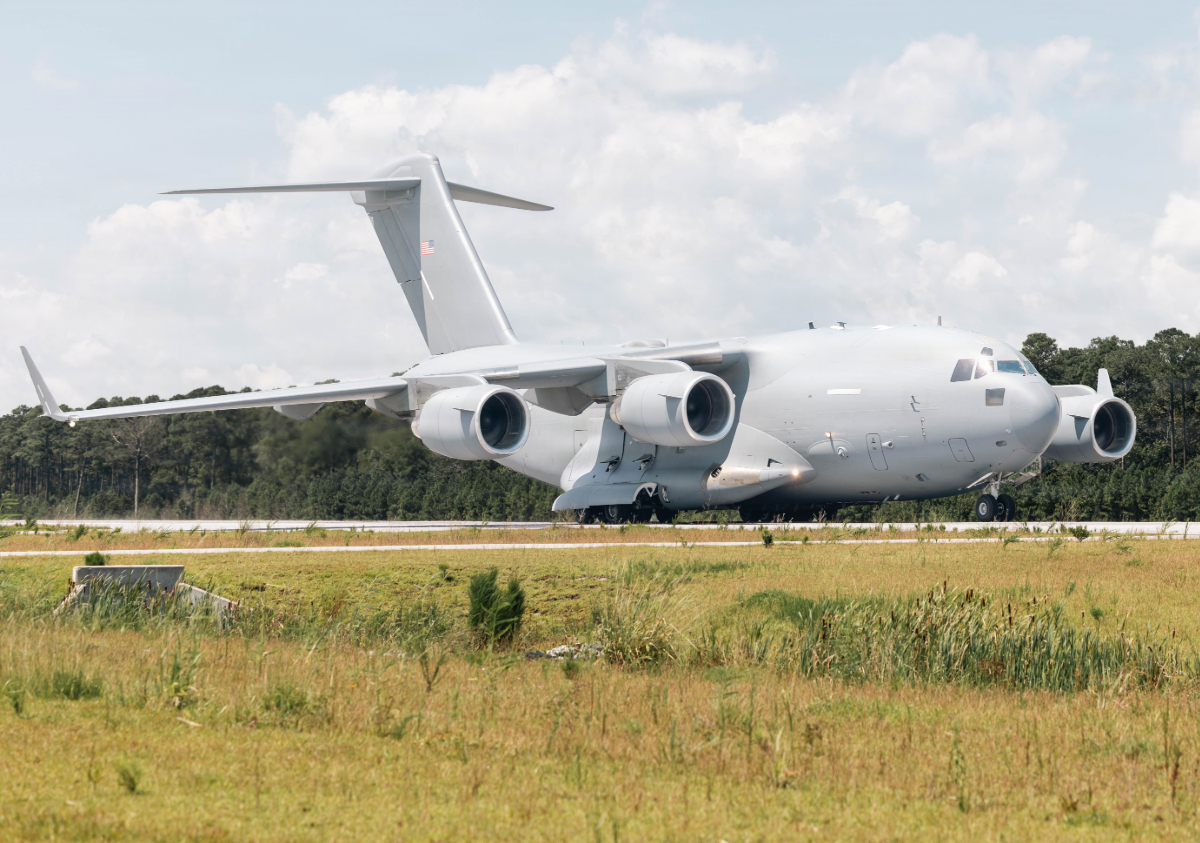
A U.S. Air Force C-17 Globemaster III landed at Camp Davis South, part of Marine Corps Base Camp Lejeune in North Carolina, marking the first time the heavy-lift aircraft has touched down there in more than 20 years.
The roughly 140-ton jet, longer than half a football field, landed alongside Canadian C-130 transports to support parachute training run by U.S. Marine Corps Forces Special Operations Command.
Airmen with the 15th Airlift Squadron, 437th Airlift Wing, 21st Air Force, flew the C-17 in as part of Air Mobility Command operations. The aircraft is built to move heavy equipment and troops into rough, short airfields, exactly the kind of conditions Davis South is designed to simulate.
The landing was possible because of work finished on the airfield’s runway. Davis South started out as a World War II-era Army airfield used to tow targets for anti-aircraft training, and it sat largely unused for decades before the Marine Corps rebuilt it, tearing up the old runway and repaving it with reinforced layers of rock, gravel and asphalt. Multiple contemporaneous accounts of that project put its cost at roughly $28 million over 18 months, with the rebuilt airfield reopening in August 2024, larger figures and an earlier date than the $11 million and 2025 reopening cited in this account, a discrepancy that remains unresolved. The finished airfield spans about 275 acres with a 4,525-foot airstrip, including 3,600 feet of paved runway and concrete turnarounds built to withstand the heat generated by vertical-lift aircraft such as the F-35B and MV-22 Osprey.
“Landing a C-17 and C-130s allows for units to have enhanced training by jumping out of different military aircraft,” said Tom Pieratti, range control officer with Camp Lejeune’s Range and Training Area Management, Range Control Branch. “Having this capability also allows for ground units to practice fly away missions or to onload/offload larger military equipment in support of operations without having to go to [Marine Corps Air Station] Cherry Point.”
1st Lt. Victoria Bravo, a team leader with Air Traffic Control Company L, Marine Air Control Squadron 2, led a Marine Air Traffic Control Mobile Team that handled the landing, setting up runway markings and providing air traffic control for both aircraft.
“The new runway improvements at Camp Davis South open significant training opportunities to operate with aircraft that are not organic to the Marine Corps and allow us to integrate with outside agencies,” Bravo said. “Evolutions like this directly validate my team’s readiness as we prepare to execute similar high-tempo operations while at Weapons and Tactics Instructor course 1-27 and ensure we are fully prepared to deliver when supporting real-world missions while deployed with the 26th Marine Expeditionary Unit.”
The upgraded field gives 2nd Marine Aircraft Wing and MARSOC a training site closer to home for heavy-airlift exercises that previously required a trip to Marine Corps Air Station Cherry Point. Camp Lejeune has additional range projects planned, including modernized rifle ranges, a seaport-seizure training facility, and new areas dedicated to training with drones and counter-drone systems.
Content preview only. Full article available at source. View Full Article
A U.S. Air Force C-17 Globemaster III landed at Camp Davis South, North Carolina, marking its first landing there in over 20 years. This event supports parachute training for U.S. Marine Corps Forces Special Operations Command. The airfield, recently upgraded at a cost of about $28 million, enhances training capabilities for ground units and allows for the movement of larger military equipment.
- A C-17 Globemaster III landed at Camp Davis South for the first time in over 20 years.
- The landing supports parachute training for U.S. Marine Corps Forces Special Operations Command.
- The airfield was recently upgraded at a cost of approximately $28 million.
- The upgraded airfield allows for enhanced training opportunities for ground units.
- The C-17's landing enables onloading/offloading of larger military equipment.