

Summary and Key Points: China’s aircraft carrier Liaoning, with 288 missile cells of escort, is circling the southern Philippines while the USS Theodore Roosevelt leads Keen Sword, the US-Japan exercise running through October 29. The Roosevelt is covering for the USS George Washington, now in the Middle East.
Two navies. Two carrier strike groups. One very crowded stretch of the western Pacific around the Philippine Sea.
China and US Naval Assets Are Getting Close in the Western Pacific (As in Aircraft Carrier Showdown)
As Interesting Engineering reported this weekend, China’s carrier Liaoning and its escorts are operating around the southern Philippines while the USS Theodore Roosevelt is in the Philippine Sea for Keen Sword, the big US-Japan exercise running from October 19 through October 29.
Japanese, Australian, Canadian, and French warships are sailing with the Roosevelt. The Liaoning is sailing with three of China’s best surface combatants.
No one has confirmed that the Chinese group plans to steer toward the exercise area.
Nor has anyone confirmed that the two carrier strike groups will ever paint each other on radar.
However, the timing of the Liaoning’s route is not a coincidence.
The People’s Liberation Army Navy (PLAN) no longer leaves coincidences to chance in the western Pacific. Especially in light of the USS George Washington’s carrier strike group leaving the Pacific to operate in the Middle East.
The Liaoning’s Route Tells The Story
Japan’s Ministry of Defense reported the Chinese group pushed through the Miyako Strait on October 14 and into the Pacific.
A day later, it turned toward the South China Sea, then swung down toward the southern Philippines.
The South China Morning Post noted the strike group is circling the Philippine archipelago counterclockwise, the exact reverse of the loop it ran in October 2024.
Philippine naval vessels shadowed the formation along the country’s southwestern coast.
The Liaoning’s escorts are particularly noteworthy.—two Type 055s, the Wuxi and the Anshan, plus the Type 052D destroyer Huainan.
Beijing classifies the 055s as destroyers.
At roughly 13,000 tons, the US Navy classifies them as cruisers.
Each 055 carries 112 vertical launch cells, and the 052D carries 64.
For those keeping score at home, that’s 288 missile cells providing cover for the carrier.
Earlier in the month, Japanese forces also picked up a Y-9 electronic reconnaissance aircraft and a WZ-7 high-altitude drone working near the carrier.
It isn’t clear whether either followed the group south.
The Liaoning had already run flight operations about 155 miles south of Ishigaki Island, according to The National Interest.
This is its second Western Pacific deployment of the year, and it’s expected to stay out for several weeks.
Where Is The USS George Washington?
So why does this matter beyond the usual cat-and-mouse?
Because the carrier that is supposed to be here isn’t. The USS George Washington, the forward-deployed carrier homeported in Yokosuka, is tied up in the Middle East.
The Roosevelt is covering the gap for Keen Sword. Beijing knew it, and the Liaoning’s deployment was Beijing’s way of sending a message.
Pulling Seventh Fleet’s carriers to put out fires in CENTCOM was a mistake.
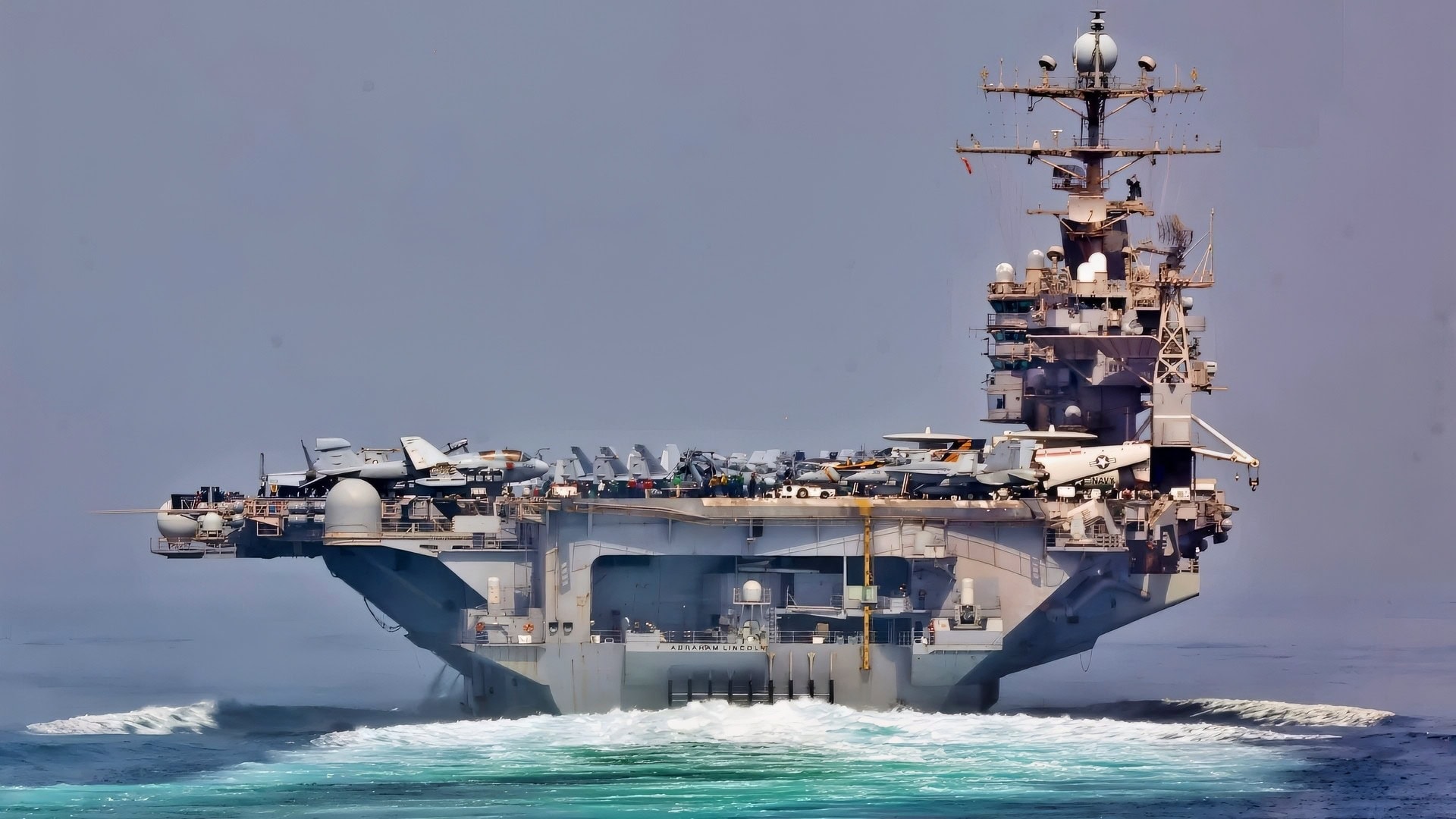
STRAIT OF HORMUZ (May 11, 2012) The guided-missile cruiser USS Cape St. George (CG 71) and the aircraft carrier USS Abraham Lincoln (CVN 72) transit the Strait of Hormuz.
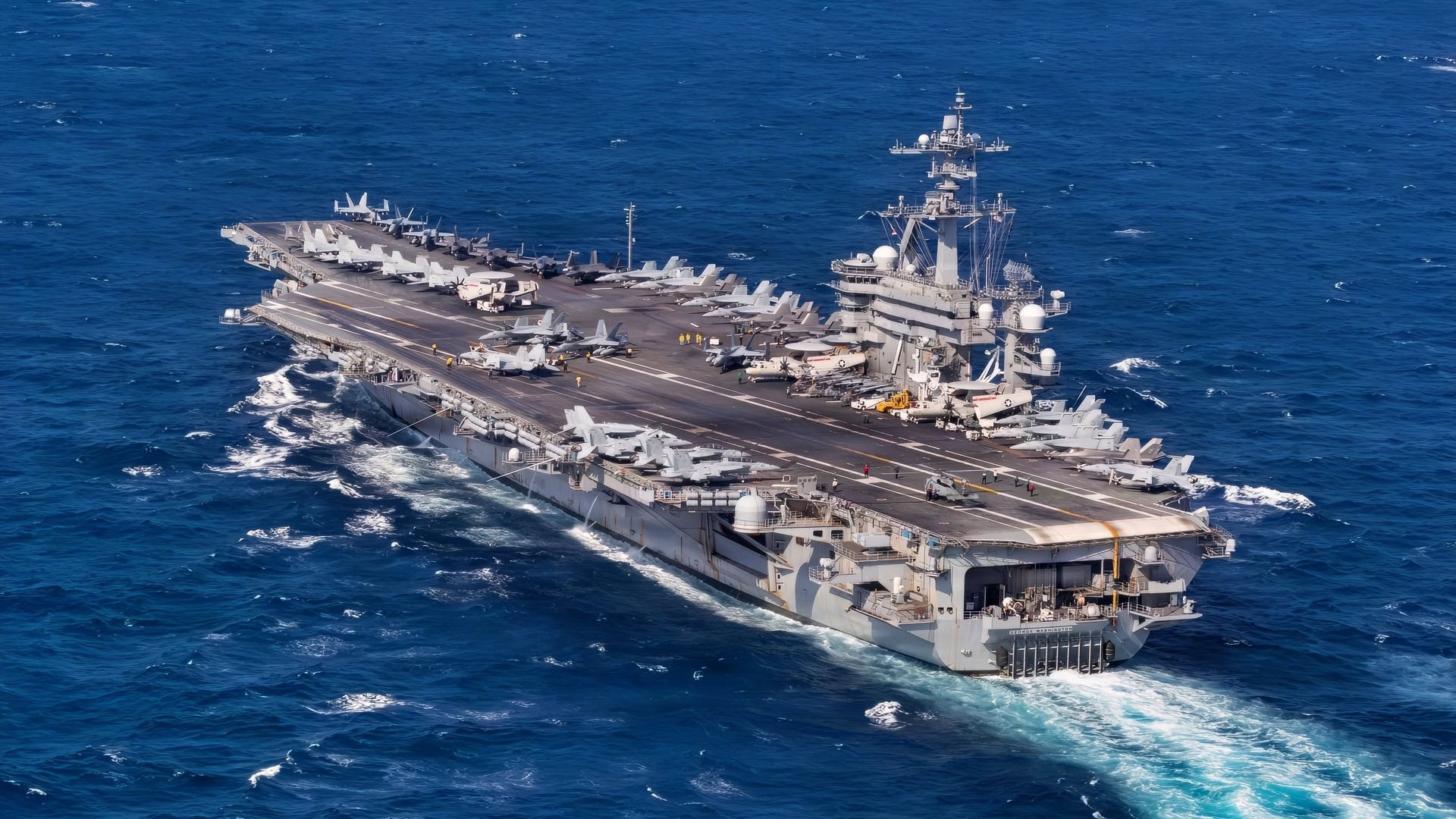
Nimitz-class aircraft carrier USS George Washington (CVN 73) operates in the South China Sea, Aug. 8, 2026. George Washington, operating in the U.S. 7th Fleet area of operations, is the U.S. Navy’s premiere forward-deployed aircraft carrier, a long-standing symbol of the United States’ commitment to maintaining a free and open Indo-Pacific, while operating alongside allies and partners across the U.S. Navy’s largest numbered fleet. (U.S. Navy photo by Mass Communication Specialist Seaman Anthony Vilardi)
It tells Beijing the US’ Pacific posture is negotiable.
While the conflict in Iran represents the current threat to US interests in the region and beyond, the shortage of aircraft carriers has forced the Navy to pull one of its operational carriers out of a contested area. At the same time, the country’s biggest potential adversary continues to push its capabilities.
The Liaoning Is Not A Front-Line Carrier
However, it is important to keep this Chinese deployment in perspective. The Liaoning is a rebuilt Soviet hull, a ski-jump STOBAR carrier of roughly 60,000 tons that launches J-15s without catapults, which caps their fuel and weapons loads.
It carries about 40 fixed-wing and rotary-wing aircraft, including 24 J-15 fighters.
By comparison, the Roosevelt is a Nimitz-class supercarrier displacing more than 100,000 tons, with four steam catapults and an air wing built on decades of blue-water experience. She carries 90 fixed-wing aircraft and helicopters.
Its strike group consists of the cruiser USS Chosin with 122 vertical launch cells, the destroyer USS Decatur with 61 vertical launch cells, and Japan Maritime Self-Defense Force, Royal Australian Navy, Royal Canadian Navy, and French Navy ships.
However, the PLAN isn’t looking for a straight-up fight this week. It’s trying to learn carrier operations.
While China is rapidly advancing technologically, it faces significant challenges in areas like sustained 24-hour air operations, anti-submarine warfare, and at-sea logistical support, which take time and experience to develop.
Some experts say China’s carriers would be vulnerable to missile and submarine attacks, noting that the People’s Liberation Army Navy has not perfected protective screening operations, particularly antisubmarine warfare.
“Unlike other parts of their military modernization, there is something politically theatrical about their carrier deployments so far,” said Trevor Hollingsbee, a former British naval intelligence analyst.
“Carrier operations are a very complicated game, and China’s got to figure this out all by itself. It still has a long, long way to go.”
However, Defense News counted at least six far-seas deployments for the Liaoning since it was completed 14 years ago.
In June 2025, the Liaoning and Shandong ran dual-carrier operations in the Pacific for the first time, logging 150 and 120 takeoffs and landings over three days. Then the Fujian started launching aircraft with electromagnetic catapults, a system only the USS Gerald R. Ford shares.
That’s the trajectory. China had one carrier in 2012. They have three today. The Pentagon estimates nine by 2035, as 19FortyFive noted this summer. The US Navy has eleven, and it can’t build replacements fast enough.
Shadowing Operations Are Growing More Tense
Close contact between navies isn’t new, but it’s becoming more intense. During the Liaoning’s far-seas training in June, Chinese state broadcaster CCTV claimed the Type 054B frigate Luohe warned off Japanese ships while carrier-based J-15s intercepted Japanese P-3C patrol planes.
Beijing framed it as professionalism. Tokyo saw it differently.
China insists this deployment complies with international law and isn’t aimed at any country.
That’s the standard line. It’s also a carrier group operating beyond the first island chain, in the same waters any US relief force headed for Taiwan would have to cross.
How Will The US Counter China’s Growing Power?
Washington’s think tanks are paying attention. CSIS recently laid out five ways the US and its allies could hold China’s carriers at risk, turning Beijing’s own anti-access playbook back on its fleet with submarines, long-range missiles, and uncrewed surface vessels.
That is certainly one way to keep them at bay.
China built a layered A2/AD bubble to keep our carriers out.
The same logic can keep theirs in.
None of this means a confrontation is coming in the Philippine Sea this week or in the foreseeable future. The likeliest outcome is a lot of watching.
Radar contacts, P-8 overflights, signals collection, and everyone taking notes.
Still, just a decade ago, if a Chinese carrier group operated in the same waters as an American carrier during a major allied exercise, it would have dominated the news cycle for a month.
Today it’s a weekend story. The PLAN has made tremendous strides in just a decade.
About the Author: Steve Balestrieri
Steve Balestrieri is a National Security Columnist. He served as a US Army Special Forces NCO and Warrant Officer. In addition to writing on defense, he covers the NFL for PatsFans.com and is a member of the Pro Football Writers of America (PFWA). His work was regularly featured in many military publications.