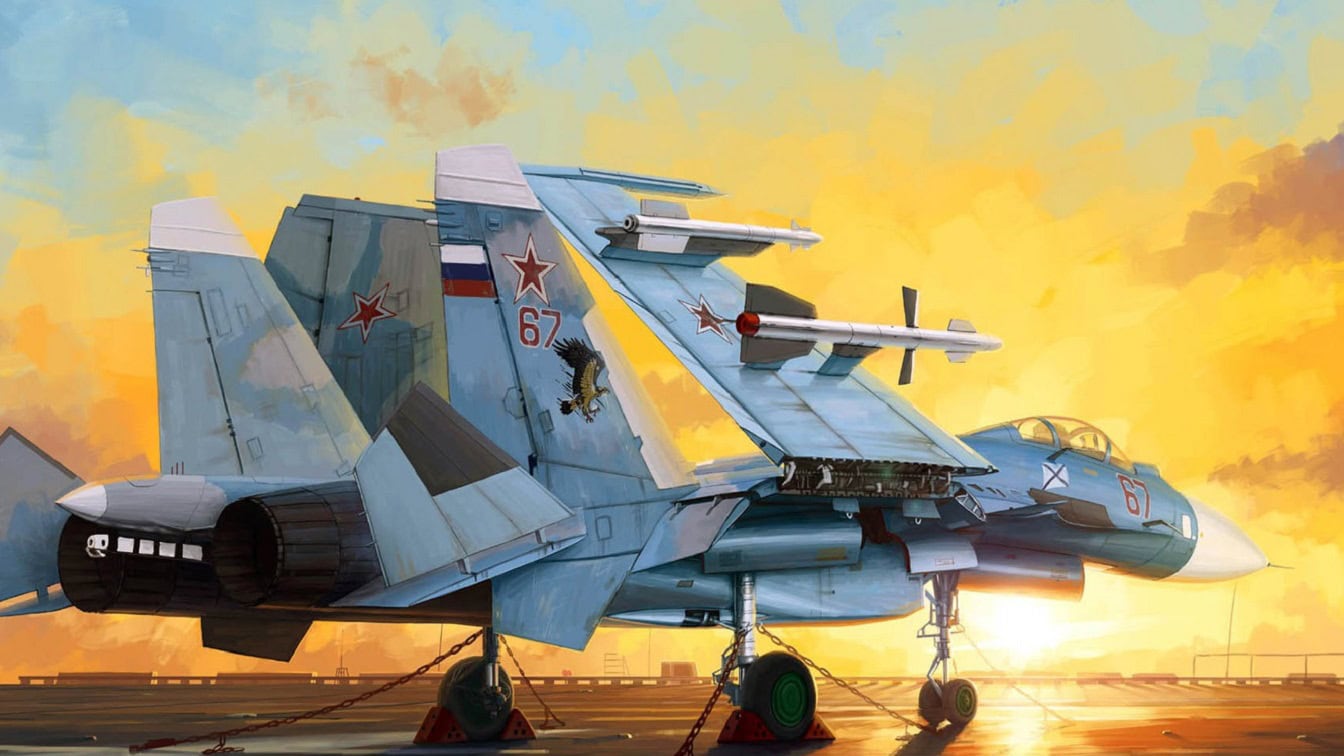
The J-15S resolved a design question China faced when it inherited the Soviet carrier-fighter lineage. Russia's Su-33UB demonstrator paired its second crew member with the pilot side by side, in the manner of the Su-34, which buys crew coordination at the cost of a wider, heavier forward fuselage. Shenyang instead took the conventional route already proven on the Su-27UB and J-11BS: a tandem cockpit under a stepped canopy, leaving the wing, undercarriage and folding mechanism essentially unchanged. That choice kept the aircraft compatible with the ski-jump decks of Liaoning and Shandong and preserved commonality with the single-seat fleet, but it forfeited the wide-console workspace a dedicated electronic-attack or long-range strike crew would prefer.
What the J-15S is actually for has never been officially stated, and the open-source evidence points in several directions at once. Assignment to the Naval Aviation University, the absence of weapons pylons in the only clear television footage, and a decade-long gap between first flight and limited service all argue for a carrier conversion trainer built in very small numbers. Yet analysts consistently note that the two prototypes doubled as testbeds for the J-15D electronic attack aircraft, and Chinese commentary has floated multirole strike and unmanned-teaming control as further uses. The most defensible reading is that the J-15S was a low-rate enabling airframe whose principal return came through its derivatives rather than through its own squadron service.
Strategically, the type is best understood as a transitional step now being overtaken. The J-15S is bound to STOBAR operations and cannot use the catapults of the Fujian, while the J-15T, the operational J-15D and the CATOBAR-capable J-15DT carry the twin-seat and electronic-attack concepts forward on a modernised airframe. Compared with the US Navy — where the two-seat F/A-18F is a fully combat-coded fleet type and the EA-18G a large operational force — China's twin-seat carrier line remains numerically marginal. Its significance lies less in the J-15S itself than in the fact that it gave the PLA Navy a domestic path to embarked electronic attack, a capability only two navies now field.