
China's Liaoning Is Testing the Western Pacific, Not Just Taiwan
 Marcus Chen
China's Liaoning Is Testing the Western Pacific, Not Just Taiwan
The Liaoning aircraft carrier entered the South China Sea on October 15 after conducting flight operations in the Philippine Sea the day before. That movement matters less because one carrier has suddenly changed the balance around Taiwan than because it forces the United States and Japan to track a moving air wing across two connected operating areas while the People's Liberation Army conducts drills in six maritime zones.
The October Pattern
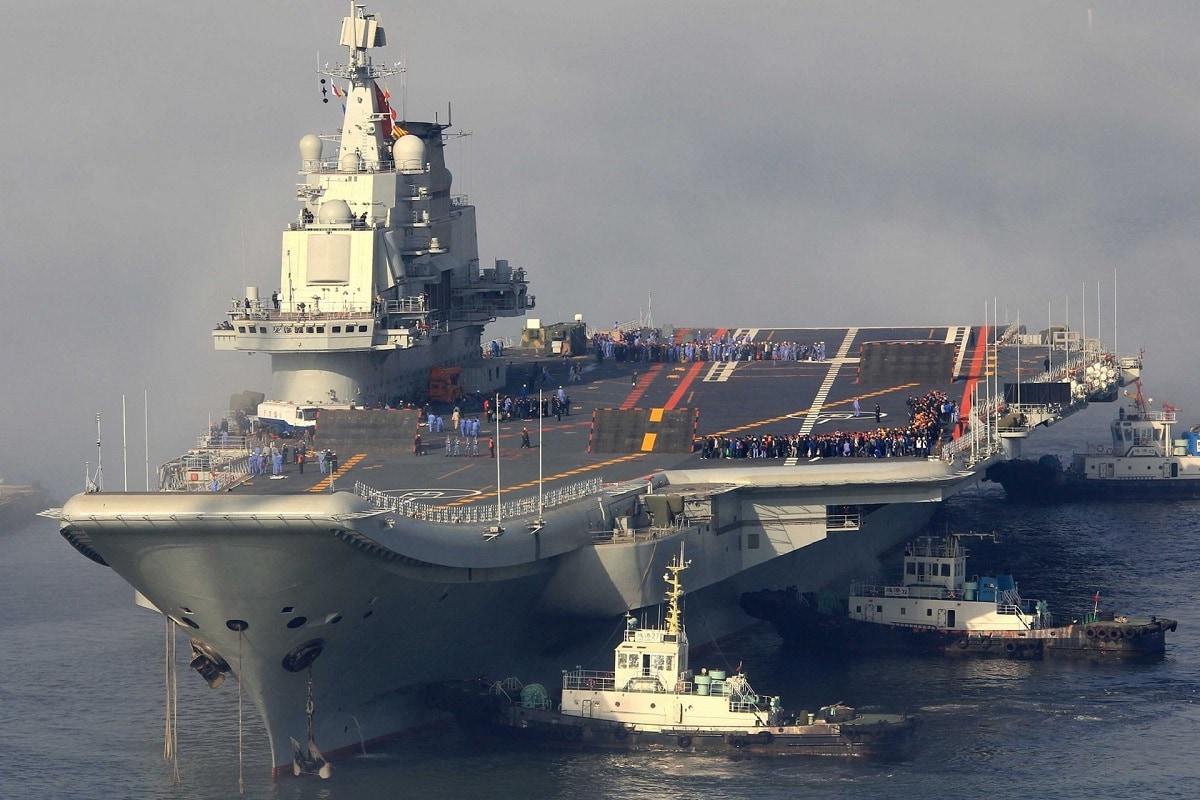
Open-source reporting indicates that the Liaoning strike group was in the western Pacific on October 14, launched flight operations in the Philippine Sea, and then moved into the South China Sea. Japan's defense minister said on October 16 that the deployment exposed limits in Japan's surveillance posture. Separately, Chinese forces began large-scale exercises on October 12 across six maritime zones, stretching from the Bohai Sea through the Yellow Sea and the East China Sea to the South China Sea, according to The Chosun Daily.
Beijing can describe each event as routine training. The operational effect is different. A carrier that shifts between the Philippine Sea and South China Sea makes the first island chain a tracking problem rather than a fixed map problem. Every Japanese, American, Philippine, and Taiwanese sensor has to maintain custody, classify the escorts, and distinguish a training sortie from a preparation for coercion. That consumes attention and aircraft hours before a crisis begins.
What Liaoning Can Actually Deliver
Liaoning is a roughly 60,000-ton, 304-meter STOBAR carrier derived from the Soviet Kuznetsov design. Its ski-jump deck limits launch weight and sortie generation compared with a US Navy catapult carrier. Its primary fighter, the J-15, is a large Flanker derivative whose useful load and endurance vary with fuel, weapons, and sea state. Estimates commonly place the embarked fighter force in the low twenties, supported by helicopters and a surface escort group.
Those numbers do not give China durable command of the Philippine Sea. A US carrier strike group brings catapult-launched aircraft, nuclear propulsion, mature replenishment practices, and a much deeper undersea and airborne surveillance network. Liaoning also remains an older training and operational platform compared with China's newer carriers. Anyone who has stood a bridge watch on a destroyer knows the hard part is not putting aircraft in the air once. It is sustaining a predictable rhythm of launches, recoveries, maintenance, fuel, weapons, and screen protection for days.
That is precisely why this deployment should not be dismissed as a photo opportunity. The ship's value is as a mobile headquarters and a forcing mechanism. It can make US and allied commanders reveal how they allocate patrol aircraft, submarines, surface escorts, and shore-based missiles. The data generated by the exercise may be more valuable to Beijing than the number of sorties flown.
Six Maritime Zones Change the Calculation
The carrier movement becomes more significant when paired with simultaneous activity across China's near seas. Six declared zones do not equal six invasion axes, and they do not prove that Beijing is rehearsing a blockade. They do show that the PLA can impose a broad surveillance and planning burden without concentrating every visible asset around the Taiwan Strait.
For a Taiwan contingency, that matters. A blockade would require persistent patrols, inspection or interdiction forces, air-defense coverage, minesweeping, logistics, and the political management of commercial shipping. Liaoning alone cannot provide that package. But a carrier operating east of Taiwan could complicate US reinforcement routes while shore-based aircraft, missiles, coast guard ships, and land-based sensors do the heavier work closer to the island. The carrier does not need to defeat a US carrier to be useful; it needs to create enough uncertainty that commanders slow down, disperse, or hold high-value aircraft farther from the fight.
The same logic applies to Japan. Tokyo's problem is not simply whether it can see Liaoning. It is whether it can maintain an unbroken picture while Chinese naval and air activity expands across the approaches to Okinawa, the Philippine Sea, and the South China Sea. A gap in tracking is operationally meaningful even when no shot is fired.
The US Response Should Be Measured in Endurance
Washington should resist the temptation to answer every Chinese carrier sortie with a symbolic freedom-of-navigation patrol. The relevant question is how long US and allied forces can keep a credible maritime picture while preserving submarines, patrol aircraft, and fighter capacity for a real contingency. Surveillance is a magazine. It can be expended.
The United States and Japan need more distributed sensors, more tanker capacity, and clearer procedures for sharing track data with the Philippines and Taiwan. They also need exercises that test the dull failures: lost communications, aircraft maintenance delays, weather, and the exhaustion of crews. A plan that works for 24 hours but collapses after a week is not sea control. It is a demonstration.
Sources and Assessment
The Chosun Daily reported the six-zone exercise beginning October 12. The China-Taiwan tension tracker at Political.org reported Liaoning flight operations in the Philippine Sea on October 14, entry into the South China Sea on October 15, and Japan's October 16 assessment of surveillance limits. Reuters reported on October 1 that US officials considered a Chinese invasion of Taiwan before 2028 increasingly unlikely, despite the PLA's 2027 readiness goal.
Those reports point to a narrow conclusion. Liaoning is not evidence that China has solved the carrier problem or achieved uncontested blue-water control. It is evidence that Beijing is learning how to use a carrier, shore-based forces, and overlapping exercises to stretch the first island chain from a geographic barrier into a continuous operational test. The danger is not that one ski-jump carrier wins a war. The danger is that the United States and its allies keep measuring Chinese power by platform quality while Beijing measures success by the surveillance burden it imposes. That is a contest of endurance, and the math is not yet comfortable for Washington.
References
The Liaoning aircraft carrier conducted flight operations in the Philippine Sea and entered the South China Sea between October 14 and 15, 2023. Concurrently, the People's Liberation Army initiated large-scale exercises across six maritime zones. Japan's defense minister highlighted the challenges posed by these movements to Japan's surveillance capabilities.
- Liaoning entered the South China Sea on October 15 after operations in the Philippine Sea.
- Chinese forces began large-scale exercises across six maritime zones on October 12.
- Japan's defense minister noted limits in Japan's surveillance posture due to the carrier's movements.