
China's Huangyan Island Exercises Deter Relevant Forces, Experts: Capability Level of Foreign Vessels Violating Rights is Inferior to "Blue Side" in Exercises
[Global Times Report, Journalists Fan Wei and Guo Yuandan] On August 1, the Southern Theater Command of the People's Liberation Army organized a joint maritime and air training exercise in the territorial waters, airspace, and surrounding maritime areas of Huangyan Island. On the same day, the China Coast Guard conducted a rights protection law enforcement control drill in the waters near Huangyan Island, focusing on law enforcement actions such as boarding and capturing, blocking intrusions, and forced towing. The Chinese side also issued the "Management Measures for the National Nature Reserve of Huangyan Island" on that day. Previously, the Philippines not only provoked Chinese vessels in the waters around Huangyan Island and engaged in propaganda, but also submitted its so-called "claims" to the United Nations and attempted to rally external countries. Experts interviewed by the Global Times on the 2nd believe that the Chinese side has launched a "three-arrow" approach to defend the sovereignty of Huangyan Island from military, police, and civilian dimensions. This is not only a clear action by China to delineate its interests to the outside world but also a clear signal from China to deter war and win wars. The Chinese exercises, through on-site actions, serve to deter the Philippines' next moves while also issuing a strong warning against military intervention by external forces in the South China Sea. Experts stated that the subjects of the training conducted by the China Coast Guard in the waters near Huangyan Island are a "show of cards," indicating that "relevant countries should weigh their own capabilities before escalating provocations."
Testing and enhancing combat readiness, warning and deterring infringement provocations
Images obtained by Global Times reporters show that during the training exercise on August 1, the Southern Theater Command deployed Type 071 landing ships, as well as Type 054A and Type 056A missile frigates. Among them, Z-20J and Z-8C helicopters took off and landed on the Type 071 ship, advancing over the waters of Huangyan Island. Type 726 air-cushion landing craft also moved in and out of the Type 071 landing ship. This indicates that the Southern Theater Command is conducting special situation handling training in the waters of Huangyan Island through maritime and air coordination. The Southern Theater Command stated that this is a necessary action in response to the current situation in the South China Sea and the actions of certain regional countries that undermine regional peace and stability, aimed at testing and enhancing the troops' combat readiness to maintain national territorial sovereignty and maritime rights and interests.
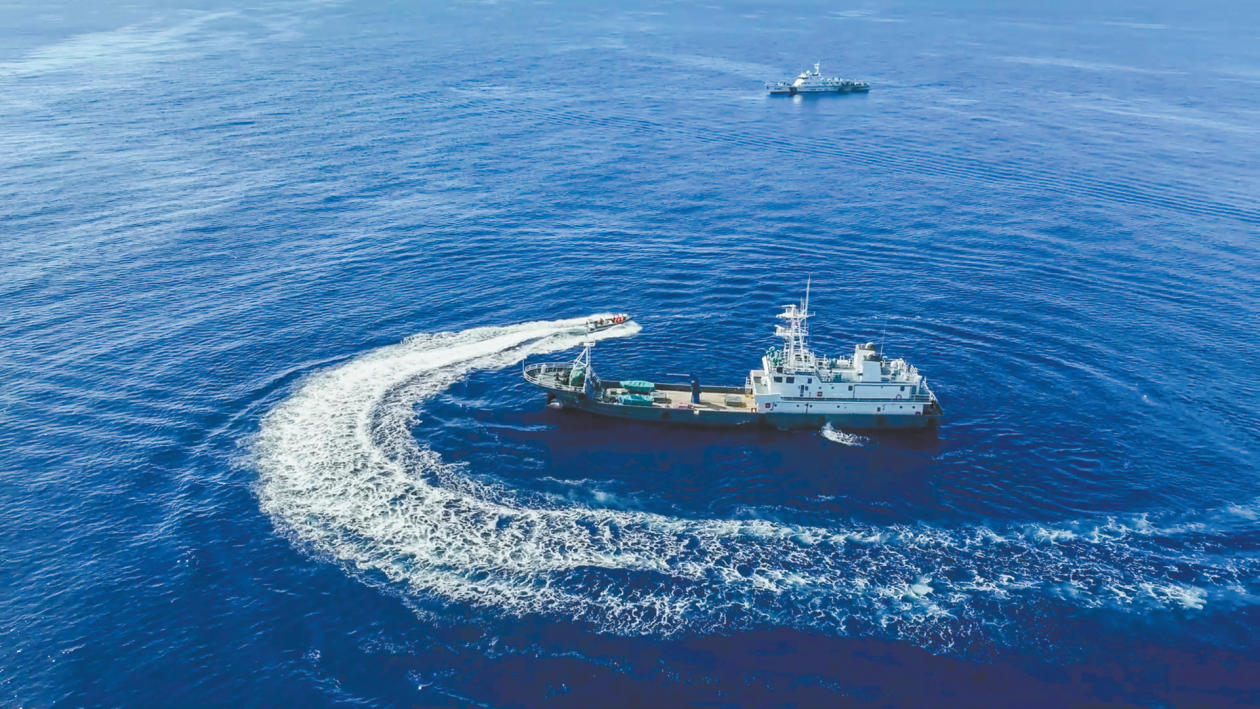
On the same day, a spokesperson for the China Coast Guard stated that the Coast Guard organized a rights protection law enforcement control drill in the waters near Huangyan Island. Video obtained by the Global Times shows that during this operation, the China Coast Guard practiced a series of law enforcement actions, from hoisting small boats to maritime pursuit and boarding inspections.
The Philippine Daily Inquirer, in its report on the training exercise near Huangyan Island on August 1, deliberately linked it to the "recent tensions in the South China Sea." Agence France-Presse reported that following recent conflicts with the Philippines in the South China Sea, China held military and Coast Guard exercises near Huangyan Island to demonstrate its strength. Radio France Internationale stated that China and the Philippines have recently faced off multiple times in the waters near Huangyan Island, with "China's response intensity further escalating."
Relevant experts told Global Times reporters that the training exercises conducted by the Southern Theater Command and the Coast Guard near Huangyan Island serve as a warning to relevant forces to cease unnecessary infringement provocations.
"Show of cards," China acts according to law
Foreign media such as Agence France-Presse noted that the recent training exercises by the Chinese military and police near Huangyan Island not only had public footage but also disclosed detailed subjects. Military expert Zhang Junsha, in an interview with Global Times on the 1st, stated that the publicly released video footage from the Southern Theater Command shows that the focus of this exercise was on maritime assault and island seizure combat capabilities. The footage shows that the H-6K bomber is equipped with YJ-12 heavy supersonic anti-ship missiles, which have a range of four to five hundred kilometers, fully covering the waters around Huangyan Island. This type of missile cruises at supersonic speeds throughout its flight, with terminal attack speeds reaching four to five Mach, capable of severely damaging or even incapacitating large surface vessels of ten thousand tons, "forming a strong deterrent against maritime provocative actions by relevant forces."
The training footage shows that the maritime forces involved include Type 071 landing ships, Type 054A, and Type 056A missile frigates. Zhang Junsha stated, "The footage shows that Z-20J and Z-8C helicopters took off and landed on the Type 071 landing ship, paired with the Wild Horse air-cushion landing craft for dock exercises, marking the mature coordination of our naval aviation power, aerial vertical delivery, and maritime heavy equipment delivery, establishing a three-dimensional amphibious combat system of 'aerial vertical assault + maritime heavy equipment landing.'" He added that the Z-8C is responsible for large-scale personnel and material delivery; the Z-20J handles both troop delivery and accompanying fire suppression, undertaking rapid helicopter landing and control tasks; the Wild Horse air-cushion craft can carry tanks, armored vehicles, and other heavy equipment, adapting to reef and shallow water environments, compensating for the inability of helicopters to deliver heavy equipment.
The video of the China Coast Guard's training on August 1 shows that this exercise fully simulates real scenarios. In the boarding and capturing phase, China Coast Guard law enforcement officers boarded a Chinese fishing vessel acting as a foreign ship while holding police equipment. In the forced towing phase, the China Coast Guard enforcement boat also used a "two-boat encirclement" method to forcibly take away a high-powered speedboat.
"The subjects of the training publicly disclosed by the China Coast Guard are highly targeted, equivalent to a full-process practical handling of the criminal acts of relevant countries that pose a potential threat to China's territorial sovereignty over Huangyan Island." Yang Xiao, a researcher at the Institute of Peace and Development Studies of the Chinese Academy of Social Sciences, stated in an interview with Global Times reporters on August 1 that boarding and capturing involves conducting inspections on foreign vessels attempting to intrude into China's territorial waters around Huangyan Island and apprehending relevant criminal suspects. Blocking intrusions involves taking coercive measures to prevent or push back foreign vessels attempting to intrude into the waters around Huangyan Island. Forced towing is an escalation of countermeasures, aimed at forcibly removing foreign infringing vessels from controlled waters, which can even be a strong means of detaining foreign infringing vessels.
Yang Xiao stated that the subjects of the training conducted by the China Coast Guard in the waters near Huangyan Island are undoubtedly a "show of cards," hoping that those countries attempting to infringe and provoke can clearly see that the law enforcement actions of the China Coast Guard in Huangyan Island are not only lawful but also must be enforced. Relevant countries should weigh their own capabilities before escalating provocations, as the foreign vessels involved in infringing Huangyan Island do not meet the capabilities and levels of the "Blue Force" vessels in this training exercise.
Experts: If the Philippines continues to provoke, China will not hold back
As China strengthens its actions in the waters around Huangyan Island, the Philippines is attempting to reinforce its illegal claims by delineating a so-called "baseline." After facing strong opposition from China, the Philippines is trying to seek international support. The Philippine Department of Foreign Affairs claimed on July 31 that it has submitted an "official nautical chart" of Huangyan Island and its surrounding waters to the United Nations Secretariat. Additionally, the Philippines has submitted a verbal statement to the United Nations Commission on the Limits of the Continental Shelf (CLCS) regarding the extension of its claims over the continental shelf in the "West Palawan Region."
The Chinese Ministry of Foreign Affairs issued a statement on the same day emphasizing that Huangyan Island is an inherent territory of China. China has indisputable sovereignty over Huangyan Island and its adjacent waters, as well as sovereign rights and jurisdiction over the relevant maritime areas. The Philippines' delineation of a so-called "baseline" on Chinese territory Huangyan Island severely infringes on China's territorial sovereignty and seriously violates international laws such as the United Nations Charter and the United Nations Convention on the Law of the Sea, making it illegal and invalid. China firmly opposes and will never accept this.
Ding Duo, director of the Regional Country Studies Institute of the South China Sea Research Institute, stated in an interview with Global Times reporters on August 2 that the latest training actions conducted by Chinese military and police forces in the waters of Huangyan Island on August 1 demonstrate the determination and capability to maintain territorial sovereignty and maritime rights and interests, while also coordinating with the statement from the Chinese Ministry of Foreign Affairs to respond to the Philippines' legal provocations, media hype, and attempts to rally external countries through on-site actions, and to deter the Philippines from potentially organizing so-called fishing vessels, government vessels, and aircraft to intrude into Huangyan Island. "If the Philippines provokes after delineating the so-called baseline, the PLA and the China Coast Guard will not hold back, and relevant law enforcement and military activities will become normalized."
After the Philippines played the so-called "legal card," on August 1, China's Ministry of Natural Resources and other departments jointly issued the "Management Measures for the National Nature Reserve of Huangyan Island," tightening protections for rare species and ecosystems in the nature reserve, prohibiting unauthorized fishing, mining, and activities such as collecting corals, coral reefs, and giant clams.
Ding Duo stated that the introduction of these "measures" makes the protection of Huangyan Island more refined, normalized, and scientific, and also more operable, providing institutional and mechanism guarantees for the ecological protection of Huangyan Island, and achieving preemptive deterrence, in-process control, and post-event accountability for the Philippines' intrusions into the Huangyan Island reserve and other illegal activities, as well as the resulting environmental damage. "If necessary, international judicial means may also be used to hold the Philippines accountable for its actions that damage the ecological environment of Huangyan Island, creating favorable conditions for China to use foreign-related legal tools to combat the Philippines' infringement actions."
After repeatedly failing to provoke incidents in the South China Sea, some politicians in the Philippines are stirring up public opinion domestically. According to the Philippine Star on August 2, Philippine Defense Secretary Teodoro recently claimed that government officials, especially elected officials, who "favor China" on South China Sea issues should consider resigning.
This statement has sparked controversy within the Philippines. The Davao Sun Star reported that Congressman Paulo Duterte from Davao City's first district criticized Teodoro's remarks, stating that the authority of elected officials comes from the Filipino people, and they should not be asked to resign without evidence of wrongdoing. He also urged Teodoro to focus on strengthening national defense rather than questioning the patriotism of those with differing opinions.
Teodoro has made absurd remarks regarding China multiple times, and the Chinese Ministry of Foreign Affairs has imposed sanctions on him and his relatives, clearly stating that he is a representative figure of a small group of "anti-China elements" in the Philippines.
On August 1, 2023, the People's Liberation Army Southern Theater Command conducted joint military exercises near Huangyan Island, involving multiple naval vessels and aircraft. The China Coast Guard also carried out law enforcement drills aimed at deterring foreign vessels. These actions were a direct response to provocations from the Philippines and other external forces, emphasizing China's commitment to defending its territorial sovereignty.
- China conducted joint military exercises near Huangyan Island on August 1, 2023.
- The exercises involved various naval vessels and aircraft, including landing ships and bombers.
- China Coast Guard performed law enforcement drills to deter foreign vessels.
- The exercises were a response to perceived provocations from the Philippines and other external forces.
- China issued new regulations for the protection of Huangyan Island's natural reserve.