
China’s Liaoning Drills Push Taiwan’s Defense Line Into the Western Pacific
 Marcus Chen
China’s Liaoning Drills Push Taiwan’s Defense Line Into the Western Pacific
China’s Liaoning aircraft carrier is now the central fact in a new Taiwan military problem: the fight may begin hundreds of miles east of the island, before any Chinese ship approaches the coastline. Taiwan’s Defense Ministry said on November 10 that Chinese forces were conducting “area denial” exercises in the Western Pacific. Reuters reported that the Liaoning was involved. That wording matters. Taipei is describing a campaign to make the sea and air approaches dangerous for U.S. forces, not merely another patrol around Taiwan.
The Drill Is About the Reinforcement Route
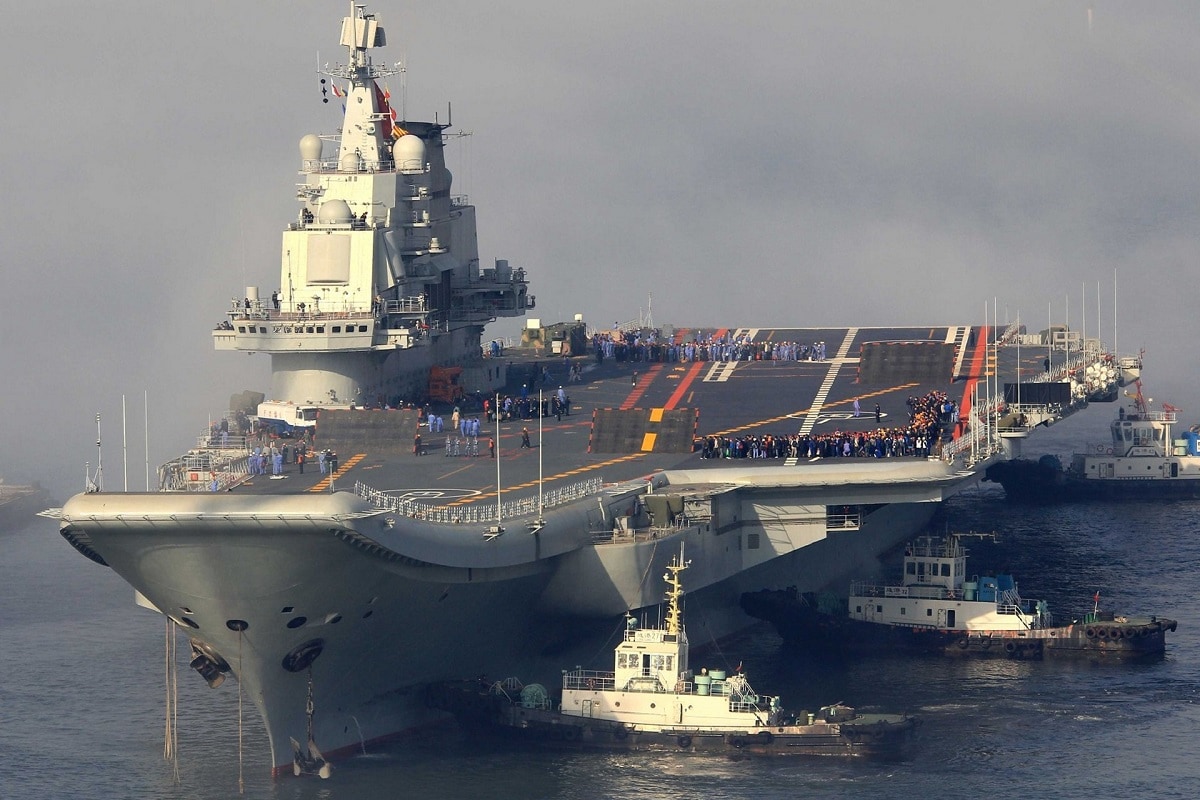
The Liaoning is not China’s newest carrier, but it is a useful instrument for this mission. The roughly 60,000-ton ship uses a ski-jump flight deck and short takeoff but arrested recovery operations. Its J-15 fighters carry less fuel and weapons than a catapult-launched aircraft would, yet the carrier can still provide airborne patrols, fighter cover, and a moving radar and command node.
That package becomes more valuable when it operates with land-based aircraft, surface combatants, submarines, and long-range missile forces. The carrier does not have to defeat a U.S. carrier strike group in a classic fleet battle. It only has to complicate the movement of tankers, reconnaissance aircraft, destroyers, and transports moving toward Taiwan. Every additional patrol line forces U.S. planners to spend more aircraft on escort, more ships on air defense, and more time on route clearance.
This is the operational difference between a Taiwan Strait exercise and a Western Pacific exercise. A blockade rehearsal concentrates pressure on Taiwan. An area-denial rehearsal reaches for the force that would try to break that pressure.
Liaoning’s Limits Are Part of the Calculation
It would be a mistake to treat the drill as proof that China has solved carrier warfare. Liaoning’s ski-jump launch system limits the weight of its aircraft at takeoff. Its air wing is smaller and less flexible than that of a U.S. nuclear-powered carrier, and the ship still depends on a wider Chinese network for sustained surveillance, targeting, logistics, and protection. A carrier operating far from the mainland cannot manufacture sortie rate out of political messaging.
But the relevant comparison is not one carrier against one carrier. China can use Liaoning as a mobile extension of a much larger anti-access system. Shore-based fighters and missile units can cover the gaps in the carrier’s organic air wing. Maritime patrol aircraft and satellites can help locate targets. Surface ships can add air-defense layers. Submarines can force an approaching U.S. formation to slow down and defend itself.
In that environment, a carrier’s value is measured in hours of uncertainty imposed on the opponent. If U.S. commanders must assume that a Chinese strike group can appear east of Taiwan, they cannot plan reinforcement around a single safe corridor. They must distribute forces, widen the search area, and preserve aircraft for self-defense. That is a win for Beijing even if Liaoning never launches a combat strike.
The First Island Chain Is No Longer the Whole Problem
For years, public debate treated the first island chain as the decisive line: Japan, Taiwan, and the Philippines form the geography that constrains China’s navy. The current activity points to a more complicated map. Chinese naval groups have repeatedly used the Philippine Sea as a training ground, and the Liaoning’s presence gives those operations an aviation component that a surface action group lacks.
That does not mean China controls the Western Pacific. Control requires persistent sensing, replenishment, communications, and the ability to keep aircraft over the battlespace. The U.S. and its allies retain major advantages in undersea warfare, long-range aviation, and dispersed bases. Japan’s southwest islands, Philippine access agreements, Guam, and Australian facilities all matter.
But geography only helps if it is supplied and defended. A U.S. plan that assumes aircraft can flow from Guam or Japan toward Taiwan without a contested approach is not a plan; it is a peacetime ferry schedule. The Liaoning’s presence makes that assumption harder to sustain.
What Taipei and Washington Should Measure
Taiwan should watch the drill for evidence of integration rather than fixating on the carrier’s silhouette. The important indicators are whether Chinese aircraft coordinate with surface ships, whether the group practices long-range communications and replenishment, whether submarines operate on the outer screen, and whether Beijing sustains the activity long enough to test crew endurance. A single carrier sortie is news. A repeatable system is a military capability.
Washington should ask a less comfortable question: how many aircraft and escorts can it put into the Western Pacific during the first 72 hours of a crisis, and how many can it keep there after Chinese missile attacks on regional bases? The answer depends less on the number of U.S. ships in the inventory than on tanker availability, runway repair, munitions stocks, and access to allied ports.
Reuters’ reporting and Taiwan’s description of “area denial” do not establish that China is preparing an imminent attack. They do establish that Beijing is rehearsing a broader operational geometry. The objective is to move the contest away from Taiwan’s coast and into the routes Washington would need to use to defend it.
The Strategic Judgment
Liaoning is not a magic weapon, and it is not a Chinese equivalent of a U.S. supercarrier. It is something more practical: a movable complication in the reinforcement problem. If China can combine one carrier group with land-based missiles, aircraft, submarines, and surveillance, then the United States must fight its way into the crisis before it can fight inside it.
That is the gap Taipei and Washington need to close. The next Taiwan contingency will not be decided only by who can strike the island. It may be decided by who can keep the Western Pacific open long enough to arrive.
Sources
China's Liaoning aircraft carrier conducted area denial exercises in the Western Pacific on November 10, 2026, complicating U.S. military movements toward Taiwan. The exercises are designed to make sea and air approaches dangerous for U.S. forces, indicating a shift in operational strategy. Taiwan's Defense Ministry highlighted the significance of these drills in altering the military dynamics in the region.
- China's Liaoning aircraft carrier is conducting area denial exercises in the Western Pacific.
- Taiwan's Defense Ministry reported the drills on November 10, 2026.
- The exercises aim to complicate U.S. military movements toward Taiwan.
- The Liaoning carrier is not the newest but is strategically significant for area denial.
- The presence of the Liaoning complicates U.S. planning for reinforcement operations.