
Dongfeng-17 First Public Video Launch: PLA Rocket Force Showcases 2500 km Strike Range
 Li Minghui
DF-17 First Public Video Launch: PLA Rocket Force Displays 2500 km Strike Range
On the evening of June 21, a detail was more interesting than the program itself: CCTV military news aired footage of the DF-17 live-fire launch for the first time. In the past, the public was familiar with the launch vehicle and missile silhouette from the 2019 military parade, but this time, we saw field training, road mobility, missile vertical launch, and multiple vehicles firing simultaneously. For the Rocket Force, this is not just a simple promotional clip, but a demonstration of a mid-range hypersonic strike chain that has been routinely trained, laid out for opponents to calculate.
The Real Information in the Footage is Not the Missile's Shape
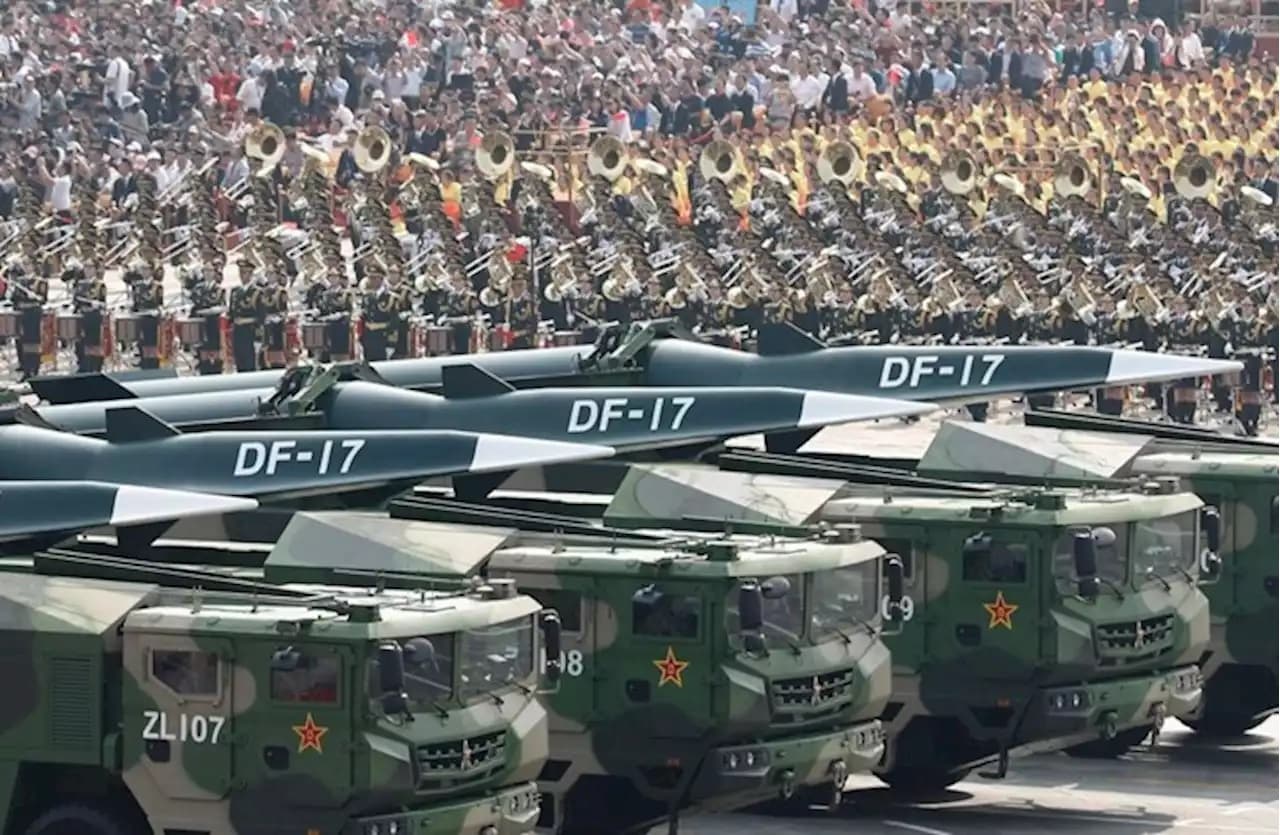
The video report from Global Times mentioned that "several new missiles are being erected" at a certain Rocket Force field training site, with combat units completing multiple waves of fire assaults while dealing with strong electromagnetic interference, precision strikes, and other special situations. This statement has a promotional tone, but it reveals very specific training subjects: it is not a display of single vehicle single shot, but a complete process of position deployment, communication resistance, fire coordination, and rapid relocation.
The public parameters provided by the South China Morning Post later indicated that the DF-17 has a range of approximately 1800 to 2500 kilometers, making its first public appearance during the National Day parade in 2019, with no previous launch footage broadcasted. If this range is calculated based on China's southeastern coastal areas, inland East China, or western Gobi training grounds, it covers not just a single point, but multiple airports, ports, radar stations, and maritime formation activity areas along the first island chain. In simple terms, its value does not lie in the phrase "flies fast," but in forcing the opponent's air defense and missile defense deployments to simultaneously face speed, maneuverable trajectories, and uncertainty of launch positions.
Why the Rocket Force Released This Footage Now
The timing is worth pondering. July 1 marks the 60th anniversary of the Second Artillery Corps, and the program placed the DF-17, DF-26D, DF-31, DF-61, and other equipment on the same narrative line, clearly emphasizing the lineage of the Rocket Force from nuclear deterrence to conventional precision strikes. What concerns me more is another layer: over the past year, the Rocket Force has undergone personnel and disciplinary restructuring that attracted significant external attention, and the release of launch footage itself also signifies a restoration of organizational image and proof that training rhythms have not been interrupted.
From a technical perspective, the DF-17 is typically understood as a boost-glide hypersonic weapon, where the ballistic missile releases the glide vehicle after the boost phase, approaching the target on a lower and more complex trajectory. Public information is limited, so we cannot overstate its hit accuracy or combat resistance to interference. However, the public video at least indicates two issues: the mobile deployment of launch vehicles is no longer in a static parade state; and the multiple vehicle simultaneous launch subject is focused on saturation penetration and position survival.
The Defense Calculations of the First Island Chain Will Be More Challenging
Placing the DF-17 in the Western Pacific operational environment must be viewed alongside the first island chain base network that the US and Japan are strengthening. The deployment of B-1B bombers in Japan, the Philippines, and the expansion of air defense and missile defense nodes in the southwestern islands of Japan will increase the demand for the Chinese Rocket Force to achieve "first-round suppression" in a conflict. The DF-17 is not necessarily a silver bullet specifically for targeting aircraft carriers, and I do not advocate for its deification. A more realistic application is against fixed or semi-fixed high-value targets: airport runways, fuel depots, command and communication nodes, air defense radars, and missile defense positions.
- Range Calculation: 1800 to 2500 kilometers allows it to cover most key nodes of the first island chain.
- Survivability Calculation: Road mobility and multiple vehicle simultaneous launches increase the margin for error in pre- and post-launch relocations.
- Cost Calculation: Hypersonic weapons are not cheap, and the real test is the scale of stockpiles and sustained re-launch capabilities.
This last point is the easiest to overlook. Parades can showcase models, and videos can show launches, but war consumes production capacity, spare parts, training munitions, and target intelligence chains. The public release of the DF-17 is a deterrent signal, but what truly determines the quality of deterrence is whether the Rocket Force can continuously detect, allocate, and re-strike targets under strong electromagnetic suppression. If the next public display is not a launch, but joint service guidance and damage assessment, that would be even more worth watching.
The People's Liberation Army Rocket Force publicly displayed and launched multiple Dongfeng-17 missiles on June 21, showcasing their operational capabilities. This event marks a significant moment as it coincides with the 60th anniversary of the Rocket Force. The Dongfeng-17, with a range of 1800 to 2500 kilometers, is designed for complex attack trajectories against high-value targets, enhancing China's military deterrence in the region.
- Dongfeng-17 missiles have a range of 1800 to 2500 kilometers.
- The public display included multiple missile launches and operational training.
- The event coincides with the 60th anniversary of the Rocket Force's establishment.
- The Dongfeng-17 is a hypersonic weapon designed for complex trajectories.
- The launch aims to demonstrate capabilities against high-value targets.