
E3-Moscow Talks 2026 Highlight Europe's Diplomatic Problem Without EU Mandate and NATO Guarantees
 Dr. Klaus Weber
E3-Moscow Talks 2026 Highlight Europe's Diplomatic Problem Without EU Mandate and NATO Guarantees
Three ambassadors, one Russian deputy minister, and no European mandate: This is the sobering outcome of the Moscow E3 meeting on June 11, 2026. The United Kingdom, France, and Germany wanted to convey to Moscow the line from the London summit with Volodymyr Zelenskyy. However, this very format shows how far European Ukraine diplomacy has run ahead of its own institutional reality.
The ambassadors of the three states met with Deputy Foreign Minister Mikhail Galusin at the Russian Foreign Ministry. According to the German diplomatic mission in Russia, they condemned Russia's recent escalation and disinformation campaigns and reaffirmed support for direct negotiations between Russia and Ukraine with active involvement from the USA and European states. This sounds like capability. Institutionally, however, it is something else: three national capitals are speaking while the EU and NATO are only indirectly present.
London Sets Conditions, Moscow Tests the Format
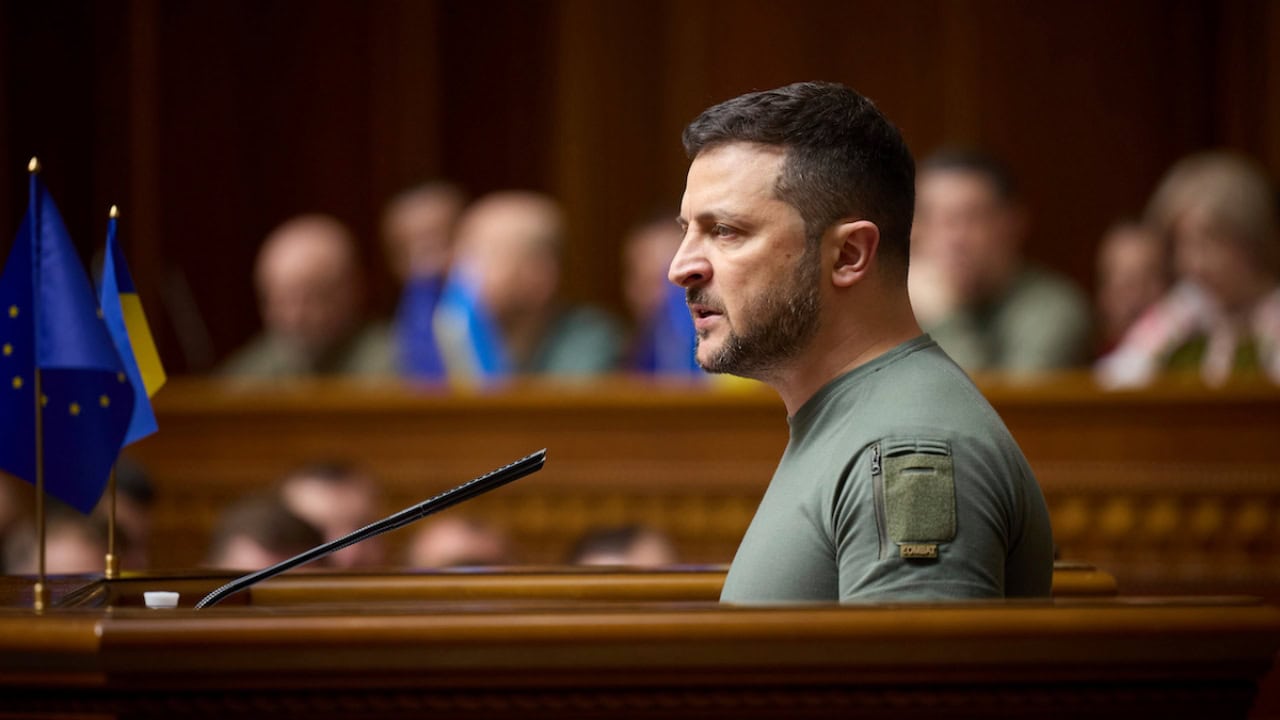
The immediate starting point was the joint statement from June 7 in London. Keir Starmer, Emmanuel Macron, and Friedrich Merz, together with Zelenskyy, outlined five conditions for a just peace: a ceasefire, negotiations along the current contact line, legally binding security guarantees for Kyiv, immobilized Russian assets until compensation, and protection of European security interests in any agreement.
The crucial sentence was almost at the end: Elements of a negotiation that involve the EU or NATO would require the consent of EU member states or NATO allies. This is formally correct but politically uncomfortable. Because when the E3 talks about security guarantees in Moscow, they can present national positions, but they cannot issue an EU guarantee or preempt a NATO guarantee.
Moscow immediately understood this weak point. Maria Zakharova referred to an allegedly "dead-end Selenskyy formula" and accused the three states of militarization. The Russian response was predictably propagandistic. What is more interesting is what it aimed at: not the military strength of the E3, but the legitimacy of their format. Russia is trying to distinguish between European great powers, EU institutions, NATO structures, and Washington. That is where Europe's problem lies.
The E3 is Politically Useful but Not a Security Mechanism
The E3 has advantages. Germany brings industrial and financial weight, France nuclear and diplomatic independence, and the United Kingdom military resolve and intelligence capacity. For crisis diplomacy, this triangle is more agile than the EU Council with 27 states. It can respond quickly, send ambassadors, formulate common lines, and demonstratively support Kyiv.
But agility is not the same as commitment. A security guarantee for Ukraine would need to answer three questions: Who provides troops or capabilities? Who decides on their deployment in case of emergency? Who bears the escalation risk towards Russia? The E3 can answer these questions nationally, but not collectively for Europe. The EU lacks a mutual defense architecture comparable to NATO Article 5. NATO, in turn, remains strategically incomplete without the USA, even if European states spend more money.
The London statement explicitly mentions the Multinational Force Ukraine. This is politically significant but legally less solid than the term suggests. A multinational force is initially a coalition of national commitments. It only becomes a guarantee when rules of engagement, command structure, air defense, logistics, reconnaissance, medical evacuation, and nuclear reassurance are clarified. These details matter more than the press formula.
Germany's Role Remains Greater Than Its Decision-Making Ability
For Berlin, the Moscow meeting is particularly instructive. Germany is one of the central European supporters in the Ukraine war and will remain involved in Kyiv's security architecture in 2026 with further billions in aid, air defense, ammunition, and industrial cooperation. At the same time, German security policy remains shaped by coalition arithmetic, budget rules, and deep strategic caution. The turning point has mobilized spending, but it has not fundamentally accelerated the German decision-making machine.
This is also evident in the difference between material aid and diplomatic responsibility. Berlin can finance IRIS-T systems, assist in procuring Patriot missiles, and support arms cooperation with Ukraine. But once a post-war order with security guarantees is negotiated, procurement policy is no longer sufficient. Then it comes down to whether Germany would be willing to militarily support a European protection architecture in case of emergency. This question has been rhetorically avoided since 2022 and has hardly been answered institutionally.
France has a different problem here. Paris speaks more sovereignly about European autonomy but lacks the fiscal depth to finance a continental security order alone. The United Kingdom remains militarily relevant after Brexit but institutionally outside the EU. Together, this explains why the E3 is politically attractive: it conceals three different weaknesses without eliminating them.
EU and NATO Remain the Real Testing Stones
The next Foreign Affairs Council on June 15 is set to address Russia's war against Ukraine again, following an exchange with Ukrainian Foreign Minister Andrij Sybiha. This sounds procedural, but that is the point. When Europe formulates a negotiation line in Moscow, it must eventually go through EU and NATO procedures. That is where the difficulty begins: unanimity, national reservations, differing threat perceptions, and the unresolved role of Washington.
The USA remains explicitly part of the desired negotiation format in the London statement. This is realistic. Without American intelligence, strategic airlift capacity, nuclear deterrence, and political backing, any European security guarantee would be less credible. But this reality contradicts the European claim to act as a security policy actor. Europe wants to sit at the table but still needs the American chair beside it for many guarantees.
The Moscow E3 initiative is therefore not a breakthrough but a stress test: Europe can formulate positions, but its binding security instruments still lie in other institutions.
The operational lesson is not that the E3 is wrong. On the contrary: Without such smaller formats, European diplomacy would be even slower. But the E3 must not be confused with a European security order. Anyone proposing direct talks with Russia must simultaneously explain how a ceasefire would be monitored, how a violation would be sanctioned, and how Kyiv would be protected in the second year after an agreement.
The Real Paradox
The E3 has done something necessary in Moscow: it confronted Russia with a European line and supported Kyiv's demand for direct talks. However, the process reveals the same structural flaw that has characterized Europe's Ukraine policy for years. The capable formats are often not legitimized enough; the legitimized institutions are often not capable enough.
Increased defense spending will only partially solve this problem. They can improve air defense, ammunition, and industrial capacity. However, they cannot automatically create a mandate, replace EU unanimity, or answer the question of who decides in case of emergency. Europe needs smaller formats like the E3 because the large institutions are slow. But it needs the large institutions because only they can make security guarantees credible.
This is the uncomfortable point of the Moscow meeting: Europe appears diplomatically more active precisely because it institutionally still does not know who Europe actually is at the decisive moment.
Sources
E3 ambassadors from the UK, France, and Germany met with Russian Deputy Minister Mikhail Galusin in Moscow on June 11, 2026, to address security guarantees for Ukraine. They condemned Russia's recent actions and supported direct negotiations involving the USA and European states. However, the E3 format lacks formal EU and NATO backing, highlighting Europe's diplomatic challenges. The next Foreign Affairs Council is set for June 15, 2026, to further discuss the situation.
- E3 ambassadors met with Russian Deputy Minister in Moscow on June 11, 2026.
- They condemned Russia's escalation and supported direct negotiations between Russia and Ukraine.
- The E3 format lacks EU and NATO guarantees, raising questions about its legitimacy.
- Germany remains a key supporter of Ukraine but faces internal political constraints.
- The next Foreign Affairs Council is scheduled for June 15, 2026, to discuss Russia's war against Ukraine.