
EU invests 3.3 billion euros in Ukrainian drones and missiles — 2026 marks Europe's industrial test of endurance
 Dr. Klaus Weber
EU invests 3.3 billion euros in Ukrainian drones and missiles — 2026 marks Europe's industrial test
The European Union plans to provide Ukraine with 3.3 billion euros for the procurement of drones and missiles. Ursula von der Leyen presented the package on September 18, 2026, as part of European winter aid. At the same time, an EU-Ukraine Drone Alliance comprising 18 members is being established, and Washington approved a potential American air defense package worth 2.68 billion dollars, linked to European funding. The figures are impressive. However, the strategic question is whether Europe is building capabilities or merely organizing its dependency more efficiently.
3.3 billion euros are a signal — not yet an industrial capability
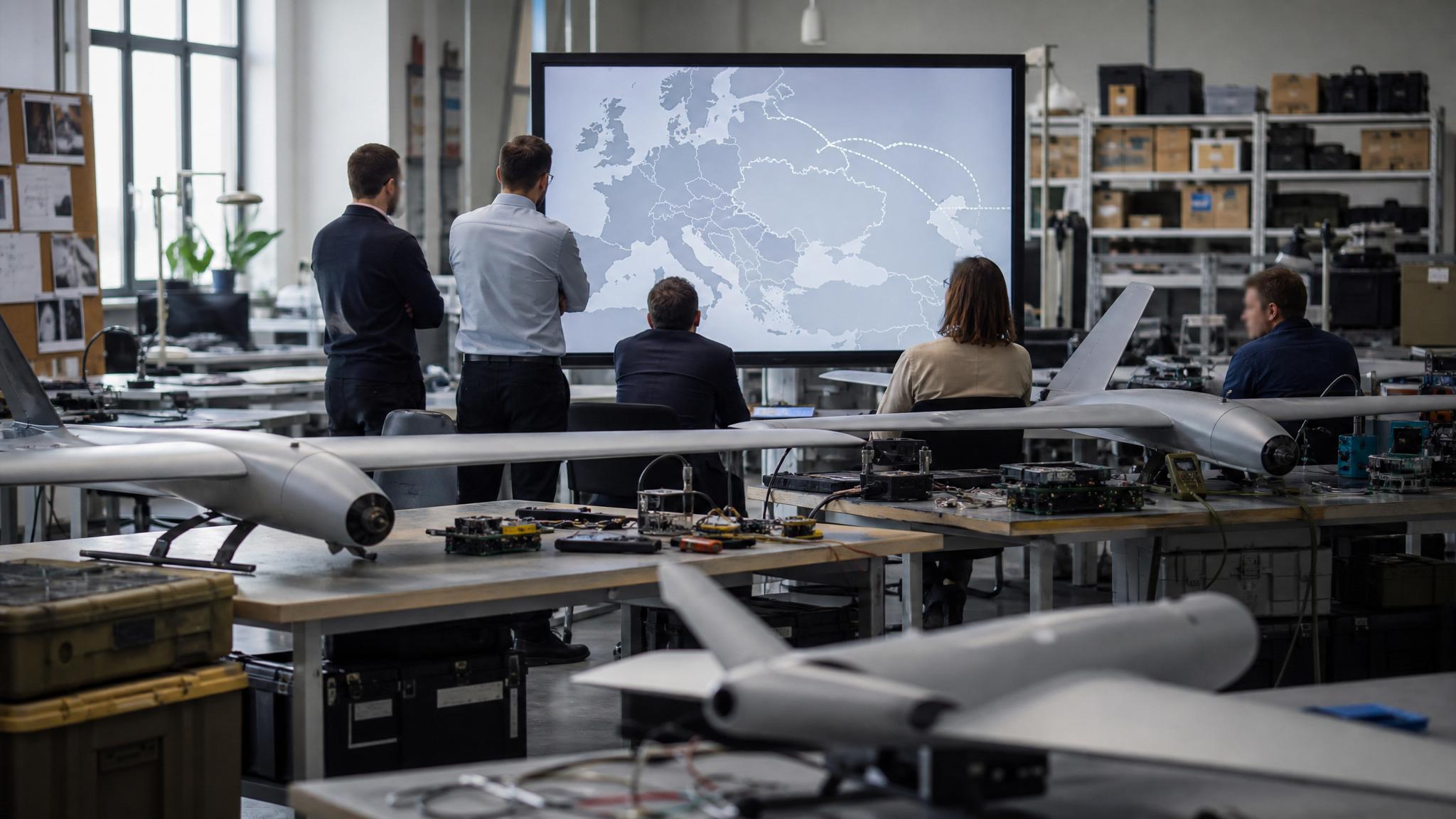
The EU funds are primarily intended to address urgent Ukrainian needs for unmanned systems and long-range munitions. For Kyiv, this is relevant because the war has simultaneously increased the demand for cost-effective reconnaissance and attack drones as well as defense and precision missiles. For Brussels, however, the decision is more than just another financial transfer. It is an attempt to transform Ukraine from a recipient of European aid into a component of European arms production.
This is precisely where the difference lies between an allocation and a capability. Money can trigger contracts, but it cannot replace an immediately available production line, qualified workforce, or secured supply chain. Reuters reported concurrently on Europe's growing need for larger and cheaper missile arsenals. This need is not theoretical: Ukraine has demonstrated how quickly precision weapons and drones can be consumed, while European stocks are insufficient for a prolonged high-intensity war.
The Drone Alliance corrects an old European mistake
The new EU-Ukraine Drone Alliance with 18 companies aims to accelerate industrial cooperation on drones and counter-UAS systems. Its greatest value lies not in the number of participants but in the ability to directly integrate Ukrainian frontline and manufacturing experience into European development processes. Ukrainian manufacturers have learned to quickly iterate systems, adapt software, and harden components against electronic warfare under wartime conditions. In contrast, Europe's defense industry often operates in long procurement cycles, whose political and technical requirements may already be outdated by the time the product reaches the troops.
This is an opportunity for PESCO, the European Defense Fund, and SAFE financing — but only if the processes are actually shortened. A common logo and a funding notice do not create a common architecture. What is crucial are open interfaces, standardized data connections, joint testing, and procurement that does not turn every national ministry into a veto player. Otherwise, the alliance will become yet another European coordination body that promises much and delivers little.
The American air defense component remains the structural paradox
The potential U.S. approval of a 2.68 billion dollar package for Ukrainian air defense, announced on September 19, underscores Europe's dilemma. Europe is providing significant funds but still requires American technology, funding channels, and export approvals for the most urgent systems. This is militarily understandable. Air defense is not an area where one can quickly create substitutes through political declarations of intent. Strategically, however, it remains contradictory to speak of European sovereignty when the protection of European cities and Ukrainian infrastructure depends on American production capacities.
The correct conclusion is not to reject U.S. systems. Europe needs American support now. Rather, the conclusion must be that any immediate aid must be linked to an industrial learning path. This includes European manufacturing licenses, joint ammunition production, reliable acceptance guarantees, and a division of labor that also encompasses technological rights. Those who only pay but cannot produce and modernize remain customers — even if the bill is signed together.
What will decide 2026
- Delivery time: The 3.3 billion euros must be translated into real deliveries, not just multi-year contract values.
- Scaling: Drone production requires electronics, batteries, sensors, and jamming protection in large quantities.
- Interoperability: Ukrainian and European systems must be integrable into NATO communication and air defense networks.
- Governance: The alliance needs clear responsibilities and measurable milestones instead of more non-binding working groups.
With this, the EU has taken a reasonable step. But political success will not be measured by the amount of the announcement but by the number of operational systems that are actually available in winter and the coming year. Europe's defense problem has never been a complete lack of money. It has been the institutional inability to quickly transform money into mass, maintenance, and military effect. Ukraine can accelerate Europe's arms industry in this regard. However, it cannot take the decision away from it. Therefore, 3.3 billion euros are a beginning — and at the same time a test of whether the European Defense Union finally transitions from financial promises to production reality.
Sources
- European Commission — EU solidarity with Ukraine, September 18, 2026
- Reuters — EU to disburse 3.3 billion euros to Ukraine to procure missiles and drones, September 19, 2026
- Defence Industry Europe — EU and Ukraine launch 18-member Drone Alliance, September 17, 2026
- U.S. Department of State — potential air defense release for Ukraine, September 19, 2026
The European Union allocated 3.3 billion euros for the procurement of drones and missiles for Ukraine on September 18, 2026. This funding is part of a broader effort to enhance Ukraine's military capabilities amid ongoing conflict. Additionally, an 18-member EU-Ukraine drone alliance is being established to improve industrial collaboration in defense production.
- EU allocates 3.3 billion euros for Ukrainian drones and missiles.
- An 18-member EU-Ukraine drone alliance is being formed.
- The U.S. approved a potential 2.68 billion dollar air defense package for Ukraine.
- The report highlights Europe's need for increased missile arsenals.
- The EU aims to integrate Ukrainian manufacturing experience into European defense processes.